Top 7 Factors to Choose a Reliable Common Rail Injector Test Bench for Diesel Repair Shops
For a diesel repair shop, investing in a common rail injector test bench is one of the most consequential equipment decisions you'll ever make. Choose wisely, and you gain the capability to diagnose, calibrate, and repair the injectors that power modern diesel engines—a service that commands premium pricing and builds long-term customer loyalty. Choose poorly, and you'll find yourself with a machine that can't test the injectors your customers bring in, produces unreliable results, or breaks down when you need it most.
The stakes are higher than ever. The global fuel injector tester market is expanding from USD 0.8 billion in 2025 to USD 1.6 billion by 2036 at a CAGR of 6.1%. The high-pressure common rail injector market alone is expected to grow from US$ 231 million in 2025 to US$ 350 million by 2031 at a CAGR of 7.2%. As the installed base of common rail diesel engines grows, so does the demand for reliable, accurate injector testing.
Here are the top 7 factors to evaluate when choosing a common rail injector test bench for your diesel repair shop—and how Crystal Automation addresses each one.
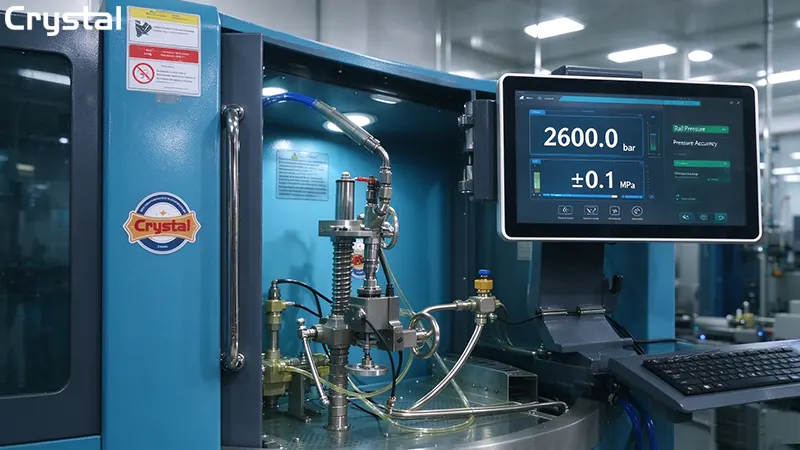
Factor 1: Pressure Capacity and Accuracy
Pressure capacity is the foundation of any common rail injector test bench. Modern common rail systems operate at extraordinarily high pressures, and your test bench must match—or exceed—those requirements to deliver meaningful diagnostics.
What to Look For
Injection pressures have progressed from 1,350 bar in first-generation common rail systems (introduced in 1997) to 2,500 bar in today's fourth-generation systems—with 3,000 bar designs already under development for heavy-duty applications. Your common rail injector test bench should deliver at least 2,600 bar to remain relevant for the current generation of injectors.
Pressure control accuracy is equally critical. Look for ±0.1 MPa (1 bar) precision. A deviation of just 0.5 MPa can produce flow measurement errors of 0.5–1.0 ml per 1,000 injections—enough to turn a "passing" injector into one that causes rough idling, black smoke, or reduced power.
What Happens If You Get It Wrong
A common rail injector test bench capped at 1,800 bar—typical of entry-level equipment—simply cannot validate the performance of modern injectors at the pressures where they actually operate. It may generate pressure, but it cannot replicate real-world conditions. The result: injectors that pass your test but fail in the engine.
Factor 2: Injector Brand and Type Compatibility
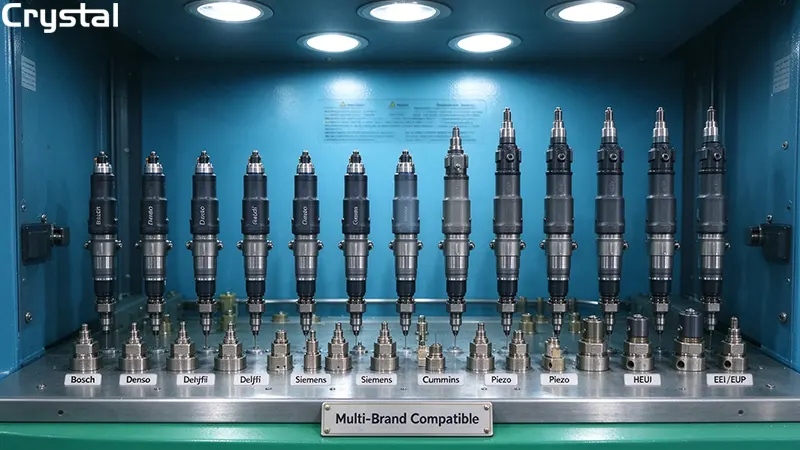
No two diesel repair shops serve the same customer base. Some specialize in European vehicles (Bosch, Siemens/VDO), others in Asian models (Denso), and still others in American trucks (Cummins, Caterpillar, Delphi). Your common rail injector test bench must support the brands you actually service.
What to Look For
A reliable common rail injector test bench should support:
- Bosch common rail injectors (including CRI 2.18, CRI 2.20, CRI 3 series)
- Denso common rail injectors
- Delphi common rail injectors
- Siemens/VDO common rail injectors
- Cummins common rail injectors
- Piezoelectric injectors — which require specialized testing due to their ceramic actuators and capacitance measurements (typically 0–12 μF)
- HEUI injectors — CAT C7, C9, 3126, 3406, 3408, Ford 6.0L, 7.3L
- EUI/EUP systems — with comprehensive adapter sets
Why Compatibility Matters
Research has found that 70% of aftermarket diesel injectors fail comprehensive testing and would present significant engine performance issues if installed. A common rail injector test bench that supports a broad range of component types ensures you can verify every injector before it leaves your shop—regardless of brand or generation.
If your test bench cannot accommodate a particular injector type, you'll be forced to turn away work—or send it to a competitor. Both outcomes cost you revenue and damage your reputation as a full-service diesel repair shop.
Factor 3: Calibration Code Generation Capability
Modern common rail injectors require calibration codes for ECU integration after servicing or replacement. Without these codes, even a perfectly repaired injector will not perform correctly in the engine.
What to Look For
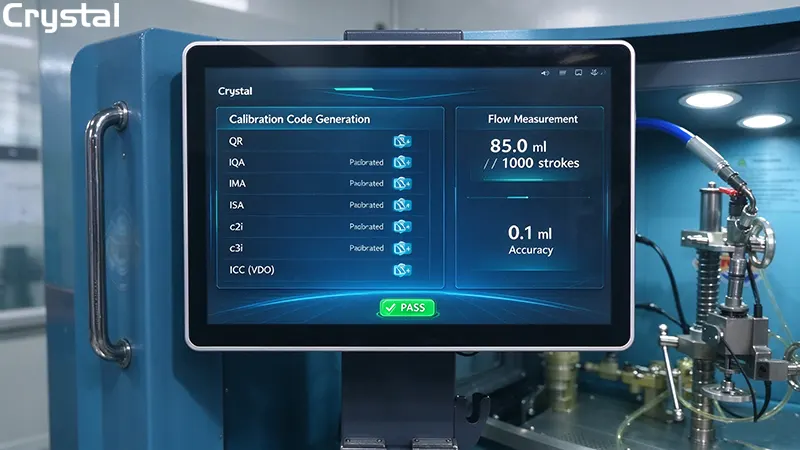
A reliable common rail injector test bench should automatically generate all major correction codes, including:
- QR (Quantity Regulation)
- IQA (Injector Quantity Adjustment)
- IMA (Injector Manufacturing Adjustment)
- ISA (Injector Specific Adjustment)
- c2i, c3i (Correction codes)
- ICC (VD0)
Why This Is Non-Negotiable
Calibration codes ensure seamless ECU communication and perfect injector integration. When an injector is replaced or serviced, the ECU must be updated with the correct correction values to maintain optimal fuel delivery. If your common rail injector test bench cannot generate these codes, you're sending injectors out the door that won't perform to specification—and your customers will be back with complaints.
The Practical Impact
Without built-in code generation, your workshop needs a separate coding device—adding cost, complexity, and the risk of transcription errors. An integrated solution streamlines the entire repair workflow.
Factor 4: Flow Measurement Accuracy
Flow rate is the single most critical diagnostic parameter for any injector. If your common rail injector test bench cannot measure flow accurately, every other test result is suspect.
What to Look For
High-precision flow meters capable of measuring with 0.1 ml accuracy or better. Look for:
- High repeatability — consistent results on repeated tests
- Stable readings — no drift during a test sequence
- Traceable accuracy — calibration certificates that verify performance
- Appropriate range — typically 0–600 ml per 1,000 injections, or up to 4,000 ml/min
Why 0.1 ml Matters
A flow measurement error of just 0.2–0.3 ml can mean the difference between a "pass" and a "fail." The quality of repair, reduced fuel consumption, and proper emissions compliance all depend on accurate fuel delivery and timing. Furthermore, variation between injectors should not exceed 3 percent at full load—and a common rail injector test bench that cannot measure with 0.1 ml accuracy cannot reliably verify compliance with these tolerances.
Factor 5: Automation and Throughput Capability
Time is money in a diesel repair shop. A common rail injector test bench that requires extensive manual intervention will slow you down, introduce human error, and reduce your profit per job.
What to Look For
Features that streamline workflow:
- Fully automatic control systems that initiate comprehensive test sequences with minimal manual intervention
- One-click automatic cleaning cycles that clean and flush injectors without disassembly
- Multi-injector testing capability—testing multiple injectors simultaneously
- Intuitive software with detailed analysis, data logging, and report printing
- Built-in databases with thousands of injector data profiles for instant model recognition
The Throughput Math
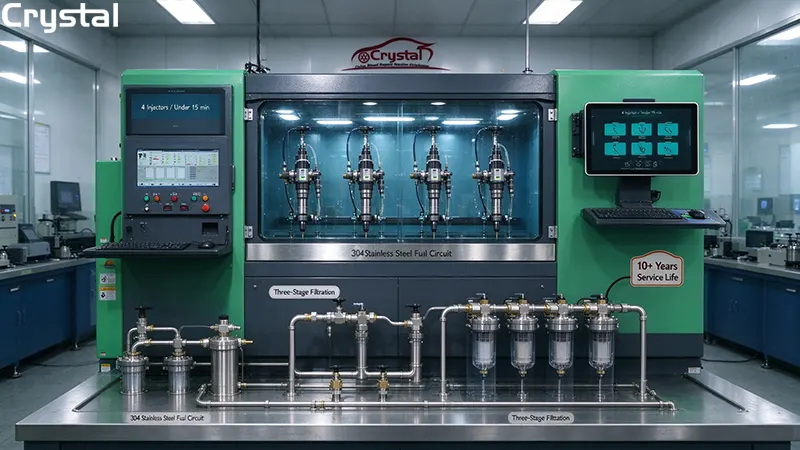
A modern industrial common rail injector test bench like the Crystal CR918-PRO can test four injectors in under 15 minutes—a fraction of the time required for manual testing. The Bosch DCP 800 pump test bench offers rapid setup and average test times of around 30 minutes.
If a technician costs $50 per hour fully loaded:
- Manual bench: 45 min per injector = $37.50 labor per injector
- Automatic bench: 15 min for 4 injectors = $3.13 labor per injector
Across 1,000 injectors per year, that's a labor cost difference of $34,370. Over a 10-year service life, the automatic bench saves over $340,000 in labor—far more than the price difference between the two machines.
Factor 6: Durability, Build Quality, and Service Life
A common rail injector test bench is a long-term investment. The quality of its construction determines how long it will deliver accurate results—and how much you'll spend on repairs and replacement over its lifespan.
What to Look For
- Fuel circuit material — 304 stainless steel for corrosion resistance and compatibility with biodiesel and alternative fuels
- Filtration system — three-stage filtration with 10-micron high-pressure filtration to prevent contamination
- Motor power — 7.5 kW to 22 kW, with frequency conversion speed regulation for energy efficiency and stable speed control
- Electrical protection — overload protection, emergency stop, and auto-protecting functions
- Expected service life — industrial-grade benches should deliver 10+ years of service with proper maintenance
Why Durability Drives TCO
Entry-level common rail injector test benches may require significant repairs or replacement within 3–5 years under daily use. Industrial-grade benches, properly maintained, deliver consistent performance for 10 years or more. When amortized over that lifespan, the industrial machine often costs less per year than the entry-level alternative—even before accounting for downtime savings.
Factor 7: After-Sales Support, Training, and Warranty
Even the best common rail injector test bench will need maintenance, calibration, and occasional repairs. The quality of after-sales support can make or break your experience.
What to Look For
- Warranty period — typically 12 months
- Technical support — readily available and knowledgeable
- Software updates — can the bench be upgraded to support new models and test standards?
- Spare parts availability — are components readily accessible?
- Training and documentation — are resources provided to help your team get up to speed?
Why Support Matters
A common rail injector test bench that sits idle—waiting for parts, repairs, or technical guidance—costs you money every day. Downtime directly impacts your workshop's revenue-generating capacity. A supplier with strong after-sales support ensures minimal downtime and maximum productivity.
Summary: The 7 Factors at a Glance
| Factor | Key Consideration | Crystal Advantage |
|---|---|---|
| 1. Pressure Capacity | 2,600 bar minimum, ±0.1 MPa accuracy | 2,600 bar with Bosch CP3.3 pump |
| 2. Injector Compatibility | Bosch, Denso, Delphi, Siemens, CAT, Cummins, piezo, HEUI, EUI/EUP | All types supported with built-in database |
| 3. Calibration Codes | QR, IQA, IMA, ISA, c2i, c3i, ICC | All major codes generated automatically |
| 4. Flow Accuracy | 0.1 ml or better | High-precision flow meter |
| 5. Automation | Automatic sequences, one-click cleaning, multi-injector testing | Fully automatic control system, 4 injectors in 15 minutes |
| 6. Durability | 304 stainless steel, three-stage filtration, 10+ year life | 304 stainless steel circuits, 10-micron filtration |
| 7. Support & Warranty | 12-month warranty, software updates, training | 12-month warranty, global support in 100+ countries |
Decision Checklist: Questions to Ask Before You Buy
Before committing to a common rail injector test bench, ask each supplier these questions:
- What is the maximum pressure and pressure accuracy? (Look for 2,600 bar, ±0.1 MPa)
- Which injector brands and types can it test? (Verify your most common injectors are supported)
- Does it generate all major calibration codes automatically? (QR, IQA, IMA, ISA, c2i, c3i, ICC)
- What is the flow measurement accuracy? (0.1 ml or better)
- How many injectors can it test simultaneously? (4+ for throughput)
- What is the expected service life and warranty period? (10+ years, 12 months)
- What after-sales support is included? (Training, software updates, spare parts availability)
The Crystal Automation Advantage
Taian Crystal Automation Co., Ltd. has been serving the global diesel service industry for years, earning a reputation for quality, innovation, and customer support. Every Crystal common rail injector test bench is built with:
- Bosch CP3.3 high-pressure pumps for reliable pressure generation
- 304 stainless steel fuel circuits for corrosion resistance and durability
- Three-stage filtration systems to keep test fluid clean
- Ergonomic workstation design to reduce operator fatigue and improve efficiency
- Wi-Fi connectivity for remote diagnostics and software updates
- Over 4,000 built-in injector test data sets (expandable to 7,600+) for instant brand and model recognition
Crystal's commitment to quality is reflected in its rigorous testing and calibration protocols. Every common rail injector test bench is factory-calibrated and shipped with a comprehensive calibration certificate, ensuring that customers receive equipment ready for immediate, accurate use.
Conclusion
Choosing a reliable common rail injector test bench is not just about buying a machine—it's about investing in your diesel repair shop's future. The right common rail injector test bench will expand your service capabilities, boost productivity, improve repair accuracy, and reduce equipment and training costs.
These 7 factors—pressure capacity, injector compatibility, calibration code generation, flow accuracy, automation, durability, and after-sales support—provide a framework for evaluating any common rail injector test bench on the market.
For diesel repair shops that want to serve the full spectrum of modern diesel vehicles, the Crystal CR918-PRO delivers on all seven factors: 2,600 bar pressure with ±0.1 MPa accuracy, multi-brand injector support, automatic calibration code generation, 0.1 ml flow accuracy, four-injector simultaneous testing in under 15 minutes, 304 stainless steel construction, and comprehensive after-sales support backed by exports to more than 100 countries.
Take the time to ask these 7 critical questions. Evaluate your options carefully. And choose a common rail injector test bench that will grow with your business—not one that will hold it back.
Written by
Taian Crystal Automation Co., Ltd.
Editor Chen
www.crystalautotest.com
WhatsApp:+86 185 9528 8526
Email:martin@crystalautotest.com
- Top 6 Steps to Diagnose Injection Pump Test Bench Flow Rate Inconsistency
- Top 7 Types of Fuel Injection Pumps Testable on Modern Injection Pump Test Bench
- 7 Steps to Accurately Test Piezoelectric Injectors at 2,600 Bar on a Common Rail Test Bench
- The 8 Most Common Faults in Common Rail Injector Test Benches

Crystal Automation is a leading Chinese manufacturer of common rail test benches and fuel injector test benches.