Multi-functional Common Rail Test Bench vs Single-Function Unit: Cost & Performance Analysis by Crystal Automation
For diesel repair shops, the choice between a multi-functional common rail test bench and a single-function unit is one of the most consequential equipment decisions you'll ever make. It affects not only your upfront capital expenditure but also your workshop's long-term service capability, throughput, and profitability.
The global fuel system testing market is projected to grow from USD 1,232 million in 2025 to USD 2,098 million by 2032, at a CAGR of 7.6%. The high-pressure common rail injector market alone is expected to expand from US$ 231 million in 2025 to US$ 350 million by 2031 at a CAGR of 7.2%. As demand for precision diesel diagnostics grows, the question of which platform delivers the best return on investment becomes increasingly urgent.
This analysis examines the cost and performance differences between multi-functional and single-function common rail test benches—and explains why Crystal Automation's multi-functional platforms are redefining the economics of diesel workshop equipment.
Understanding the Two Approaches
Before diving into the numbers, it's important to define what each type of test bench actually does.
Single-Function Common Rail Test Bench
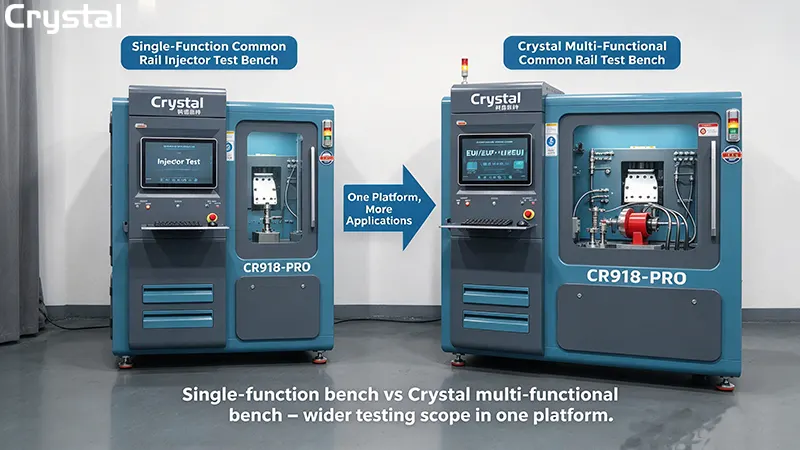
A single-function unit is designed for one specific task—typically testing common rail injectors only, or high-pressure pumps only, or EUI/EUP systems only. It does that one job well, but its capabilities stop there. If your workshop needs to test a different component type, you need a second machine.
Multi-Functional Common Rail Test Bench
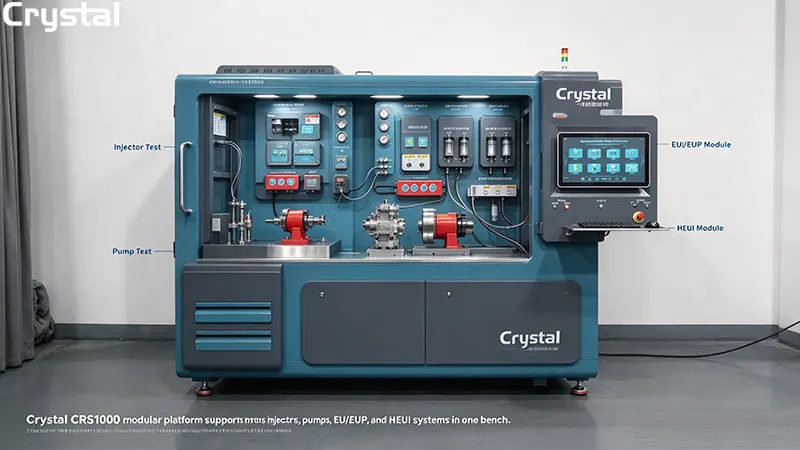
A multi-functional platform—like Crystal Automation's CRS1000 series or CR918-PRO—is engineered to test multiple component types on a single integrated machine. The CRS1000, for example, supports testing of common rail injectors, high-pressure common rail pumps, EUI/EUP systems, HEUI systems, and medium-pressure actuating pumps. Users can select a single testing function or combine two or even three functions in one system.
Cost Analysis
Initial Investment: The Sticker Price Trap
The most visible difference between the two approaches is the initial purchase price. A single-function unit typically costs less than a multi-functional platform—at first glance.
| Investment Component | Single-Function Unit | Multi-Functional Platform |
|---|---|---|
| Base machine cost | Lower | Higher |
| Injector testing capability | Yes | Yes |
| Pump testing capability | No (requires second machine) | Yes (built-in) |
| EUI/EUP testing capability | No (requires second machine) | Optional module |
| HEUI testing capability | No (requires third machine) | Optional module |
| Total to cover all component types | 3–4 machines | 1 machine |
The problem with the single-function approach becomes apparent when you need to expand your service offering. To match the capability of a single multi-functional platform, you would need to purchase:
- One injector test bench
- One pump test bench
- One EUI/EUP test bench (if available)
- One HEUI test bench (if available)
The combined cost of these machines typically far exceeds the price of a single multi-functional platform—and that's before accounting for the additional floor space, training, and maintenance each machine requires.
Floor Space: The Hidden Cost
Workshop space is expensive. Every square meter dedicated to equipment is space that cannot be used for vehicle bays, parts storage, or customer areas.
| Space Requirement | Single-Function Units | Multi-Functional Platform |
|---|---|---|
| Injector test bench | 2–3 m2 | 2–3 m2 |
| Pump test bench | 2–3 m2 | Included |
| EUI/EUP test bench | 1–2 m2 | Included |
| HEUI test bench | 1–2 m2 | Included |
| Total footprint | 6–10 m2 | 2–3 m2 |
A multi-functional platform can reduce your equipment footprint by 60–75% compared to purchasing separate single-function units. In urban workshops where square meter costs are high, this space savings alone can justify the investment.
Training and Labor Costs
Every additional machine requires training. Your technicians need to learn the controls, the software, the maintenance procedures, and the safety protocols for each unit.
| Training Factor | Single-Function Units | Multi-Functional Platform |
|---|---|---|
| Number of machines to learn | 3–4 | 1 |
| Training time (initial) | 3–5 days per machine | 3–5 days total |
| Ongoing training for new features | Required for each machine | Single update |
| Operator flexibility | Limited to specific machines | One operator, all functions |
A multi-functional platform simplifies training and enables operator flexibility—one technician can test injectors in the morning and pumps in the afternoon without switching machines or workstations.
Maintenance and Calibration Costs
Maintenance is the largest ongoing cost of test bench ownership—and it scales with the number of machines you operate.
| Maintenance Task | Single-Function Units | Multi-Functional Platform |
|---|---|---|
| Annual calibration | 3–4 services | 1 service |
| Filter replacements | 3–4 sets | 1 set |
| Oil changes | 3–4 procedures | 1 procedure |
| Spare parts inventory | Duplicated across machines | Single inventory |
| Warranty coverage | Multiple expiration dates | Single expiration date |
Crystal's multi-functional platforms feature 304 stainless steel fuel circuits and three-stage filtration systems that reduce maintenance frequency and extend component life. The CRS1000 series requires only one set of consumables—one oil change, one filter replacement, one calibration—regardless of how many component types you test.
Total Cost of Ownership Comparison
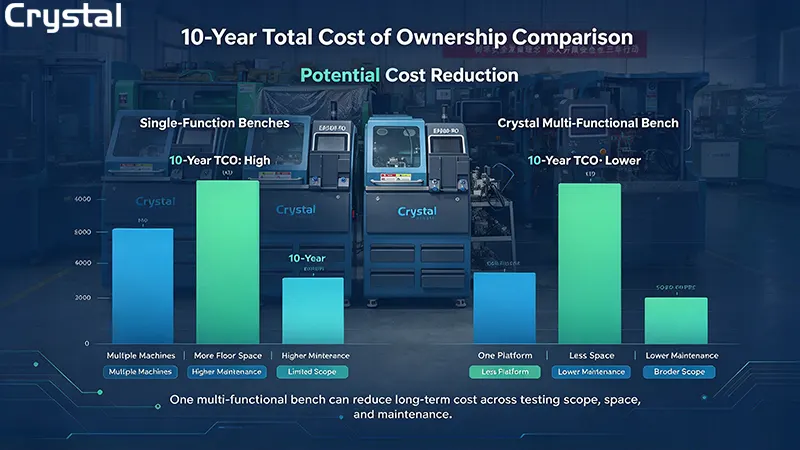
When all costs are considered over a 10-year service life, the multi-functional platform's advantage becomes clear.
| Cost Category | Single-Function Units (3 machines) | Multi-Functional Platform (1 machine) |
|---|---|---|
| Initial purchase | $12,000–$18,000 | $15,000–$25,000 |
| Floor space (10 years) | $30,000–$50,000 | $10,000–$15,000 |
| Training (10 years) | $5,000–$8,000 | $2,000–$3,000 |
| Maintenance and calibration | $15,000–$20,000 | $6,000–$8,000 |
| Spare parts inventory | $3,000–$5,000 | $1,000–$2,000 |
| Total TCO (10 years) | $65,000–$101,000 | $34,000–$53,000 |
| Savings with multi-functional | — | $31,000–$48,000 |
The multi-functional platform delivers 30–50% lower total cost of ownership over a decade—even though its initial purchase price is higher.
Performance Analysis
Test Capability Coverage
A single-function unit tests one component type. A multi-functional platform tests multiple component types with equal precision.
| Component Type | Single-Function Unit | Multi-Functional Platform |
|---|---|---|
| Common rail injectors (solenoid) | Yes | Yes |
| Common rail injectors (piezo) | Often no | Yes (0–12 μF capacitance) |
| High-pressure common rail pumps | No | Yes (Bosch CP1/CP3/CP4, Denso HP, Delphi) |
| EUI/EUP systems | No | Optional module |
| HEUI injectors and pumps | No | Optional module |
| Medium-pressure actuating pumps | No | Optional module |
The Crystal CRS1000 series supports testing of common rail injectors, high-pressure common rail pumps, EUI and EUP systems, HEUI systems, and medium-pressure actuating pumps—all in one integrated workstation. This breadth of capability means your workshop can accept a wider range of jobs without turning away work.
Throughput and Speed
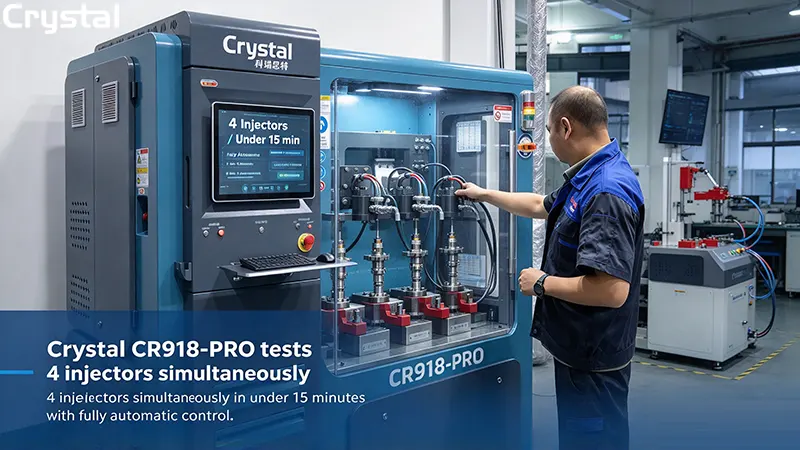
A multi-functional platform is not just more capable—it's often faster. Crystal's CR918-PRO can test four injectors in under 15 minutes with fully automatic control. The system's one-click automatic cleaning eliminates manual disassembly time, and the built-in database with thousands of injector profiles enables instant model recognition.
| Performance Metric | Single-Function Unit | Multi-Functional Platform |
|---|---|---|
| Injector testing speed | 30–45 min per injector | 15 min for 4 injectors |
| Automated sequences | Limited | Fully automatic |
| Multi-injector testing | 1 at a time | Up to 12 simultaneously |
| Calibration code generation | Manual or separate device | Automatic (QR, IQA, IMA, ISA, c2i, c3i, ICC) |
The throughput difference is dramatic. A workshop using single-function units for each component type must move components between machines, recalibrate for each test, and manually record results. A multi-functional platform streamlines the entire workflow.
Precision and Accuracy
Multi-functional platforms do not compromise precision for versatility. Crystal's test benches deliver:
- Pressure accuracy: ±0.1 MPa
- Flow accuracy: 0.1 ml
- Temperature control: 40 ± 2°C
- Response time resolution: 0–999 μS
- Injection duration control: 0–65,535 μs
These specifications match or exceed what single-function units deliver. The multi-functional platform is not a "jack of all trades, master of none"—it is a precision instrument across every function it supports.
Flexibility and Future-Proofing
The diesel industry is evolving rapidly. Injection pressures have progressed from 1,350 bar to 2,500 bar, with 3,000 bar designs under development. Piezoelectric injectors are becoming more common. Alternative fuels—biodiesel, HVO, hydrogen blends—are entering the market.
A single-function unit is frozen in time. It tests what it was designed to test, and nothing more. A multi-functional platform can adapt:
- Add modules as new component types enter your market
- Upgrade software to support new injector models
- Expand capability without replacing the entire machine
The Crystal CRS1000 series is specifically designed for this modular expansion. Users can select a single testing function or combine two or even three functions in one system—and add capabilities as their business grows.
Real-World Scenarios
Scenario 1: Small Workshop (1–2 Technicians)
A small workshop servicing mostly older diesel vehicles with occasional common rail work.
Single-function approach: Purchase an entry-level injector test bench for $5,000–$8,000. Struggle when a common rail pump comes in. Turn away work or send it to a competitor.
Multi-functional approach: Invest in a compact multi-functional platform for $12,000–$18,000. Test injectors, pumps, and EUI/EUP systems as they come in. Capture every job that walks through the door.
Verdict: For a small workshop, the multi-functional platform may stretch the budget initially—but it eliminates the "sorry, we can't test that" conversation that costs you customers.
Scenario 2: Medium Workshop (3–5 Technicians)
A medium workshop servicing a mix of passenger cars, light commercial vehicles, and agricultural equipment.
Single-function approach: Purchase an injector test bench ($8,000) and a pump test bench ($10,000). Total: $18,000. Still cannot test HEUI or EUI/EUP systems. Floor space: 4–6 m2.
Multi-functional approach: Invest in a CRS1000-series platform with injector and pump modules ($22,000). Test both component types on one machine. Floor space: 2–3 m2. Later, add HEUI or EUI/EUP modules as demand grows.
Verdict: The multi-functional platform delivers broader capability, smaller footprint, and a clear upgrade path—at a comparable or lower total cost.
Scenario 3: Large Workshop or Regional Center (6+ Technicians)
A large workshop positioning itself as a regional diesel service center.
Single-function approach: Purchase multiple single-function units for redundancy. Total: $30,000–$40,000. Floor space: 8–12 m2. Multiple training and maintenance schedules.
Multi-functional approach: Invest in two CRS1000-series platforms configured with different modules. Total: $35,000–$45,000. Full capability coverage with redundancy. Floor space: 4–6 m2. One training program, one maintenance schedule.
Verdict: For a large workshop, multi-functional platforms deliver the same comprehensive capability with greater operational simplicity and a smaller physical footprint.
When to Choose Each Approach
Choose a Single-Function Unit If:
- You service only one component type (e.g., injectors only) and have no plans to expand
- Your volume is very low—a few tests per week
- Your budget is extremely constrained and expansion is not a consideration
- You already own other equipment that covers the remaining component types
Choose a Multi-Functional Platform If:
- You service multiple component types (injectors, pumps, EUI/EUP, HEUI)
- You plan to expand your service offering over time
- You want to minimize floor space, training, and maintenance complexity
- You want a clear upgrade path as new diesel technology emerges
- You want the lowest total cost of ownership over the equipment's service life
For most professional diesel repair shops, the multi-functional platform is the more rational choice—not because it's cheaper upfront, but because it's cheaper over time, more capable, and better positioned for the future.
The Crystal Automation Multi-Functional Advantage
Crystal Automation's multi-functional platforms are engineered specifically to deliver the cost and performance advantages outlined above.
CRS1000 Series
The CRS1000 series features a completely new streamlined layout with a rotating control panel for ergonomic operation. Its modular design supports:
- High-pressure common rail injectors
- High-pressure common rail pumps
- EUI and EUP systems
- HEUI systems
- Medium-pressure actuating pumps
Users can select a single testing function or combine two or even three functions in one system. Both test and waste oil tanks are crafted from industrial-grade 304 stainless steel for maximum corrosion resistance, while all fluid lines incorporate a three-stage filtration system to prevent contamination.
CR918-PRO
The CR918-PRO is Crystal's flagship multi-functional test bench, delivering:
- 2,600 bar pressure capability with ±0.1 MPa accuracy
- 0.1 ml flow measurement accuracy
- Four-injector testing in under 15 minutes
- One-click automatic cleaning
- Automatic calibration code generation (QR, IQA, IMA, ISA, c2i, c3i, ICC)
- Built-in database with thousands of injector profiles
- Wi-Fi connectivity for remote diagnostics and software updates
Shared Crystal Advantages
Both platforms share Crystal's core engineering philosophy:
- 304 stainless steel fuel circuits for durability and green fuel compatibility
- Three-stage filtration with 10-micron high-pressure filtration
- Frequency conversion speed regulation for stable, energy-efficient operation
- Motor power options from 7.5kW to 22kW
- Comprehensive electrical protection with auto-protecting functions
- 12-month warranty and global after-sales support in more than 100 countries
Summary: Cost & Performance at a Glance
| Factor | Single-Function Unit | Multi-Functional Platform |
|---|---|---|
| Initial purchase | Lower (1 machine) | Higher (1 machine) |
| Total cost to cover all component types | Higher (3–4 machines) | Lower (1 machine) |
| Floor space | 6–10 m2 | 2–3 m2 |
| Training complexity | Multiple machines | Single platform |
| Maintenance and calibration | 3–4 services per year | 1 service per year |
| 10-year TCO | $65,000–$101,000 | $34,000–$53,000 |
| Component coverage | Limited to one type | Injectors, pumps, EUI/EUP, HEUI |
| Throughput | Sequential, slow | Parallel, fast |
| Upgrade path | Replace entire machine | Add modules |
| Future-proofing | Poor | Excellent |
Conclusion
The choice between a multi-functional common rail test bench and a single-function unit is not merely a question of budget—it's a question of business strategy. A single-function unit may cost less on the day of purchase, but it limits your service capability, consumes more floor space, requires more training and maintenance, and offers no path to expansion.
A multi-functional platform—like Crystal Automation's CRS1000 series or CR918-PRO—costs more upfront but delivers 30–50% lower total cost of ownership over a decade, broader service capability, higher throughput, and a clear upgrade path as diesel technology evolves.
For diesel repair shops that intend to remain competitive in an industry defined by rapid technological change, the multi-functional platform is not just the better choice—it's the only choice that makes long-term financial sense.
As one industry observer notes, this type of equipment is "more than just equipment; it is a business strategy"—one that eliminates rejected jobs, maximizes workshop space, and positions your business for sustained growth.
Written by
Taian Crystal Automation Co., Ltd.
Editor Chen
www.crystalautotest.com
WhatsApp:+86 185 9528 8526
Email:martin@crystalautotest.com
- Top 8 Differences: Injection Pump Test Bench vs Common Rail Test Bench
- Best Injection Pump Test Bench Buying Guide – 7 Questions Every Diesel Workshop Must Ask
- Best Injection Pump Test Bench Compatibility – 4 Fuel Pump Types You Can Test
- Best Injection Pump Test Bench Oil Change Guide – 4 Steps at 200 Hours for Peak Performance

Crystal Automation is a leading Chinese manufacturer of common rail test benches and fuel injector test benches.