Top 8 Differences: Injection Pump Test Bench vs Common Rail Test Bench
Choosing the right test bench for your diesel workshop is one of the most consequential equipment decisions you'll ever make. Two machines dominate the market: the injection pump test bench and the common rail test bench. While they may look similar on the outside—both are large, computer-controlled pieces of equipment with pumps, tanks, and control panels—they are engineered for fundamentally different purposes.
The global fuel system testing market is projected to grow from USD 1,232 million in 2025 to USD 2,098 million by 2032, at a CAGR of 7.6%. The high-pressure common rail injector market alone is expected to grow from US$ 231 million in 2025 to US$ 350 million by 2031 at a CAGR of 7.2%. As the market expands, understanding the differences between these two types of test benches becomes critical.
Here are the top 8 differences between an injection pump test bench and a common rail test bench—and what each means for your workshop.
Difference 1: Primary Components Tested
The most fundamental difference lies in what each machine is designed to test.
Injection Pump Test Bench
An injection pump test bench is designed to test fuel injection pumps—the mechanical or electronic pumps that deliver fuel to the injectors. These include:
- Mechanical inline pumps – Bosch K, M, MW, A, B, BV, P series
- VE distributor pumps – EP/VA, EP/VM, VE series
- Electronic distributor pumps – Bosch VP36, VP37, VP44
- Electronic unit pumps (EUP) and electronic unit injectors (EUI)
The injection pump test bench evaluates pump performance: delivery quantity per cylinder, injection timing, governor response, and internal leakage.
Common Rail Test Bench
A common rail test bench is designed to test common rail components—the high-pressure pump, the fuel rail, the injectors, and the electronic control valves that regulate rail pressure. These include:
- High-pressure common rail pumps – Bosch CP1/CP3/CP4, Denso HP0–HP4, Delphi
- Common rail injectors – solenoid and piezoelectric types
- DRV/MPROP valves – fuel pressure regulating valves
- Rail pressure sensors
The common rail test bench evaluates injector flow rate, return flow, response time, electrical characteristics, and pump delivery efficiency.
Difference 2: Pressure Capability and Test Range
Pressure capability is the most visible specification difference between the two machine types.
| Specification | Injection Pump Test Bench | Common Rail Test Bench |
|---|---|---|
| Typical pressure range | 0–400 bar (mechanical systems) | 0–2,600 bar (or higher) |
| Pressure accuracy | ±2–5 bar | ±0.1–0.5 bar |
| Test fluid temperature | 40 ± 2°C | 40 ± 2°C |
| Speed range | 0–4,000 RPM | 0–4,000 RPM |
Injection Pump Test Bench
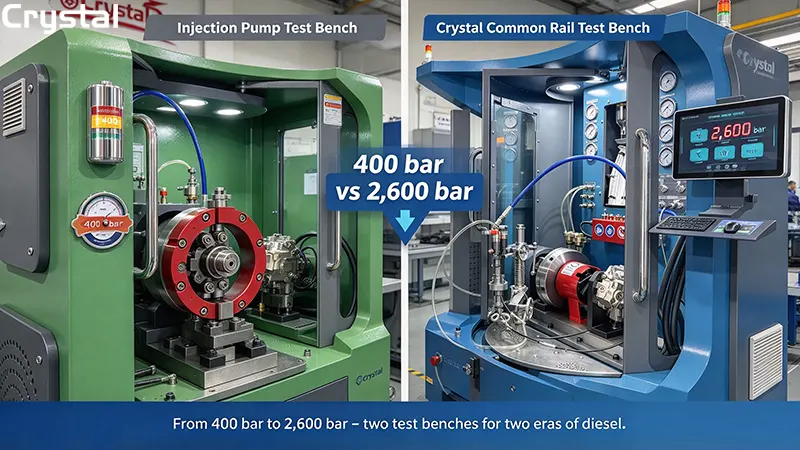
Injection pump test benches typically operate at pressures up to 400 bar, which is sufficient for testing mechanical and early electronic injection pumps. The focus is on mechanical delivery volume and timing, not ultra-high-pressure performance.
Common Rail Test Bench
Common rail test benches must generate pressures up to 2,600 bar and beyond to match the operating pressures of modern common rail systems. Injection pressures have progressed from 1,350 bar in first-generation systems to 2,500 bar in today's fourth-generation systems—with 3,000 bar designs under development. Pressure control accuracy of ±0.1 MPa is essential for reliable diagnostics.
Difference 3: Drive System and Mechanical Interface
The way the test bench drives the component under test differs significantly between the two machine types.
Injection Pump Test Bench
An injection pump test bench drives the pump camshaft directly through a mechanical coupling. The drive system must provide:
- High torque at low speeds to simulate engine cranking
- Precise speed control for governor testing
- Variable speed range (typically 0–4,000 RPM)
- Forward and reverse rotation capability
The pump is mounted on a cradle or fixture, and the drive shaft connects to the pump camshaft through a coupling. Alignment is critical—even slight misalignment causes vibration and inaccurate test results.
Common Rail Test Bench
A common rail test bench typically drives the high-pressure pump through a similar mechanical coupling, but it also requires electrical connections to the injectors and valves. The bench must:
- Provide electrical actuation signals to injectors (solenoid or piezo)
- Control DRV/MPROP valves through current modulation
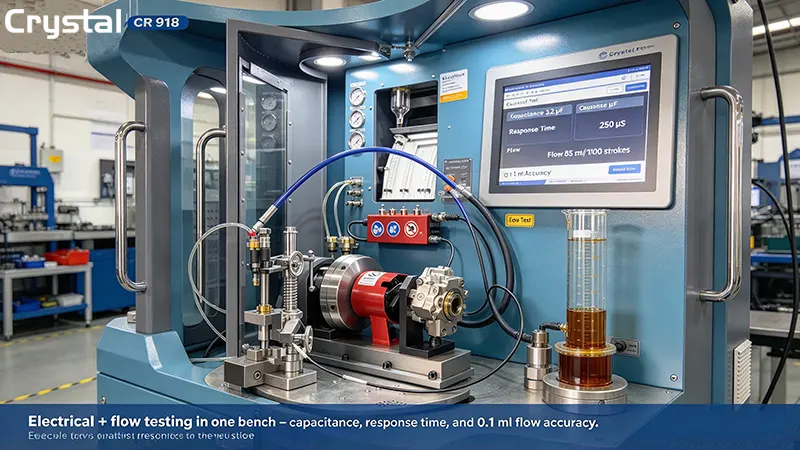
- Measure electrical response (capacitance, resistance, response time)
The common rail test bench is as much an electronic test instrument as a mechanical one.
Difference 4: Measurement Parameters and Test Outputs
The parameters measured—and the outputs generated—differ between the two machine types.
Injection Pump Test Bench
An injection pump test bench measures:
- Delivery quantity per cylinder (ml per 1,000 strokes)
- Delivery balance between cylinders (3% max variation at full load)
- Injection timing and interval angle
- Governor performance (speed droop, response)
- Internal leakage (pressure decay rate)
- Supply pressure (0.3–0.5 bar at pump inlet)
The output is typically a test report showing delivery volumes and pass/fail status against OEM specifications.
Common Rail Test Bench
A common rail test bench measures:
- Injector flow rate (0.1 ml accuracy)
- Return flow (back leakage)
- Injection duration (100–5,000 μs)
- Response time (0–999 μS)
- Capacitance (0–12 μF for piezo injectors)
- Coil resistance and inductance
- Pump delivery efficiency at multiple pressures
The output includes calibration codes (QR, IQA, IMA, ISA, c2i, c3i, ICC) for ECU integration—essential for modern injector replacement.
Difference 5: Injector Compatibility and Testing
One of the most significant differences is injector testing capability.
Injection Pump Test Bench
An injection pump test bench typically does not test injectors directly. It tests the pump that supplies fuel to the injectors. Injector testing requires separate equipment—either a dedicated injector test stand or a common rail test bench.
Some injection pump test benches can test mechanical injectors (pop testing) using a separate injector tester attachment, but they cannot test electronic or common rail injectors.
Common Rail Test Bench
A common rail test bench is designed specifically to test electronic injectors—both solenoid and piezoelectric types. It provides:
- Electrical actuation at precise pulse widths
- High-pressure fuel supply up to 2,600 bar
- Flow measurement with 0.1 ml accuracy
- Return flow measurement for internal leakage detection
- Calibration code generation for ECU integration
The common rail test bench is essential for any workshop servicing modern diesel engines.
Difference 6: Electrical and Electronic Testing Capabilities
Modern diesel systems are as much electronic as mechanical. The electrical testing capabilities of the two machine types differ dramatically.
Injection Pump Test Bench
An injection pump test bench may include basic electrical testing for:
- Solenoid valve function (12V/24V)
- Cold advance and shutoff solenoids
- Basic sensor verification
However, it does not test injector electrical characteristics or generate calibration codes.
Common Rail Test Bench
A common rail test bench includes comprehensive electrical testing:
- Capacitance measurement (0–12 μF) for piezo injectors
- Resistance measurement for solenoid coils
- Inductance measurement and response time (0–999 μS)
- Drive current control (0–30A)
- Opening voltage control (12V, 80V, 150V)
- DRV/MPROP valve current modulation
This level of electrical testing is essential for diagnosing modern injector faults and generating valid calibration codes.
Difference 7: Automation Level and Throughput
The degree of automation differs between the two machine types—and directly impacts labor cost and throughput.
| Feature | Injection Pump Test Bench | Common Rail Test Bench |
|---|---|---|
| Test sequence initiation | Manual or semi-automatic | Fully automatic |
| Multi-component testing | 1 pump at a time | Up to 4–12 injectors simultaneously |
| Cleaning | Manual disassembly | One-click automatic |
| Calibration codes | Not applicable | Automatic generation |
| Data logging | Basic | Comprehensive digital reports |
Injection Pump Test Bench
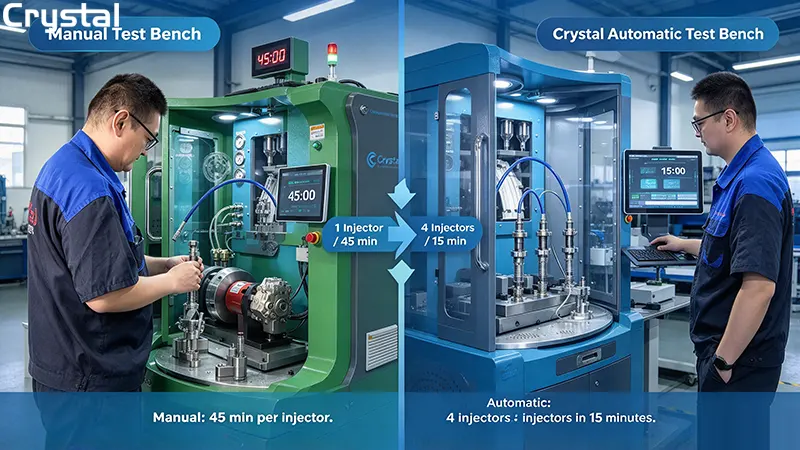
Injection pump test benches are often semi-manual. Operators adjust pressure and speed by hand, read gauges, and record results. Multi-pump testing is typically sequential—one pump at a time.
Common Rail Test Bench
Common rail test benches are built for throughput. The Crystal CR918-PRO can test four injectors in under 15 minutes—a fraction of the time required for manual testing. One-click automatic cleaning eliminates manual disassembly. Automatic data logging and report generation reduce operator time.
Automation can reduce operator error by 50% compared to manual test benches.
Difference 8: Target Market and Application
The final difference is the market each machine serves—and the business model it supports.
Injection Pump Test Bench
Injection pump test benches serve:
- Older diesel vehicles – trucks, buses, agricultural machinery, marine engines
- Mechanical fuel system repair – inline and distributor pumps
- Markets with older fleets – where mechanical systems remain dominant
- Workshops with limited budgets – entry-level injection pump test benches start around $4,000
Common Rail Test Bench
Common rail test benches serve:
- Modern diesel vehicles – passenger cars, light commercial, heavy-duty trucks
- Common rail system repair – injectors, high-pressure pumps, valves
- Markets with modern fleets – where common rail systems dominate
- Workshops positioning for growth – common rail test benches command higher investment but deliver higher revenue per job
The market trend: As diesel technology advances, the demand for common rail test benches is growing faster than for injection pump test benches. Workshops that invest in common rail capability position themselves for the future.
Summary: The 8 Differences at a Glance
| # | Difference | Injection Pump Test Bench | Common Rail Test Bench |
|---|---|---|---|
| 1 | Primary components tested | Injection pumps | Common rail injectors and pumps |
| 2 | Pressure capability | 0–400 bar | 0–2,600 bar (or higher) |
| 3 | Drive system | Mechanical coupling | Mechanical + electrical actuation |
| 4 | Measurement parameters | Delivery, timing, governor | Flow, return, response, capacitance |
| 5 | Injector compatibility | Not directly tested | Solenoid, piezo, HEUI, EUI/EUP |
| 6 | Electrical testing | Basic | Comprehensive (capacitance, response time) |
| 7 | Automation level | Manual/semi-automatic | Fully automatic, multi-injector |
| 8 | Target market | Older mechanical systems | Modern common rail systems |
Which Test Bench Is Right for Your Workshop?
The answer depends on your market and business strategy.
Choose an Injection Pump Test Bench If:
- You service primarily older mechanical diesel systems
- Your market still has a significant installed base of mechanical pumps
- Your budget is constrained
- You don't plan to expand into modern common rail systems
Choose a Common Rail Test Bench If:
- You service modern diesel vehicles (2010 and newer)
- You want to capture the growing common rail repair market
- You need to generate calibration codes for injector replacement
- You want to position your workshop as a modern diesel service center
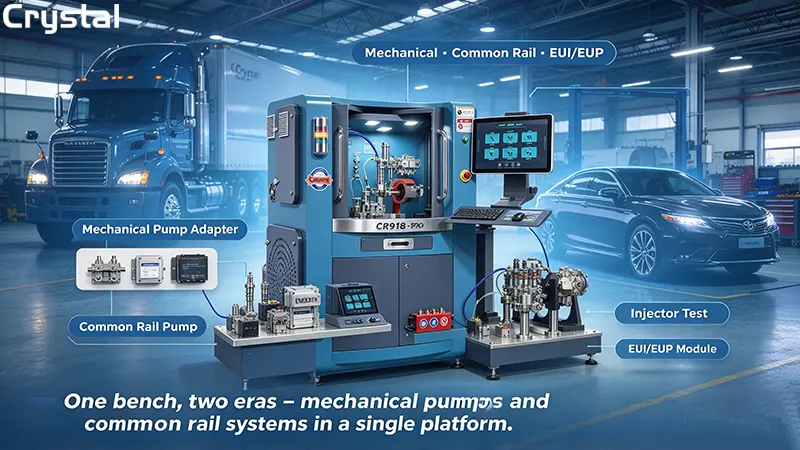
Choose a Multi-Functional Test Bench If:
- You service both older and modern diesel systems
- You want one machine that handles everything
- You want to maximize return on investment
- You plan to grow your service offering over time
Conclusion
The injection pump test bench and the common rail test bench are not competitors—they are complementary tools designed for different eras of diesel technology. The injection pump test bench serves the mechanical diesel systems that still power millions of vehicles worldwide. The common rail test bench serves the electronic, ultra-high-pressure systems that dominate modern diesel engines.
Understanding the top 8 differences between these two machine types is essential for making an informed purchasing decision. The right choice depends on your market, your customers, and your growth strategy.
For workshops that want to serve both worlds, a multi-functional test bench like the Crystal CR918-PRO offers the best of both—mechanical pump testing and common rail diagnostics in a single, integrated platform.
Written by
Taian Crystal Automation Co., Ltd.
Editor Chen
www.crystalautotest.com
WhatsApp:+86 185 9528 8526
Email:martin@crystalautotest.com
- Best Injection Pump Test Bench Compatibility – 4 Fuel Pump Types You Can Test
- Top 7 Common Rail Test Bench Trends: What's Driving Diesel Workshop Growth in 2026
- Common Rail Test Bench Maintenance: 9 Essential Tips for Peak Performance
- 7 Key Precautions for the Operation and Use of Common Rail Injector Test Benches

Crystal Automation is a leading Chinese manufacturer of common rail test benches and fuel injector test benches.