Top 7 Common Rail Test Bench Trends: What's Driving Diesel Workshop Growth in 2026
The diesel industry is undergoing a profound transformation. Stricter emissions standards, rising fuel prices, and the push for alternative fuels are reshaping how diesel engines are designed, maintained, and repaired. At the heart of this evolution lies a critical piece of equipment: the common rail test bench.
The global test benches market was valued at USD 1.85 billion in 2025 and is projected to grow at a CAGR of 6% to reach USD 3.22 billion by 2034. The fuel injector tester market alone is expected to expand from USD 0.8 billion in 2025 to USD 1.6 billion by 2036 at a CAGR of 6.1%.
But what specific trends are driving this growth? Here are the top 7 trends shaping the common rail test bench market in 2026—and what they mean for diesel workshops worldwide.
1. Ultra-High Pressure Systems Exceeding 2,500 Bar
Injection pressures have progressed from 1,350 bar in first-generation common rail systems (introduced in 1997) to 2,500 bar in today's fourth-generation systems—with 3,000 bar designs already under development.
The ultra-high-pressure common rail systems market is valued at USD 6.0–6.2 billion in 2026. Heavy-duty on-road engines account for 51% of this market, with OEM line-fit sales dominating at 61% share. Systems operating at pressures exceeding 2,500 bar are no longer a premium option but a core enabling technology for achieving mandated reductions in NOx and particulate matter.
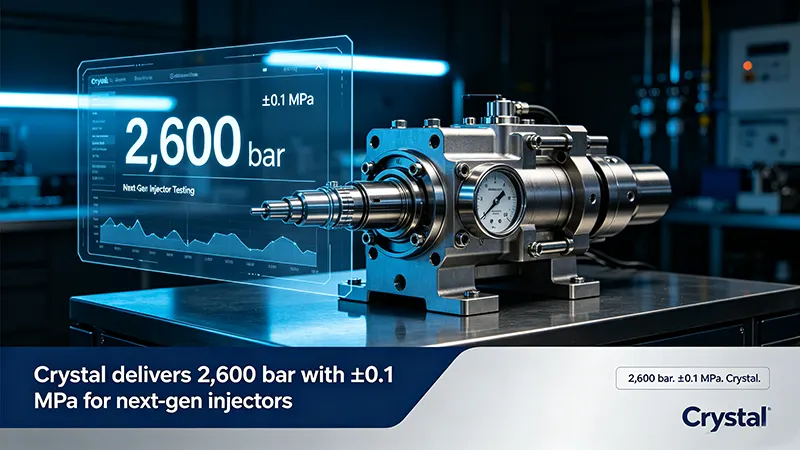
What this means for workshops: Test benches must now operate at 2,600 bar or higher with pressure control accuracy of ±0.1 MPa to properly diagnose the latest injectors. Benches capped at 2,000 bar simply cannot test fourth-generation systems.
Crystal's response: Crystal's high-pressure common rail test benches operate at pressures up to 2,600 bar with ±0.1 MPa accuracy, powered by Bosch CP3.3 original pumps.
2. Stricter Emission Regulations (Euro 7, China 6, US EPA Tier 5)
The global push for cleaner emissions is the single largest driver of common rail test bench demand. Euro 7 is set to take effect in November 2026 for light-duty vehicles, while China 6 and US EPA Tier 5 standards continue to tighten.
These regulations mandate precise fuel injection control to reduce NOx and particulate matter. Commercial vehicle emission upgrading and heavy-duty machinery development are driving the iteration of high-pressure diesel common rail systems. The global diesel engine market is projected to reach USD 67.44 billion in 2026 and continue growing at a CAGR of 5.49% to USD 93.14 billion by 2032.
What this means for workshops: Every engine must meet tighter emissions targets. Injectors must operate with microscopic accuracy. Test benches must provide quantifiable, data-driven diagnostics with pass/fail results that can be traced and verified.
Crystal's advantage: Crystal test benches feature fully automatic control systems that generate comprehensive test reports with pass/fail indicators, enabling workshops to document compliance.
3. AI-Driven Diagnostics and Machine Learning
Artificial intelligence is revolutionizing diesel injector diagnostics. Machine learning algorithms are now being applied to predict main injection quantity in high-pressure common rail systems using input parameters including engine load, fuel pressure, injection speed, and pulse time.
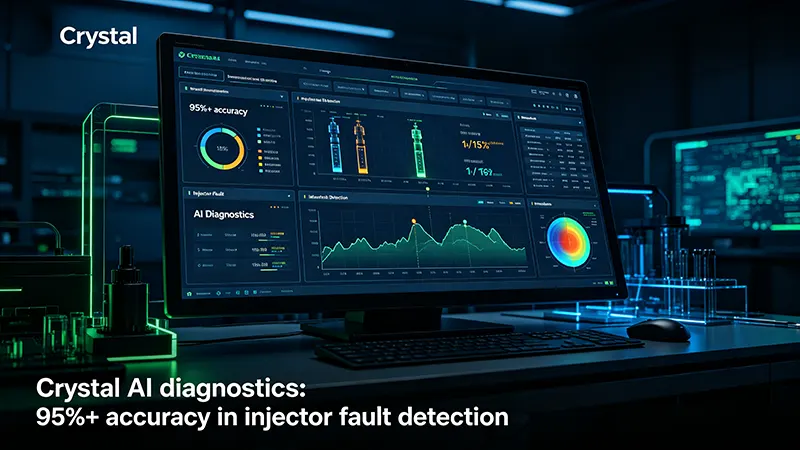
Artificial Neural Network (ANN) models are being developed to predict injection flow rate based on experimental data collected from common rail injector test benches with integrated temperature control. Research has demonstrated that AI-based diagnostic methods can achieve accuracy rates exceeding 95% in detecting plunger cracks and leaks in high-pressure common rail systems.
What this means for workshops: Test benches are evolving from simple measurement tools into intelligent diagnostic systems that can predict failures before they occur. This reduces diagnostic time, minimizes human error, and enables preventive maintenance.
Crystal's approach: Crystal's CR918-PRO employs advanced sensing technology and an intelligent control system, enabling precise measurement and analysis of various key parameters of the fuel injector.
4: Modular and Flexible Test Bench Designs
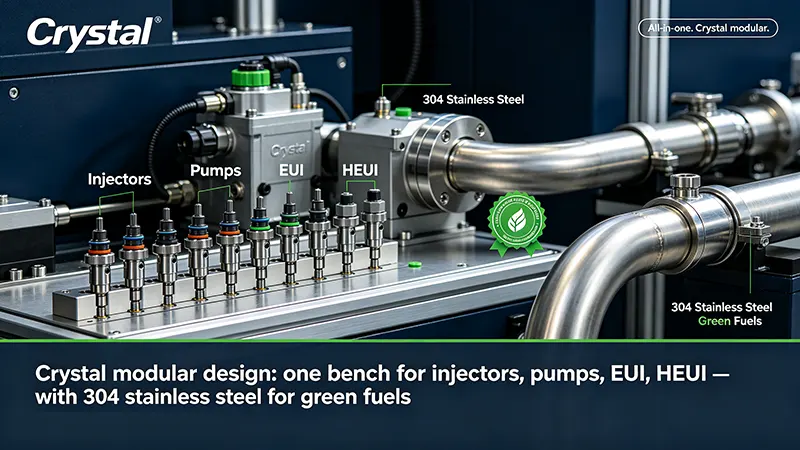
Workshops need equipment that can adapt to changing demands. Modular test bench designs allow a single platform to test multiple component types—common rail injectors, high-pressure pumps, EUI/EUP systems, and HEUI systems—by simply swapping fixtures.
The Crystal E1, for example, features an independent modular system that integrates power supply, fuel delivery, temperature control, and measurement systems into a single, easy-to-maintain platform. It can test two, four, or six common rail injectors simultaneously at pressures up to 2,500 bar.
What this means for workshops: One modular test bench can replace multiple single-purpose machines, saving workshop floor space, reducing capital investment, and simplifying training. As one industry report notes, *"Modularity drives ROI. Configurable frames, interchangeable fixtures, and swappable I/O let users repurpose benches across programs"* .
5. Green Fuels and Alternative Diesel Blends
The shift toward sustainable fuels is accelerating. Research is increasingly focused on biodiesel, HVO (Hydrotreated Vegetable Oil), and hydrogen blends. Engine bench tests are being conducted on common-rail diesel engines using B100 and B20 biodiesel blends to study effects on output power, fuel consumption, and emissions.
As alternative fuels gain market share, test benches must be capable of handling fuels with different viscosities, lubricities, and corrosive properties. This requires advanced materials (like 304 stainless steel fuel circuits) and precise temperature control systems.
What this means for workshops: Test benches must be fuel-flexible. Workshops that can test injectors for both conventional diesel and alternative fuel blends will have a competitive advantage.
Crystal's design: Crystal test benches feature 304 stainless steel fuel circuits for corrosion resistance and durability, ensuring compatibility with a wide range of fuel types.
6. Automation and Multi-Injector Testing
Time is money in a busy workshop. Fully automatic test benches that can test multiple injectors simultaneously are transforming workshop productivity.
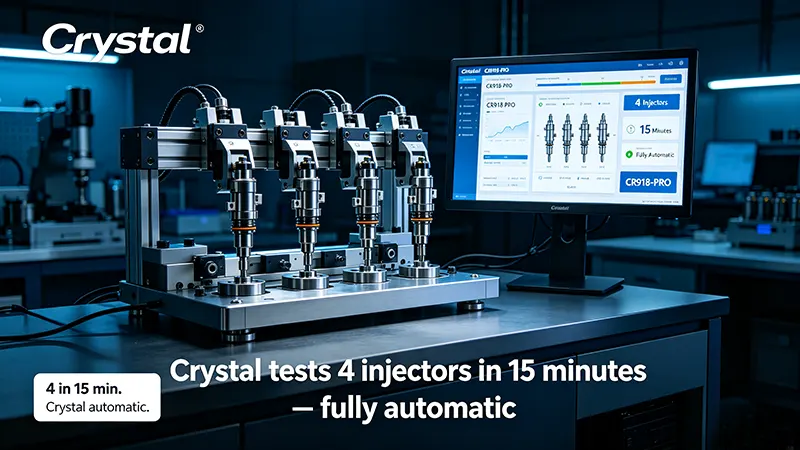
The Crystal CR918-PRO can test four injectors in under 15 minutes—a fraction of the time required for manual testing. Bosch's new DCP 800 pump test bench, debuting at Automechanika Frankfurt in September 2026, offers rapid setup and average test times of around 30 minutes, testing common-rail pumps at pressures up to 2,700 bar.
The global fuel system testing market is predicted to grow from USD 1,232 million in 2025 to USD 2,098 million in 2032, at a CAGR of 7.6%—reflecting the surging demand for automated testing solutions.
What this means for workshops: Automation reduces operator error, increases throughput, and allows technicians to focus on diagnosis rather than machine operation. Workshops that invest in automated test benches can service more vehicles in less time.
7: Data-Driven Quality Management and IoT Integration
Modern test benches are no longer standalone machines—they are data nodes in a connected workshop ecosystem. The latest trends include model-based and hardware-in-the-loop (HIL) testing, digital twins, and software-defined architectures that decouple measurement hardware from application workflows.
Buyers increasingly prioritize interoperability (open APIs, OPC UA, Ethernet-based fieldbuses), cybersecurity for networked benches, and analytics that convert raw signals into actionable quality metrics. Test benches that integrate with PLM, MES, QMS, and calibration management systems are winning bids.
What this means for workshops: Test data is becoming a competitive asset. Centralized historians, test analytics, and ML-assisted anomaly detection convert signal streams into quality insights. Workshops that can document, analyze, and share test data will have a significant advantage in quality assurance and customer trust.
Summary: The 7 Trends at a Glance
| Trend | Key Data | Impact on Workshops |
| 1. Ultra-high pressure | 2,500–3,000 bar systems, 3,000 bar under development | Test benches must handle 2,600 bar+ |
| 2. Stricter emissions | Euro 7 (Nov 2026), China 6, EPA Tier 5 | Precision diagnostics are mandatory |
| 3. AI diagnostics | 95%+ accuracy in fault detection | Faster, more accurate diagnosis |
| 4. Modular design | One platform tests injectors, pumps, EUI, HEUI | Replaces multiple machines |
| 5. Green fuels | Biodiesel, HVO, hydrogen blends in testing | Fuel-flexible equipment required |
| 6. Automation | 4 injectors in 15 minutes | Higher throughput, lower costs |
| 7. Data integration | IoT, HIL, digital twins | Quality management and traceability |
What This Means for Crystal Automation
For Crystal Automation, these seven trends represent both a challenge and an opportunity. The company's CR918-PRO multi-functional test bench and Crystal E1 modular system are well-positioned to meet the demands of 2026 and beyond:
- Pressure capability up to 2,600 bar with ±0.1 MPa accuracy
- Multi-injector testing of 2, 4, or 6 injectors simultaneously
- Comprehensive component support for common rail injectors, pumps, EUI, EUP, and HEUI systems
- Automatic calibration code generation including QR, IQA, IMA, ISA, c2i, c3i, and ICC (VD0)
- 304 stainless steel fuel circuits for fuel flexibility and durability
- Fully automatic control systems that streamline testing and reduce operator error
As the diesel industry continues to evolve, one thing is clear: precision testing is no longer optional. Workshops that invest in advanced common rail test benches today will be the ones that thrive tomorrow.
Written by
Taian Crystal Automation Co., Ltd.
Editor Chen
www.crystalautotest.com
WhatsApp:+86 185 9528 8526
Email:martin@crystalautotest.com
- From Diagnosis to Repair: How Crystal Common Rail Test Benches Reduce Diesel Engine Downtime
- Top 10 High Quality Fuel Injector Test Bench Reviews
- Two CR318Pro Common Rail Injector Test Bench Shipped Simultaneously to Italy - Made in China Earns Dual Recognition in the European Market
- 7 Steps to Accurately Test Piezoelectric Injectors at 2,600 Bar on a Common Rail Test Bench

Crystal Automation is a leading Chinese manufacturer of common rail test benches and fuel injector test benches.