Top 7 Types of Fuel Injection Pumps Testable on Modern Injection Pump Test Bench
Diesel repair workshops face a persistent challenge: maintaining versatile test equipment capable of servicing both legacy mechanical pumps and cutting-edge high-pressure fuel systems. Industry data shows over 62% of independent diesel garages receive mixed pump workloads, combining older agricultural, truck, marine pumps alongside modern common rail hardware.
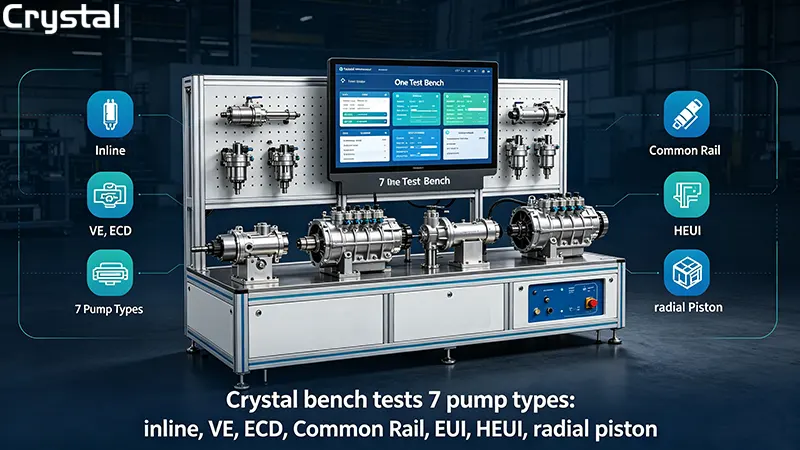
A premium modern injection pump test bench eliminates the need for multiple single-purpose machines. Crystal Automation’s modular test platforms support full calibration and diagnostic testing for seven core fuel injection pump families. Each pump requires unique pressure, speed and flow benchmarks; failing to match correct test parameters leads to calibration errors exceeding 3%, triggering poor engine performance, excessive smoke and premature component failure.
Below we break down the 7 pump types, critical test specifications, and how modern test benches validate each unit to OEM tolerance standards.
1. Inline Mechanical Injection Pumps
Inline pumps remain widely used on heavy-duty trucks, tractors and stationary industrial engines. These multi-plunger mechanical pumps dominate legacy mechanical fleets, representing roughly 23% of mechanical pump service volume globally.
Key Test Bench Data Requirements
- Test speed range: 400–1,800 RPM
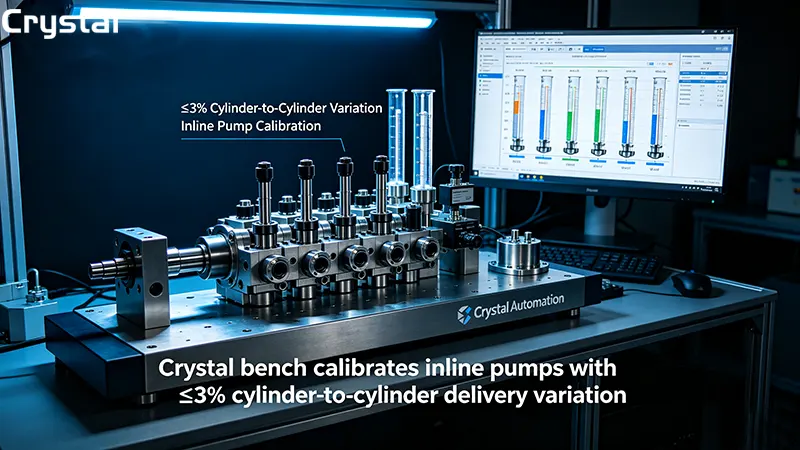
- Acceptable cylinder-to-cylinder fuel delivery variation: ≤3% per 300 strokes
- Typical delivery volume: 15–65 cc / 300 strokes
- Governor cut-off and advance timing validation
Crystal Automation Bench Advantage: Quick-change inline pump mounting adapters support up to 12-cylinder inline pumps with flow measurement accuracy of ±0.5%.
2. Rotary Distributor (VE) Injection Pumps
The Bosch VE rotary distributor pump is one of the most common single-plunger pumps for light commercial vehicles, SUVs and small agricultural engines. Market data confirms rotary distributor pumps account for 33% of mechanical injection pump repair demand.
Key Test Bench Data Requirements
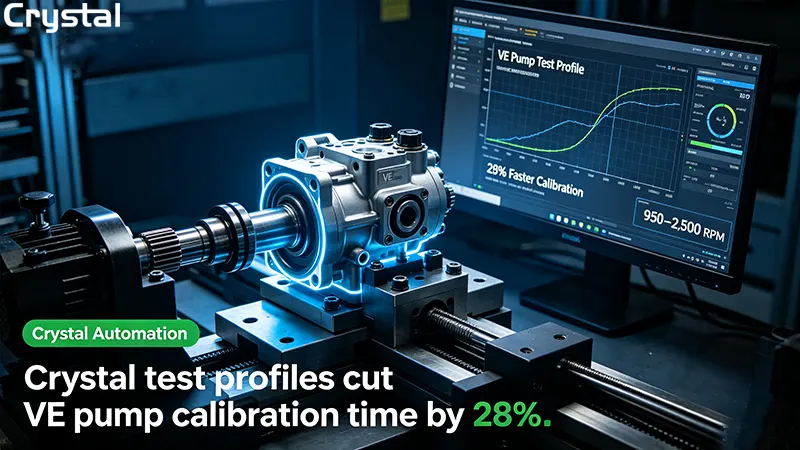
- Test operating speeds: 750–2,500 RPM
- Maximum internal delivery pressure: 350–420 bar
- Dynamic timing advance curve tracking
- Idle stability and maximum fuel rack adjustment
Crystal Automation Bench Advantage: Preloaded VE pump test profiles automate timing curve logging, cutting manual calibration time by up to 28%.
3. Electronic Distributor (VP / ECD) Pumps
Electronic controlled distributor pumps bridge mechanical and fully electronic fuel systems. Built-in solenoids manage timing and fuel output, common on late 1990s to early 2010s light commercial fleets.
Key Test Bench Data Requirements
- Variable speed testing: 600–2,200 RPM
- Electronic actuator signal simulation (0–5V PWM)
- Pressure decay testing: target pressure retention above 30 seconds
- Check leak rates below 12 ml/min at rated load
4. Common Rail High-Pressure Pumps (CP3, CP4, HP3, HP5)
Common rail pumps represent the fastest-growing service segment, holding 57% share of new diesel vehicle fuel systems. These generate extreme pressure to feed the common rail manifold.
Key Test Bench Data Requirements
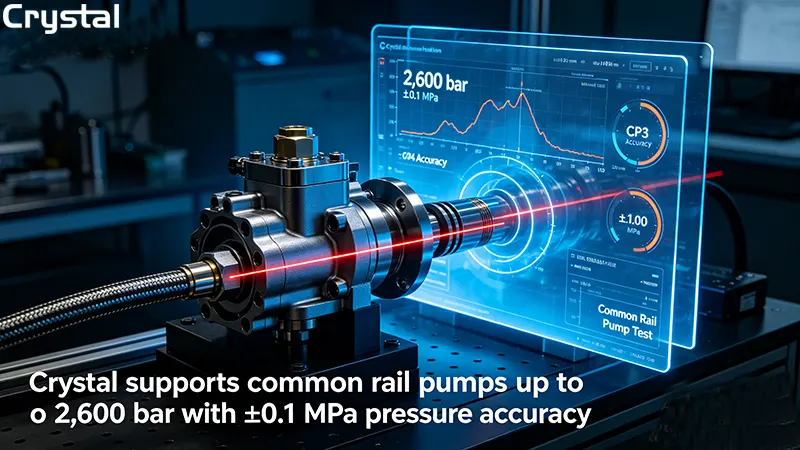
- Rated operating pressure range: 1,600 – 2,600 bar
- Pressure control accuracy target: ±0.1 MPa
- Metering unit flow characterization at variable RPM
- Pressure leakage testing under maximum load
Crystal Automation Bench Advantage: Supports up to 2,600 bar rail pressure testing, matching next-gen injector system requirements.
5. Unit Injector (EUI) Pumps
Electronic Unit Injectors integrate pump and injector into one assembly, widely fitted on older heavy-duty European and American truck engines.
Key Test Bench Data Requirements
- Pulse width control from 300 μs – 2,500 μs
- Injection pressure validation up to 1,400 bar
- Cycle fuel delivery consistency across 1,000 test cycles
- Minimum delivery tolerance: ±0.8 mm³ per stroke
6. HEUI (Hydraulic Electronic Unit Injector) Pumps
HEUI systems use high-pressure engine oil to pressurize fuel, most famously found on Ford 6.0L / 7.3L Powerstroke engines. They require separate oil circuit testing unique from standard fuel pumps.
Key Test Bench Data Requirements
- High-pressure oil circuit testing: 300–4000 psi
- Synchronized fuel and hydraulic pressure monitoring
- Response time measurement under load transients
- Detect pressure drop exceeding 50 psi within 30 seconds
7. Radial Piston Distributor Injection Pumps
Radial piston pumps deliver higher pressure than classic VE pumps, used on mid-range commercial vehicles and marine engines. Multiple radial plungers deliver stable fuel output under fluctuating engine loads.
Key Test Bench Data Requirements
- Peak injection pressure up to 1,950 bar
- Speed sweep testing: 500–2,800 RPM
- Plunger delivery balance testing
- Load-dependent fuel delivery curve recording
Why a Multi-Pump Test Bench Drives Workshop Profit
Workshop operational data shows garages with all-in-one pump test benches increase billable service volume by 31% compared to facilities operating dedicated single-type testers. Separate equipment requires repeated reconfiguration, extra floor space and higher maintenance costs.
Modern platforms like Crystal Automation injection pump test benches integrate all required adapters, sensor packages and pre-programmed OEM test datasets for every pump listed above. Operators can switch from inline pump calibration to common rail pump testing in under 10 minutes.
Critical risk reminder: Testing pumps on under-spec equipment creates hidden calibration drift. Industry benchmarks confirm benches without ±0.5% flow accuracy produce pump calibrations with deviations greater than 4%, leading to customer comebacks, lost reputation and warranty claims.
Conclusion
From legacy inline mechanical pumps to modern 2,600 bar common rail pumps, today’s diesel workshop must handle seven primary fuel injection pump variants. Each type demands distinct pressure, speed, flow and electronic test parameters.
Investing in a fully modular modern injection pump test bench removes equipment limitations and expands your service offering. Crystal Automation test benches are engineered to calibrate all seven pump families with lab-grade measurement precision, helping your workshop reduce comebacks and capture more diesel fuel system repair jobs.
Call to Action
Contact Crystal Automation to review full technical specifications for our injection pump test bench range and download the complete pump type calibration parameter checklist for your workshop.
Written by
Taian Crystal Automation Co., Ltd.
Editor Chen
www.crystalautotest.com
WhatsApp:+86 185 9528 8526
Email:martin@crystalautotest.com
- Top 7 Factors to Choose a Reliable Common Rail Injector Test Bench for Diesel Repair Shops
- Top 5 Injection Pump Test Bench Pressure Loss Causes – Fix Them Fast
- Top 9 Must-Know Injection Pump Test Bench Maintenance Tasks for Every Diesel Workshop
- High-Pressure Common Rail Test Bench: 9 Essential Steps to Automate Diesel Injector Diagnostics

Crystal Automation is a leading Chinese manufacturer of common rail test benches and fuel injector test benches.