The 8 Most Common Faults in Common Rail Injector Test Benches
The common rail injector test bench serves as the core precision equipment for the maintenance, testing, and calibration of diesel injectors; the operational stability of this equipment directly determines the accuracy of injector test data and the success rate of repairs. Given that these test benches operate continuously under conditions of high pressure and high frequency—compounded by factors such as workshop dust, fuel impurities, wear and tear from assembly/disassembly, and inadequate maintenance—they are highly susceptible to various structural, hydraulic, and electronic control system failures. According to big data statistics on equipment failures within the industry, over 90% of test bench downtime issues stem from eight major typical faults, which commonly manifest as abnormal pressure, fuel quantity deviations, excessive leakage, and electronic control system failures. Such malfunctions not only result in inaccurate test data and elevated rework rates but also lead to accelerated wear on high-pressure components, exorbitant repair costs, and financial losses due to workshop downtime. To standardize the equipment troubleshooting process, reduce failure rates, and extend the service life of the machinery, the eight most common typical faults associated with common rail injector test benches have been systematically summarized herein, incorporating actual test data, probability statistics, deviation thresholds, and root causes.
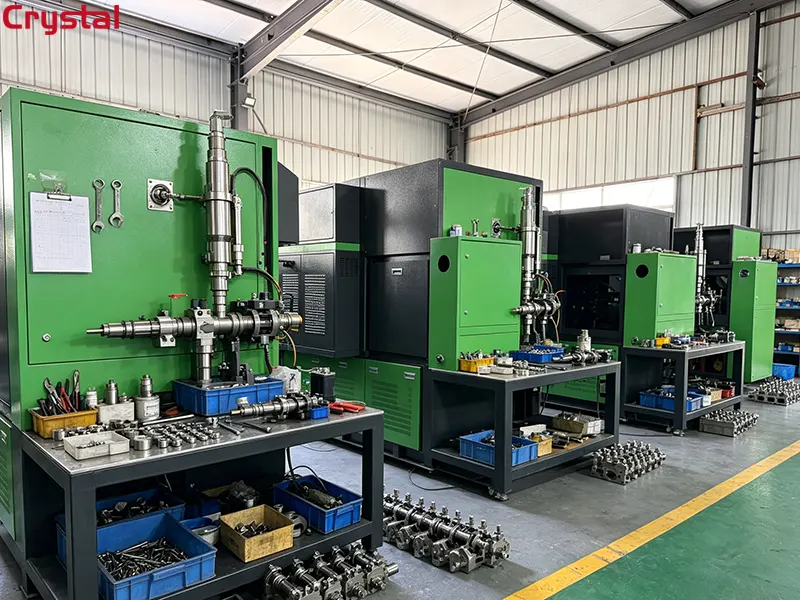
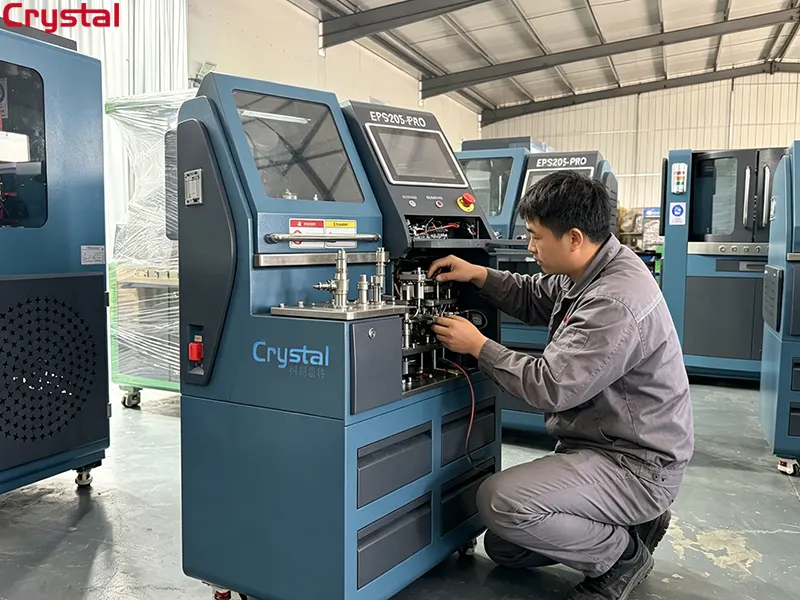
1. Core Components of the Common Rail Injector Test Bench
1.1. High-Pressure Plunger Pump
- Function: Pressurizes low-pressure fuel to the standard common rail pressure (up to 1600–1800 bar).
- Key Parameters: Pressure rise rate ≥ 100 bar/s; pressure drop during pressure holding < 15 bar/10s.
- Wear-prone Parts: Plunger pair assemblies, oil seals, check valves; Corresponding Faults: Insufficient pressure, pressure fluctuations.
1.2. Pressure Control Valve (Rail Pressure Regulator)
- Function: Precisely controls the system rail pressure and provides dynamic pressure stabilization.
- Wear-prone Parts: Spool sticking/seizing, spring fatigue; Corresponding Faults: Unstable pressure.
1.3. High-Pressure Accumulator
- Function: Dampens pressure fluctuations and ensures constant injection pressure.
- Wear-prone Parts: Bladder aging, seal leakage.
1.4. Injector Fixture/Clamping Assembly
- Function: Precisely positions, seals, and secures various types of common rail injectors, while receiving high-pressure fuel.
- Wear-prone Parts: High-pressure gaskets/seals, locating sleeves; Corresponding Faults: External high-pressure leakage.
1.5. Measuring Cup / Flow Measurement Module
- Function: Measures single-shot injection volume and cumulative fuel volume to determine fuel quantity deviations.
- Key Parameters: Measurement accuracy ≤ ±1%.
- Wear-prone Parts: Line blockages, liquid level sensor failure.
1.6. Return Fuel Collection and Measurement Module
- Function: Detects the volume of internal leakage (return fuel) from the injector to assess its sealing integrity.
- Standard: Return fuel volume < 12 mL/min under high-pressure operating conditions.
1.7. Atomization Observation Chamber
- Function: Allows for visual inspection (via the naked eye or an auxiliary lens) of the fuel spray pattern, spray cone angle, and any dripping/leaking conditions.
2. Overall Machine Fault Rate
2.1. Monthly Fault Probability
- New Machines (0–2 years): Monthly fault probability per unit is 12% (mostly minor issues such as seals, wiring, etc.).
- Mid-Life Machines (2–5 years; the primary models currently in active use): Monthly fault probability per unit... 35% (Increased frequency of wear-related and jamming-related faults).
- Older units (5+ years): Monthly fault probability per unit is 68% (Aging of precision mating parts; occurrence of multiple concurrent faults).
2.2. Annual Fault Frequency
- 0–2 years: Average 1–2 faults per year.
- 2–5 years: Average 4–6 faults per year.
- 5+ years: Average 9–12 faults per year.
3. The Eight Most Common Faults in Common Rail Injector Test Benches
3.1. Unstable High-Pressure System Pressure (Fault rate: approx. 22%)
- Symptoms: Set pressure of 1000–1600 bar results in actual fluctuations of ±50 to 150 bar; pressure drop exceeds 30 bar after holding steady for 10 seconds.
- Data Standard: Static pressure fluctuation ≤ ±20 bar; pressure drop over 10 seconds < 15 bar.
- Primary Causes: Aging of high-pressure pump seals (accounts for 60%), sticking pressure-regulating valve, minor leaks in piping.
3.2. Excessive Injector Return Flow (Internal leakage exceeds limits; fault rate: approx. 18%)
- Symptoms: Return flow exceeds 20 mL/min at rated pressure (1600 bar); return flow exceeds 8 mL/min at idle speed (300 bar).
- Data Standard: High-pressure return flow < 12 mL/min; idle-speed return flow < 5 mL/min.
- Primary Causes: Wear on control valve/valve seat (accounts for 70%), damage to needle valve sealing surface.
3.3. Excessive Injection Volume Deviation (Fault rate: approx. 15%)
- Symptoms: Idle-speed fuel volume deviation exceeds ±15% (Standard: 8–12 mm³/stroke). Full-load fuel quantity deviation > ±10% (Standard: 40–50 mm³/stroke).
- Data Standard: Fuel quantity deviation ≤ ±5% under all operating conditions.
- Primary Causes: Nozzle wear (50%), solenoid valve drive malfunction, plunger pair wear.
3.4. High-Pressure Leakage (External Leakage; Failure Rate: ~12%)
- Symptoms: Oil seepage at joints/seals; pressure drop > 50 bar after holding pressure at 1600 bar for 30 seconds; visible oil traces.
- Data Standard: Pressure drop < 20 bar after holding pressure for 30 seconds; no visible leakage.
- Primary Causes: O-ring aging (65%), loose high-pressure fuel line fittings, poor sealing at the injector mounting surface.
3.5. Poor Atomization / Spray Deflection (Failure Rate: ~10%)
- Symptoms: Diffuse fuel spray pattern; distinct fuel streaks/droplets visible; spray cone angle deviation > ±8° (Standard: 15°–25°).
- Data Standard: Droplet size < 5 μm; cone angle deviation ≤ ±3°; no fuel streaks/drips.
- Primary Causes: Nozzle orifice wear/carbon deposits (80%), needle valve sticking.
3.6. Drive Circuit Fault (No Injection / Weak Injection; Failure Rate: ~9%)
- Symptoms: Solenoid valve fails to actuate; coil resistance < 0.6 Ω or > 1.5 Ω (Standard: 0.8–1.2 Ω).
- Data Standard: Resistance 0.8–1.2 Ω; drive voltage 110–130 V; pulse width 0.5–5 ms (rectangular wave).
- Primary Causes: Coil burnout (55%), damaged drive module, poor contact in wiring harness.
3.7. Failure to Build Pressure (Unable to Reach Setpoint; Failure Rate: ~8%)
- Symptoms: Maximum pressure < 800 bar (Setpoint: 1600 bar); pressure rise rate < 50 bar/s.
- Data Standard: Rises to 1600 bar within 10 seconds ...bar; Pressure rise rate ≥ 100 bar/s.
- Primary Causes: High-pressure pump plunger wear (50%), stuck pressure regulating valve, clogged fuel inlet filter element.
3.8. Data Acquisition/Communication Anomalies (Failure Rate: approx. 6%)
- Symptoms: Pressure/flow data spikes (fluctuations > ±3%); Data packet loss rate in communication with the host PC > 5%.
- Data Standards: Data fluctuation ≤ ±1%; Packet loss rate < 1%; Sampling frequency ≥ 10 Hz.
- Primary Causes: Sensor drift (40%), poor data cable shielding, mainboard A/D module failure.
4. Probability of Occurrence for the Eight Typical Faults in Common Rail Injector Test Benches
| No. | Fault Type | Occurrence Rate | Corresponding Core Components | High-Risk Scenarios |
| 1 | Unstable High-Pressure System Pressure | 22% | High-pressure plunger pump, pressure regulating valve, accumulator | Long-term continuous operation, high fuel impurity levels |
| 2 | Excessive Injector Return Flow (Internal Leakage Exceeds Limits) | 18% | Testing fixture, injector sealing components | Frequent disassembly/assembly, normal wear of precision parts |
| 3 | Injector Delivery Volume Deviation Exceeds Limits | 15% | Flow metering components, drive module | Long periods without calibration, sensor drift |
| 4 | External Leakage in High-Pressure Lines/Connections | 12% | Sealing elements, high-pressure fuel lines, fixtures | O-ring aging, frequent disassembly/assembly, loose fasteners |
| 5 | Poor Injector Atomization/Spray Deflection | 10% | Atomization observation chamber, fixture positioning components | Fuel gumming, carbon deposit accumulation |
| 6 | Electronic Control Drive Circuit Failure | 9% | Drive board, solenoid valve wiring harness, coils | Unstable voltage, wiring aging, electrical overload |
| 7 | System Pressure Fails to Build | 8% | High-pressure pump assembly, pressure regulating valve, filter element | Failure to replace filter elements for extended periods; severe plunger wear |
| 8 | Data Acquisition / Communication Anomalies | 6% | Pressure/Flow Sensors; Industrial Control Mainboard | Electromagnetic Interference; Sensor Aging |
5. Introduction to Repair Costs for Common Rail Injector Test Benches
5.1. Data Acquisition / Communication Anomalies (Least Expensive)
- Cost: 200–800 RMB.
- Scope: Sensor calibration, signal cable replacement, AD module repair.
- Characteristics: 80% of cases involve calibration or connector issues; no major components require replacement.
5.2. High-Pressure Leakage (External Leaks)
- Cost: 500–1,500 RMB.
- Scope: Replacement of O-rings and gaskets; tightening of connectors.
- Characteristics: Material costs are low, while labor costs constitute the majority of the expense.
5.3. Poor Injection Atomization / Spray Deviation
- Cost: 800–2,500 RMB.
- Scope: Injector cleaning, lapping, or replacement (Injectors: 1,500+ RMB).
- Notes: Carbon buildup or minor wear is inexpensive to fix; chipped nozzle holes require injector replacement.
5.4. Drive Circuit Faults (No Injection / Weak Injection)
- Cost: 1,000–3,000 RMB.
- Scope: Solenoid coils, driver boards, wiring harnesses.
- Notes: Driver boards cost approx. 800 RMB (OEM: 2,000+ RMB); coils are inexpensive but prone to recurring issues.
5.5. Unstable Pressure
- Cost: 1,500–4,000 RMB.
- Scope: Pressure control valves, high-pressure pump seals, check valves.
- Notes: Aging seals cost approx. 1,500 RMB to replace; stuck or worn pressure control valves cost 3,000+ RMB.
5.6. Excessive Return Flow (Internal Leakage Exceeds Limits)
- Cost: 2,000–5,000 RMB.
- Scope: Repair or replacement of control valves, valve seats, and needle valve sealing surfaces.
- Notes: Precision-matched components are expensive; spare parts cost 5,000+ RMB.
5.7. Injection Volume Deviation Exceeds Limits
- Cost: 2,500–6,000 RMB.
- Scope: Plunger assemblies, injectors, solenoids + calibration.
- Notes: Often requires disassembly for inspection, precision lapping, and full-range operational calibration.
5.8. Failure to Build Pressure (Most Expensive)
- Cost: 4,000–12,000 RMB.
- Scope: High-pressure pump plungers/cams, main shafts, pressure control valve assemblies.
- Notes: The high-pressure pump is the "heart" of the test bench; a complete assembly costs 10,000+ RMB.
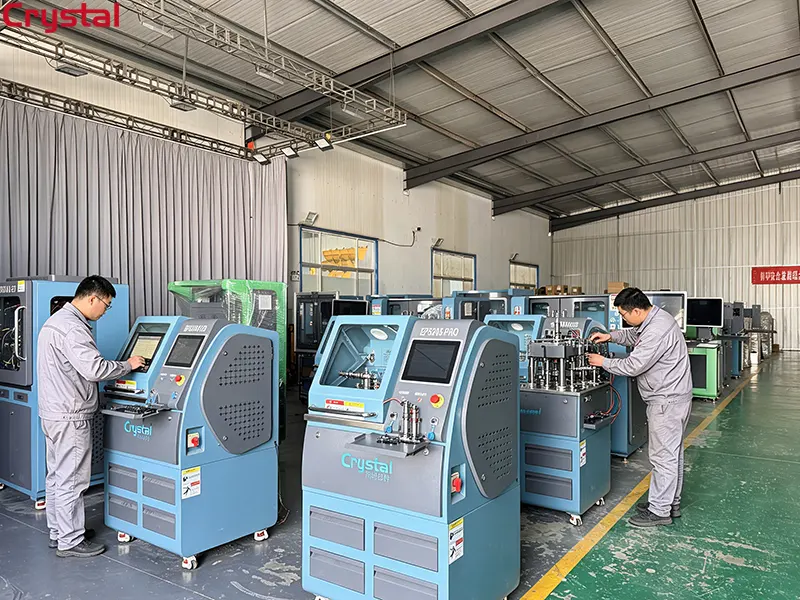
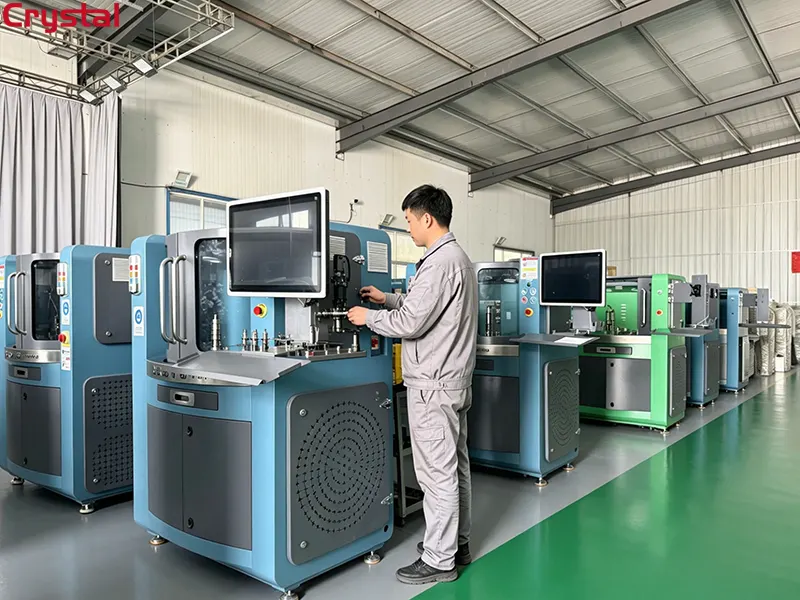
6. Reasons for High Repair Costs for Common Rail Injector Test Benches
- High Proportion of Precision Components: High-pressure pumps, injectors, and control valves all rely on micron-level tolerances; these components have limited service lifespans and high unit costs.
- High Calibration Costs: Once repaired, the injectors must undergo comprehensive calibration across all operating conditions (idle, medium pressure, and high pressure)—covering flow rates, return flow, and atomization. The labor hours required for this calibration typically account for 30% to 50% of the total repair cost.
- Significant Downtime Losses: Repairs typically take 1 to 3 days. Based on a daily output of 8 repaired injectors—each generating a revenue of 150 RMB—the direct financial loss due to downtime amounts to 1,200 to 3,600 RMB per day.
- Brand Premium: The cost of original equipment manufacturer (OEM) parts is 2 to 3 times higher than that of generic aftermarket parts, and the lead times for ordering these parts are often lengthy.
7. The Importance of Regular Maintenance for Common Rail Injector Test Benches
7.1. Significantly Reducing Failure Probability and Minimizing Downtime
Adhering to standardized maintenance protocols can reduce the overall failure rate of the equipment by 40%. Furthermore, the incidence of common faults—such as unstable high-pressure readings, plunger wear, and clogged filter elements—can be reduced by as much as 55%.
- Neglecting Maintenance: For equipment aged 2 to 5 years, the monthly probability of failure stands at 35%, resulting in an average of 4 to 6 failures per year.
- Standardized Maintenance: For equipment of the same age, standardized maintenance reduces the monthly failure probability to under 21%, resulting in an average of only 1 to 2 failures per year.
Reducing equipment failures directly prevents unscheduled downtime. Based on a daily average of 10 injectors tested—with each generating 150 RMB in revenue—avoiding a single major breakdown (which typically causes 1 to 3 days of downtime) can save between 1,500 and 4,500 RMB in lost revenue.
7.2. Strictly Controlling Repair Costs and Avoiding Costly Major Overhauls
The root cause of 80% of major equipment failures lies in a lack of routine daily maintenance.
- Routine Maintenance Costs: The annual average cost for monthly and quarterly consumables (filter elements, seals, and cleaning fluids) is a mere 800 to 1,500 RMB.
- Consequences of Neglecting Maintenance: Neglect leads to the premature wear of critical components—such as high-pressure pumps, pressure regulating valves, and precision mating parts. A single major overhaul can cost between 4,000 and 12,000 RMB, causing annual repair expenses to skyrocket to between 15,000 and 25,000 RMB.
- Comparative Conclusion: For every 1 RMB invested in maintenance, you can save 8 to 15 RMB in repair expenses.
7.3. Ensuring Testing Accuracy and Preventing Testing Errors
The test bench is classified as a piece of precision metrology equipment; its accuracy directly impacts the quality of injector repair work.
- Clogged filter elements, carbon buildup in oil passages, and contamination on sensors can lead to pressure fluctuations exceeding tolerance limits and fuel quantity measurement deviations greater than ±10%—far exceeding the standard tolerance of ±5%.
- Regular cleaning, calibration, and air bleeding help stabilize various parameters, thereby ensuring the accuracy of test data regarding pressure, return flow, injection volume, and atomization.
- A loss of accuracy can lead to misdiagnosis: functional injectors may be incorrectly flagged as defective, while repaired components may fail re-inspection, resulting in a rework rate increase of over 25% and incurring additional costs for labor and consumables.
In summary, the eight most common faults associated with common rail injector test benches stem primarily from five core causes: fuel contamination, aging seals, wear on precision mating parts, instability in the electronic control system, and a lack of routine maintenance. Among these issues, abnormal high pressure, excessive return flow, and deviations in injection volume are the most frequent occurrences, accounting for over 67% of all equipment faults. Most equipment failures do not result from sudden, catastrophic damage, but rather from irreversible problems accumulated over time through gradual wear, parameter drift, and neglected maintenance. Compared to the high costs of major overhauls and the financial losses incurred during downtime following a breakdown, basic maintenance practices—such as regular cleaning, filter replacement, parameter calibration, and electrical circuit inspections—can effectively reduce the overall equipment failure rate by over 40%. These measures significantly minimize wear on precision components and ensure that the test bench maintains its required testing accuracy and operational stability. In daily equipment management, simply focusing on targeted control of high-frequency failure points and strictly implementing standardized maintenance protocols is sufficient to effectively prevent the vast majority of potential faults, thereby lowering operating costs, enhancing the efficiency of injector testing and repair, and maximizing the service life of the equipment.
Written by
Taian Crystal Automation Co., Ltd.
Editor Chen
www.crystalautotest.com
WhatsApp:+86 185 9528 8526
Email:martin@crystalautotest.com
- Top 7 Factors to Choose a Reliable Common Rail Injector Test Bench for Diesel Repair Shops
- Top 8 Differences: Injection Pump Test Bench vs Common Rail Test Bench
- Top 6 Factors That Determine Injection Pump Test Bench Total Cost of Ownership
- Top 5 Injection Pump Test Bench Market Trends Driving 5.7% CAGR Through 2031

Crystal Automation is a leading Chinese manufacturer of common rail test benches and fuel injector test benches.