Top 6 Factors That Determine Injection Pump Test Bench Total Cost of Ownership
When a diesel workshop considers purchasing an injection pump test bench, the conversation almost always starts—and too often ends—with the purchase price. But the purchase price is only the first chapter of the story. The true financial impact of an injection pump test bench is measured by its total cost of ownership (TCO)—a figure that encompasses everything from acquisition to maintenance to resale value over the equipment's entire service life.
The global test benches market was valued at USD 1.85 billion in 2025 and is projected to grow at a CAGR of 6% to reach USD 3.22 billion by 2034. The high-pressure common rail injector market alone is expected to grow from US$ 231 million in 2025 to US$ 350 million by 2031 at a CAGR of 7.2%. With this level of investment at stake, understanding TCO is not optional—it's essential.
Here are the top 6 factors that determine injection pump test bench total cost of ownership—and how to evaluate each one before you buy.
Factor 1: Purchase Price and Configuration Cost
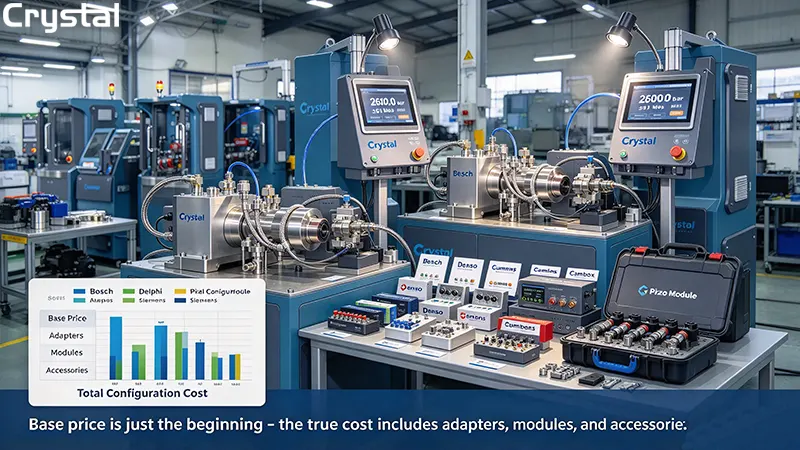
The acquisition cost is the most visible component of TCO, but it's also the one most often misunderstood. The "sticker price" of an injection pump test bench rarely reflects the actual configuration you need.
What Determines the Base Price
Entry-level injection pump test benches can start around $4,000, while full-featured industrial systems command significantly higher prices. The price difference reflects fundamental capability differences:
- Pressure capacity: Benches rated for 1,800 bar cost substantially less than those rated for 2,600 bar or 3,000 bar
- Motor power: Options range from 7.5kW to 22kW, with higher power delivering more stable speed control under load
- Number of test cylinders: Support for 6, 8, or 12 cylinders affects both price and throughput
- Automation level: Fully automatic control systems with multi-injector testing cost more than manual benches
The Hidden Configuration Costs
The base price frequently excludes the accessories required to test the pumps and injectors you actually service. A complete configuration may require:
- Brand-specific adapter kits for Bosch, Denso, Delphi, Siemens, and Cummins components
- Cambox systems for camshaftless pumps
- Piezoelectric injector testing modules (capacitance 0–12 μF, response time 0–999 μS)
- HEUI and EUI/EUP testing modules
- Additional drive couplings and mounting flanges
- Extended cabling for multi-injector test setups
A "bargain" injection pump test bench that requires thousands of dollars in additional accessories may cost more than a mid-range bench that includes them as standard.
How to Evaluate
Request a fully configured quotation that includes every accessory needed to test the specific pump families in your market. Compare not just the base price, but the price per test capability—the cost divided by the number of pump and injector types the configured bench can handle.
Factor 2: Maintenance and Consumable Costs
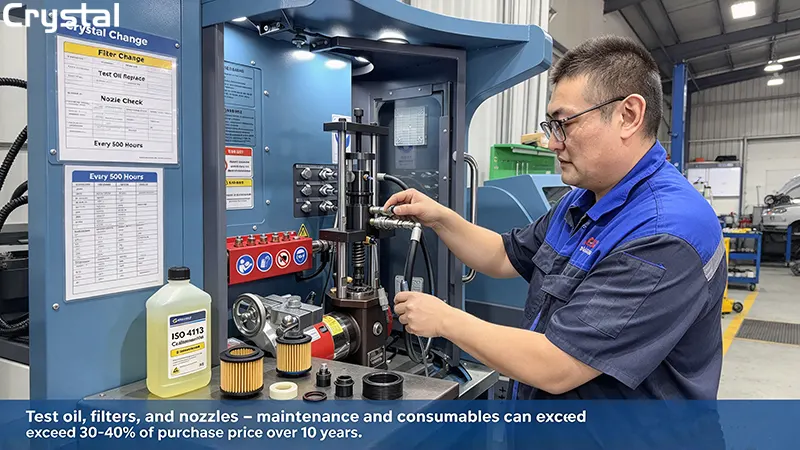
Maintenance is the largest ongoing cost of injection pump test bench ownership—and the one most frequently underestimated. Over a 10-year service life, maintenance and consumables can easily exceed 30–40% of the original purchase price.
Recurring Costs to Budget For
| Consumable / Service | Interval | Typical Cost Impact |
|---|---|---|
| Test oil (ISO 4113) | Every 400 hours or 500 pumps | Moderate — 50L tank capacity |
| Hydraulic oil (CVT) | First change at 200 hours, then every 1,200 hours | Moderate |
| Test oil filter | Every 200 pumps or every 2 months | Low but frequent |
| Test nozzles / orifice plates | As wear is detected | Moderate |
| Drive couplings and flanges | As wear is detected | Varies |
| Calibration service | Annually (or more frequently for high-volume shops) | Significant |
The Bosch Maintenance Standard
Bosch specifies that test oil and the test oil filter must be replaced after testing 200 injection pumps, or at the latest every 2 months. For a high-volume workshop testing 500 pumps per month, that's 2.5 filter changes per month—a cost that adds up quickly.
Why Fluid Quality Drives TCO
Using contaminated or incorrect test fluid is a false economy. A cloudy grey test oil indicates contamination that can damage injection pumps and test nozzles. A dark yellow but clear test oil indicates mixing with lubricating oil from the injection pumps. Both conditions accelerate wear on precision components, driving up repair and replacement costs.
How to Evaluate
Request the recommended maintenance schedule and consumable pricing list from each manufacturer. Calculate the annual consumable cost based on your expected testing volume. A bench with lower consumable costs may deliver lower TCO even if the purchase price is higher.
Factor 3: Calibration and Accuracy Maintenance Costs
Calibration is not optional—it's what keeps your injection pump test bench results trustworthy. But calibration frequency and cost vary dramatically between equipment tiers.
Why Calibration Frequency Matters to TCO
Test benches with high-quality, stable components hold their calibration longer. Entry-level benches with lower-grade sensors and mechanical controls may require calibration every 3–6 months, while industrial-grade benches with precision digital sensors may need calibration only annually.
The cost difference compounds:
- Entry-level bench: 2–4 calibrations per year × $X per calibration
- Industrial bench: 1 calibration per year × $Y per calibration
Even if $Y is higher than $X, the annual total may be lower for the industrial bench—and the accuracy is higher between calibrations.
Pressure and Flow Verification Components
Beyond scheduled calibration, injection pump test benches require periodic verification of:
- Standard test injectors — opening pressure must be maintained at 17.5 MPa
- Pressure gauges and sensors — deviation must not exceed ±0.5 MPa
- Flow meters — must maintain 0.1 ml accuracy or better
- Temperature sensors — must hold calibration fluid at 40 ± 2°C
Failure to maintain these components leads to inaccurate test results, misdiagnosed pumps, and costly comebacks—all of which inflate TCO.
How to Evaluate
Ask each manufacturer for:
- Recommended calibration intervals
- Cost of calibration service (in-house or factory)
- Availability of calibration reference standards
- Whether calibration can be performed on-site or requires shipping
Factor 4: Training, Labor, and Throughput Efficiency
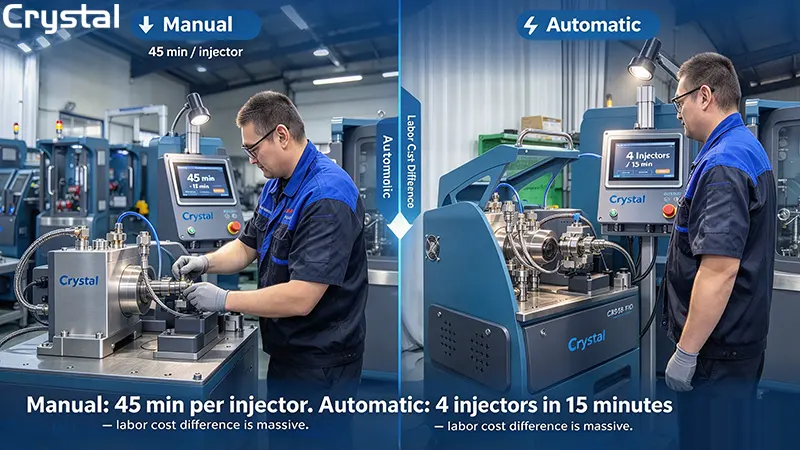
The labor cost associated with operating an injection pump test bench is a major—and frequently overlooked—component of TCO. A bench that takes twice as long to complete each test effectively doubles your labor cost per job.
Throughput Comparison
| Bench Type | Injector Testing Speed | Pumps Tested Per Day (est.) |
|---|---|---|
| Entry-level (manual) | 45–60 min per injector | 6–10 |
| Industrial (automatic) | 15 min per injector (4 simultaneously) | 20–30+ |
A modern industrial injection pump test bench like the Crystal CR918-PRO can test four injectors in under 15 minutes—a fraction of the time required for manual testing. The Bosch DCP 800 pump test bench offers rapid setup and average test times of around 30 minutes.
The Labor Math
If a technician costs $50 per hour fully loaded:
- Manual bench: 45 min per injector = $37.50 labor per injector
- Automatic bench: 15 min for 4 injectors = $3.13 labor per injector
Across 1,000 injectors per year, that's a labor cost difference of $34,370. Over a 10-year service life, the automatic bench saves over $340,000 in labor—far more than the price difference between the two machines.
Automation can reduce operator error by 50% compared to manual test benches, directly reducing the cost of comebacks and rework.
How to Evaluate
Ask for cycle time data for the specific injector and pump types you service most frequently. Calculate labor cost per test based on your local technician rates. Consider the annual throughput your workshop requires and whether the bench can meet that demand without overtime.
Factor 5: Downtime, Reliability, and Service Life
The cost of an injection pump test bench that sits idle—waiting for parts, repairs, or calibration—can exceed the cost of the machine itself. Downtime directly impacts your workshop's revenue-generating capacity.
Reliability and Service Life Comparison
| Factor | Entry-Level | Industrial-Grade |
|---|---|---|
| Expected service life | 3–5 years | 10+ years |
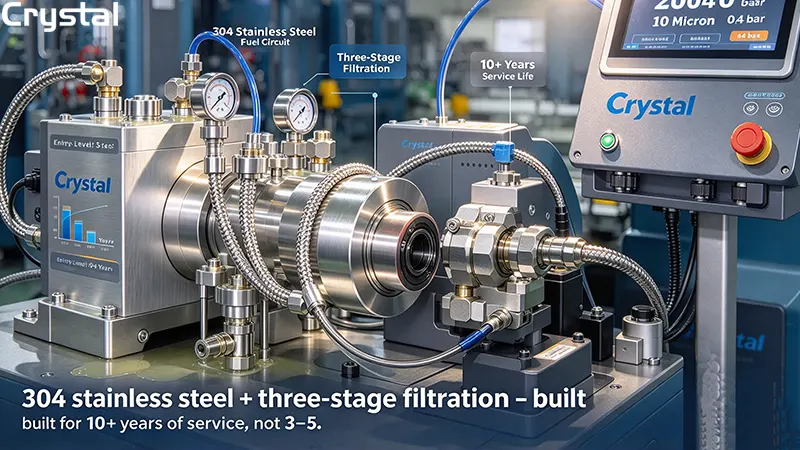
| Fuel circuit material | Carbon steel | 304 stainless steel |
| Filtration | Single-stage | Three-stage, 10-micron |
| Motor | 5.5–7.5 kW | 7.5–22 kW |
| Speed regulation | Mechanical | Frequency conversion |
| Warranty | 6–12 months | 12 months+ |
The Cost of Downtime
When an injection pump test bench fails, the consequences extend beyond the repair bill:
- Lost testing revenue — every day the bench is down is a day you cannot bill for testing services
- Delayed customer jobs — extending repair turnaround times and damaging reputation
- Expedited shipping costs — for urgent parts replacement
- Technician idle time — paying staff who cannot work
An industrial injection pump test bench, properly maintained, delivers consistent performance for 10 years or more. When amortized over that lifespan, the industrial machine often costs less per year than the entry-level alternative—even before accounting for downtime savings.
Parts Availability and Support
Consider:
- Spare parts stock — are common wear items readily available?
- Technical support — is it responsive and knowledgeable?
- Warranty terms — what is covered, and for how long?
- Software updates — can the bench be upgraded to support new models?
Crystal test benches are exported to more than 100 countries, underscoring their reliability and the company's commitment to after-sales support. Every Crystal bench comes with a detailed manual and training resources, ensuring your team can perform proper maintenance and troubleshoot issues quickly.
How to Evaluate
Ask for:
- Mean time between failures (MTBF) data, if available
- Recommended spare parts kit and its cost
- Warranty terms and what's covered
- Local service availability — can a technician reach you within 24–48 hours?
Factor 6: Resale Value and Future-Proofing
The final TCO factor is often ignored: what will your injection pump test bench be worth in 5 or 10 years—and will it still be capable of testing the pumps and injectors that come through your doors?
Resale Value
Industrial-grade injection pump test benches from established manufacturers retain value far better than entry-level or unbranded machines:
- Brand reputation — Crystal, Bosch, and other recognized brands command higher resale prices
- Capability — benches rated for 2,600 bar retain value better than 1,800 bar benches as the market shifts to higher pressures
- Condition — well-maintained benches with service records sell faster and at higher prices
- Modularity — benches that can be upgraded with new modules appeal to a wider range of buyers
Future-Proofing Against Technology Shifts
The diesel industry is evolving rapidly:
- Injection pressures have progressed from 1,350 bar to 2,500 bar, with 3,000 bar designs under development
- Piezoelectric injectors are becoming more common
- Alternative fuels — biodiesel, HVO, hydrogen blends — require fuel-compatible materials
- AI-driven diagnostics are becoming standard
An injection pump test bench that cannot adapt to these shifts will need to be replaced sooner—driving up TCO.
The Crystal CRS1000 Modular Advantage
The Crystal CRS1000 series features a modular design that allows the bench to be configured for testing high-pressure common rail injectors, high-pressure common rail pumps, EUI and EUP systems, HEUI systems, and medium-pressure actuating pumps. Users can select a single testing function or combine two or even three functions in one system.
This modularity delivers two TCO benefits:
- Lower initial investment — buy only the modules you need today
- Extendable capability — add modules as your service offering expands, avoiding premature replacement
How to Evaluate
Ask:
- What is the expected resale value after 5 years?
- Can the bench be upgraded to support new injector types or higher pressures?
- Are additional modules available, and at what cost?
- Does the manufacturer have a history of supporting legacy equipment with parts and software updates?
Summary: The 6 TCO Factors at a Glance
| Factor | Key Consideration | Impact on TCO |
|---|---|---|
| 1. Purchase Price & Configuration | Base price plus required accessories | Upfront capital cost |
| 2. Maintenance & Consumables | Test oil, filters, nozzles, calibration | 30–40% of purchase price over 10 years |
| 3. Calibration & Accuracy | Frequency and cost of calibration services | Varies by equipment tier |
| 4. Training, Labor & Throughput | Tests per hour × labor rate | Largest ongoing cost |
| 5. Downtime & Reliability | Service life, parts availability, support | Revenue impact of idle time |
| 6. Resale Value & Future-Proofing | Brand, capability, modularity | End-of-life asset recovery |
The Crystal Automation TCO Advantage
Crystal Automation's injection pump test benches are engineered to minimize total cost of ownership across all six factors:
Purchase and configuration:
- Modular CRS1000 series lets you buy only what you need today
- Comprehensive accessory ecosystem supports Bosch, Denso, Delphi, Siemens, and Cummins components
Maintenance and consumables:
- 304 stainless steel fuel circuits resist corrosion and extend fluid life
- Three-stage filtration system with 10-micron high-pressure filtration reduces contaminant-related wear
- Recommended maintenance intervals are clearly documented, and consumables are readily available
Calibration and accuracy:
- High-precision sensors maintain 0.1 ml flow accuracy and ±0.1 MPa pressure accuracy
- Digital displays enable in-house verification between professional calibrations
Throughput and labor:
- CR918-PRO tests four injectors in under 15 minutes with fully automatic control
- One-click automatic cleaning eliminates manual disassembly time
- Automatic generation of all major calibration codes (QR, IQA, IMA, ISA, c2i, c3i, ICC)
Reliability and service life:
- Built for 10+ years of service with proper maintenance
- Motor power options from 7.5kW to 22kW with frequency conversion speed regulation
- Comprehensive electrical protection and auto-protecting functions
- Exported to more than 100 countries
Resale value and future-proofing:
- Modular design supports capability expansion
- Compatible with current and emerging fuel types
- Recognized brand with strong market presence
Conclusion
The purchase price of an injection pump test bench is just the beginning of the financial story. The true cost of ownership is determined by six factors: acquisition and configuration, maintenance and consumables, calibration, labor and throughput, downtime and reliability, and resale value.
When all six factors are considered, the economics of buying a cheap bench versus investing in an industrial-grade injection pump test bench become clear. The initial savings from a low-cost purchase are typically erased within the first two to three years by higher maintenance costs, slower throughput, and greater downtime.
For workshops that intend to remain competitive as diesel technology advances, the question is not whether you can afford an industrial-grade injection pump test bench — it's whether you can afford the total cost of owning anything less.
Written by
Taian Crystal Automation Co., Ltd.
Editor Chen
www.crystalautotest.com
WhatsApp:+86 185 9528 8526
Email:martin@crystalautotest.com
- 5 Features That Separate Entry-Level from Industrial Injection Pump Test Benches
- Top 6 Injection Pump Test Bench Problems and Troubleshooting Guide
- Common Rail Test Bench Buying Guide: 7 Questions Every Diesel Workshop Must Ask
- 7 Methods of Power Speed Regulation for High-Pressure Common Rail Test Bench

Crystal Automation is a leading Chinese manufacturer of common rail test benches and fuel injector test benches.