Top Multi-Brand Common Rail Injector Test Bench: Can It Test Bosch, Denso, Delphi & Siemens?
Walk into any modern diesel workshop and you will see a familiar scene: a Ford Transit with a Bosch common rail system parked beside a Toyota Hilux running Denso injectors, while a Volkswagen or Renault waits for Delphi or Siemens/VDO piezo service on the other side of the bay. European, Asian, and American vehicles share the same lifts, the same technicians, and the same diagnostic bay.
The question every workshop owner must answer is simple: can one common rail injector test bench handle all of them?
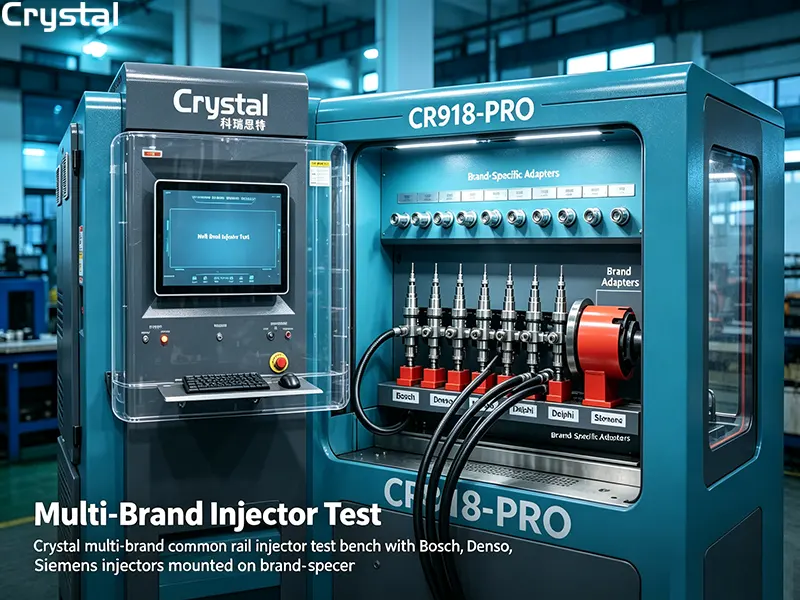
This is not a "nice to have" question. Bosch and Delphi together account for roughly 70% of the global diesel common rail injection system market, Denso dominates the Asian OEM landscape, and Siemens/VDO's piezoelectric technology is irreplaceable in specific European vehicle platforms. A test bench that covers only one or two of these brands does not just limit your capability—it routes three or four brands' worth of work to your competitors every week. And the real barrier to genuine multi-brand compatibility goes far beyond swapping a mounting fixture.
Why Covering All Four Brands Is the Minimum for a Modern Workshop
Start with the demand side. The global diesel common rail injection system market was valued at approximately RMB 27.18 billion (about USD 3.8 billion) in 2025, with the top two suppliers holding roughly 70% of the market. The remaining 30% is distributed among Denso, Siemens/VDO, Cummins, Caterpillar, and other suppliers. But for a workshop serving end customers, the vehicle mix does not follow market share percentages. A Volkswagen piezo injector, a Toyota Denso injector, and a Ford Transit Bosch injector can all appear on the same week's work order.
Now look at the supply side. An industry judgment that is frequently cited is that equipping a workshop with dedicated test benches for Bosch, Delphi, Denso, and Siemens separately is financially unviable for 90% of independent repair shops. That is precisely why multi-brand test benches exist: to cover four major injector families with the capital expenditure of a single machine.
But "coverage" has depth. Physically fitting an injector into a fixture is not the same as being able to test it. Measuring flow is not the same as generating a valid calibration code. Genuine multi-brand compatibility requires breaking down the independent technical requirements each brand imposes on the test bench.
Brand-by-Brand: What Each Manufacturer Demands from a Test Bench
Bosch: The Largest Volume, the Most Complex Coding System
Bosch is the world's largest manufacturer of common rail injectors by installed volume, covering passenger cars, light commercial vehicles, heavy trucks, and industrial engines. Bosch injectors span multiple product generations: CRI 2.18, CRI 2.20, and CRI 3 series solenoid injectors, plus piezoelectric types.
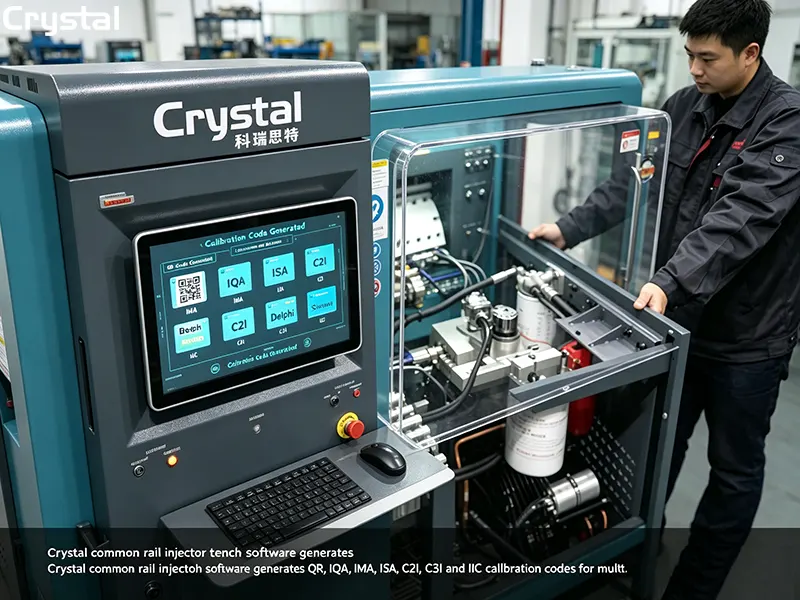
The test bench requirement concentrates on coding. Bosch solenoid injectors require IQA and IMA codes, Bosch piezo injectors require IMA/ISA codes, and there are additional formats including QR, c2i, c3i, and ICC (VD0). Some test benches require separate configuration to cover the full Bosch piezo coding set. If a bench can measure flow but cannot generate Bosch codes, the Bosch repair is incomplete—the ECU receives no correction data, and the injector may perform no better in the engine than it did before the repair.
Denso: Independent Coding Format, Database Depth Is the Threshold
Denso injectors dominate Asian-brand vehicles and are increasingly common in European and North American applications. Denso's core coding format is the QR code, which both solenoid and piezoelectric Denso injectors rely on for ECU matching.
Denso's second requirement is database depth. Denso injectors have a vast number of model variants, and injectors that look identical externally may have different flow characteristics and coding parameters. A test bench database that covers only a few hundred mainstream models will either fail to identify a non-mainstream variant or fall back to a near-equivalent model—and the risk in the latter case is that code generation is based on an approximation rather than the injector's actual specification. An industry benchmark for a "sufficient" database is 4,000+ injector profiles, with some premium platforms extendable to 6,000 or even 7,600+ profiles.
Delphi: C2i/C3i/C4i Codes, Proprietary Mounting Geometry
Delphi common rail systems are widely used in European vehicles, particularly Ford, Renault, and PSA Group models. Delphi's coding formats are C2i, C3i, and C4i, none of which are interchangeable with Bosch or Denso formats.
Delphi's challenge to the test bench is more mechanical. Delphi injectors have a different mounting geometry from Bosch and require dedicated adapters. In addition, Delphi injectors' electrical characteristics—coil resistance, inductance, response time—differ from Bosch solenoid injectors. This means the bench's control software must be able to switch drive parameters by brand, rather than using one unified current waveform to drive every solenoid injector.
Siemens/VDO: The "Extra Dimension" of Piezoelectric Testing
Siemens/VDO common rail systems primarily serve Volkswagen Group vehicles, and their technical signature is the piezoelectric injector. Piezo and solenoid injectors have fundamentally different test logic: solenoid injectors are evaluated through coil current and BIP response, while piezo injectors are evaluated through capacitance, insulation resistance, and charge control.
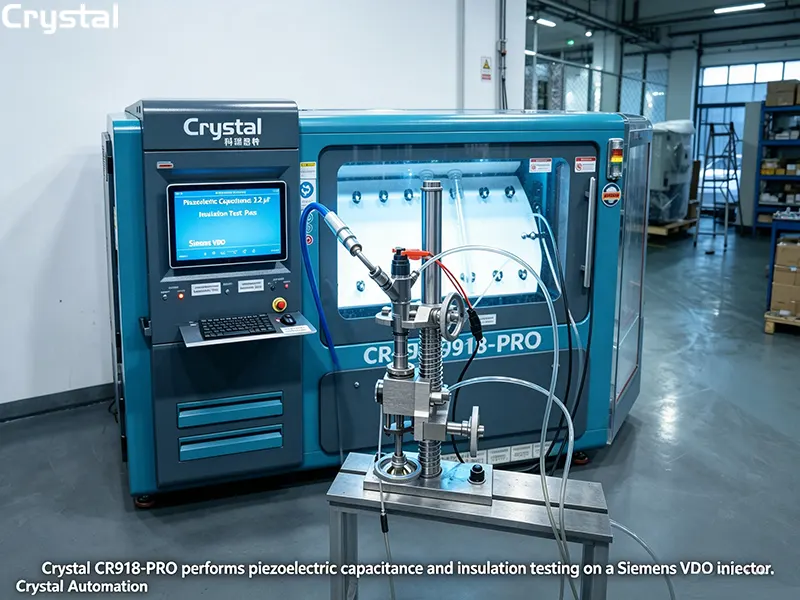
Piezo injector capacitance is typically in the microfarad range (commonly covering 0–12 μF). A capacitance value outside specification indicates possible delamination, cracking, or contamination within the piezo ceramic stack—problems that are completely invisible in external appearance and mechanical dimensions. The test bench must provide capacitance measurement, insulation testing, and resistance testing to deliver a complete electrical health assessment for Siemens/VDO piezo injectors. Siemens' coding format is IIC, distinct from Bosch, Denso, and Delphi.
Coding Capability: The "Last Mile" of Multi-Brand Compatibility
The technical differences across the four brands ultimately converge on a single benchmark: can the test bench generate correction codes that meet ECU specifications for every brand?
Industry guidance is direct on this point: without coding capability, you cannot correctly calibrate Bosch, Delphi, Siemens, or Denso injectors—the vehicle will run poorly or fail to start. This is not a "nice to have" feature; it is a necessary condition for a complete repair.
A qualified multi-brand common rail injector test bench should cover at least the following coding formats:
| Brand | Required Coding Formats | Test Type |
|---|---|---|
| Bosch | IQA, IMA, ISA, QR, c2i, c3i, ICC (VD0) | Solenoid + Piezo |
| Denso | QR code | Solenoid + Piezo |
| Delphi | C2i, C3i, C4i | Solenoid |
| Siemens/VDO | IIC | Piezo |
It is worth noting that some test benches marketed as "multi-brand" require separate unlock fees per brand for code generation, or rely on ongoing license subscriptions. When selecting a bench, confirm whether coding capability is built into the machine or requires an additional subscription—the latter continuously erodes the profit margin per repair over the equipment's service life.
Price and Return on Investment: How Much More Does Multi-Brand Cost, and How Much Does It Save?
Multi-brand test bench prices span a wide range. Based on 2026 market data, entry-level Chinese-manufactured benches fall in the USD 5,000–10,000 range; mid-range platforms such as the Hartridge AVM2-PC are priced at USD 12,000–18,000; premium platforms such as the Bosch EPS 815 run USD 18,000–25,000; and fully automated configurations can exceed USD 15,000 or significantly more. The Crystal CR918-PRO carries a published price of approximately USD 14,590 through some channels, positioning it in the upper-mid range.
On purchase price alone, a multi-brand bench appears more expensive than "starting with a single brand." But the hidden cost of a single-brand approach lies in the accumulation of dedicated fixtures. Real-world industry cases show that each brand-specific mounting tool set for a dedicated test bench costs around DKK 3,000 (several hundred US dollars), and covering multiple brands means multiple fixture sets purchased in sequence. More importantly, 90% of independent workshops cannot afford to equip separate dedicated test benches for each brand—so in practice, "buy single-brand now, add later" often means "never add."
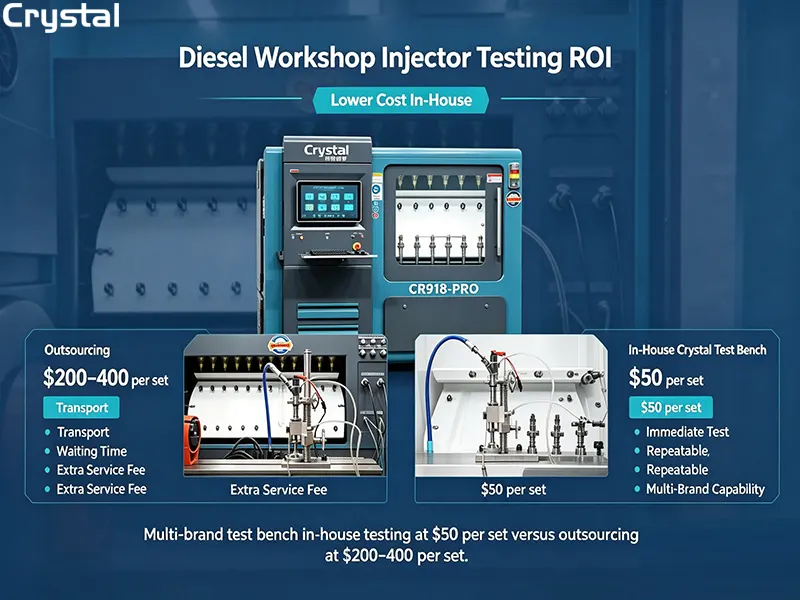
On return on investment, an industry calculation framework that is frequently cited runs as follows: without a test bench, injector diagnostics are outsourced at approximately USD 200–400 per set, with a turnaround time of 3–7 days. With an in-house test bench, internal testing cost drops to approximately USD 50 per set, with same-day results, and per-job repair revenue can rise from USD 500 to USD 800–1,200, because the workshop can capture work that would otherwise be lost. For a busy diesel workshop, the typical payback period is 12–24 months. The direct contribution of multi-brand coverage is that it enlarges the "workload denominator" in the payback calculation—every additional brand covered means more injectors enter the in-house testing workflow rather than flowing to competitors.
The 5-Step Checklist for Verifying Multi-Brand Compatibility
Before signing a purchase order, the following five steps separate "genuinely compatible" from "brochure-compatible."
Step 1: Test with your own injectors on-site. Remove one injector of each brand from vehicles you actually service—one Bosch CRI, one Denso, one Delphi, and one Siemens piezo—and ask the supplier to run a complete test sequence on each. Do not accept the excuse that "this model needs special configuration"; a genuine multi-brand platform should complete the work within its standard workflow.
Step 2: Demand to see the coding output for each brand. Confirm that the code format matches what the ECU expects. Bosch IMA and Denso QR are different formats; Delphi C3i and Siemens IIC are not the same thing either. Failed or malformed code generation means the repair loop breaks at the final step.
Step 3: Confirm the adapter list and pricing. Multi-brand testing requires multi-brand fixtures. Ask the supplier for a complete adapter list and clarify which items are included in the base price and which require additional purchase. A missing fixture may only be discovered three months after delivery—at which point a job that could have been accepted must be declined.
Step 4: Check database coverage. Ask how many injector profiles the database contains and whether it covers the models your workshop actually encounters. 4,000+ profiles is a reasonable benchmark; if the supplier can only offer a vague "covers mainstream brands" statement without a verifiable profile list, the database depth is questionable.
Step 5: Request regional customer references. Ask for contact details of workshops in your region, servicing a similar vehicle mix, that use the platform to test all four brands. A supplier confident in its multi-brand capability will provide references; one that hesitates is telling you something.
Crystal CR918-PRO: An Engineering Reference Point for Multi-Brand Compatibility
The design of Crystal Automation's CR918-PRO serves as a reference for the technical requirements outlined above:
- Brand coverage: Supports Bosch, Denso, Delphi, Siemens/VDO, Cummins, and Caterpillar injectors, covering both solenoid and piezoelectric types.
- Code generation: Automatically generates major correction codes including QR, IQA, IMA, ISA, c2i, c3i, and ICC (VD0), covering the coding requirements of all four brands.
- Piezo testing capability: Supports capacitance measurement, insulation testing, and resistance testing for piezo injectors, matching the electrical diagnostic requirements of Siemens/VDO and Bosch piezo injectors.
- Pressure and flow precision: 2,600 bar pressure capability, ±0.1 MPa control accuracy, and 0.1 ml flow measurement accuracy—providing a reliable measurement foundation for code generation.
- Database: Built-in thousands of injector profiles, expandable to cover mainstream model variants.
- Automation: Supports multi-injector parallel testing and automated test sequences, reducing the risk of setup errors when operators switch between brands.
Crystal's positioning is not "the cheapest option," but rather complete multi-brand capability within the mid-range price bracket—coding built in, piezo testing in place, and an expandable adapter system. For workshops facing four brands every week that do not need to purchase a dedicated test bench for each brand, this is a configuration that balances capital efficiency against coverage breadth.
Frequently Asked Questions (FAQ)
Can one multi-brand common rail injector test bench really test Bosch, Denso, Delphi, and Siemens at the same time?
Physically, yes—but only if the test bench has three things simultaneously: brand-specific adapters (solving the mounting interface), brand-specific code generation (solving ECU matching), and piezoelectric testing capability (solving Siemens/VDO and some Bosch piezo injectors). A bench that satisfies only one or two of these is not a genuine multi-brand platform.
Why is coding capability more critical than flow measurement?
Flow measurement tells you "what state the injector is in now"; code generation tells the ECU "how to compensate for this injector's individual characteristics." Without coding, even accurate flow data leaves the ECU controlling the engine with the old parameters—and the repair outcome is not reflected in vehicle performance.
How much more does a multi-brand test bench cost than a single-brand unit?
The purchase price itself may be 30%–80% higher. But the hidden cost of the single-brand approach is this: to cover four brands, you either buy multiple dedicated test benches (unviable for 90% of independent workshops) or continue to outsource or decline work whenever another brand arrives. The value of a multi-brand bench is not that it is "cheaper"—it is that a single machine's capital expenditure blocks four brands' worth of work from flowing to competitors.
What additional capabilities are required for piezoelectric injector testing?
Piezo injectors require capacitance measurement (typically in the microfarad range), insulation resistance testing, and charge-controlled drive—logic that is fundamentally different from the coil current drive used for solenoid injectors. A bench without these capabilities cannot deliver an effective electrical health assessment for Siemens/VDO piezo injectors or Bosch piezo injectors.
How can I avoid buying a "multi-brand" test bench that actually covers only two brands?
Insist on an on-site demonstration using your own injectors—one from each of the four brands, each run through the complete test and code generation sequence. Ask to see the database model list and the coding output format. Do not accept verbal claims of "support"; accept only verifiable output.
Conclusion
"Can one test bench test Bosch, Denso, Delphi, and Siemens?" The answer is yes—but the quality of that "yes" depends on the completeness of three dimensions: adapters, coding, and piezo testing. Physical mounting is the entry point, code generation is the closed loop, and piezo capability is the ceiling.
In a workflow that faces four brands every week, a test bench covering only one or two brands is not a "good enough starting point"—it is an asset that continuously creates bottlenecks. The real value of multi-brand compatibility is not in saving on a single purchase, but in ensuring that every common rail injector test bench entering the workshop—regardless of brand—becomes work that can be completed in-house, rather than a referral slip handed to a competitor.
Written by
Taian Crystal Automation Co., Ltd.
Editor Chen
WhatsApp:+86 185 5385 2072
Email:martin@crystalautotest.com
- Top 7 Factors to Choose a Reliable Common Rail Injector Test Bench for Diesel Repair Shops
- Top 9 Must-Know Injection Pump Test Bench Maintenance Tasks for Every Diesel Workshop
- The Nine Major Advantages of Using Electronic Speed Control on Common Rail Injector Test Benches
- Multi-functional Common Rail Test Bench vs Single-Function Unit: Cost & Performance Analysis by Crystal Automation

Crystal Automation is a leading Chinese manufacturer of common rail test benches and fuel injector test benches.