Top 7 Ways a Multi-functional Common Rail Test Bench Boosts Repair Profits
For diesel workshop owners, the question is never simply "should we buy a test bench?" The real question is: which test bench converts capital into profit fastest—and keeps converting it for the next decade?
A multi-functional common rail test bench answers that question differently from a single-purpose machine. It is not just a diagnostic tool; it is a revenue platform. Every capability it adds, every job it lets you accept instead of decline, every hour of technician time it saves—these are direct contributions to repair profits.
The global fuel injector tester market is expanding from USD 0.8 billion in 2025 to USD 1.6 billion by 2036, a clear signal that precision injector and pump testing has moved from specialist niche to core workshop service. Meanwhile, research has found that 70% of aftermarket diesel injectors fail comprehensive testing and would cause significant engine performance issues if installed. That statistic is both a warning and an opportunity: the workshops equipped to verify every component capture the work that others cannot safely handle.
Here are the top 7 ways a multi-functional common rail test bench boosts repair profits—with the mechanics of each profit path explained.
Way 1: Expand Service Capability and Stop Turning Away Work
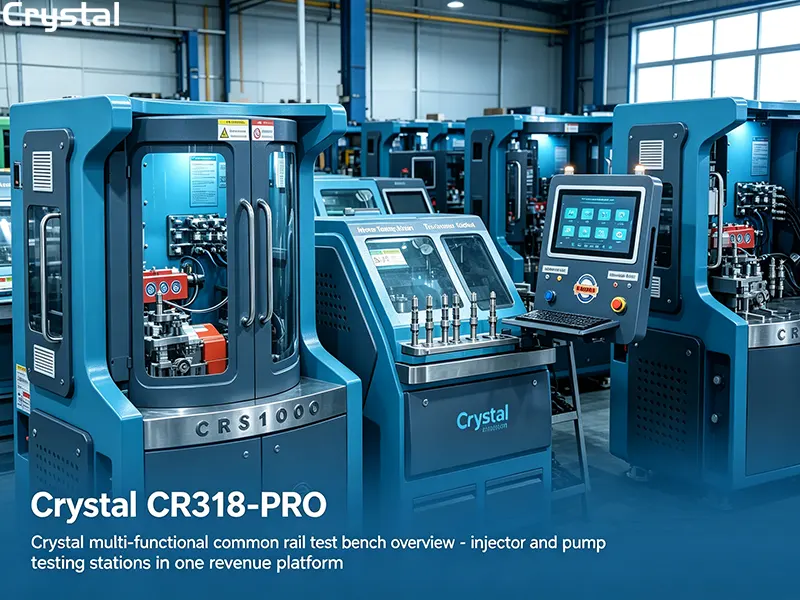
The first and most direct profit driver is capability. A multi-functional common rail test bench allows your workshop to accept jobs it would otherwise decline or outsource.
The Revenue Mechanism
A single-function injector bench tests injectors. When a customer arrives with a high-pressure common rail pump, an EUI/EUP unit, or a HEUI injector, that job leaves your workshop—either rejected outright or sent to a competitor. Every declined job is lost revenue, and worse, it trains the customer to take future work elsewhere.
A multi-functional platform covers the component families that actually arrive at a modern diesel workshop:
- High-pressure common rail injectors (solenoid and piezoelectric)
- High-pressure common rail pumps (Bosch CP1/CP3/CP4, Denso HP series, Delphi)
- EUI and EUP systems
- HEUI injectors and pumps (CAT C7, C9, 3126, 3406, and Ford 6.0L/7.3L)
- Medium-pressure actuating pumps
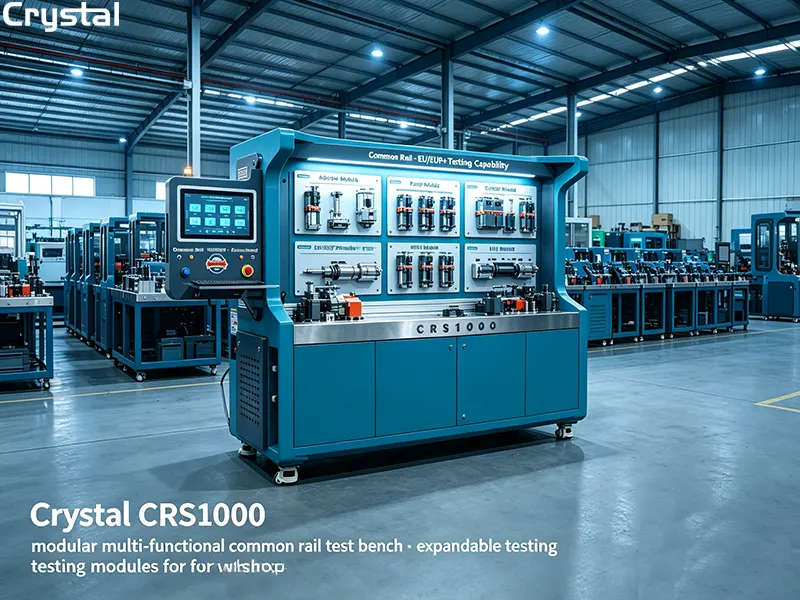
Crystal Automation's CRS1000 series is explicitly engineered around this breadth: a modular design that supports common rail injectors, high-pressure pumps, EUI/EUP, HEUI, and medium-pressure actuating pumps on one integrated platform. The CR918-PRO extends the same philosophy with compatibility across CR pumps, CR injectors, EUI/EUP, and CAT HEUI injectors.
The Profit Impact
Every accepted job that would previously have been declined is incremental revenue with no additional equipment cost. For a workshop handling a mixed European/Asian/American vehicle base, the difference between a single-function and multi-functional bench can be the difference between serving 60% of incoming fuel system work and serving 95%.
Way 2: Increase Throughput and Bill More Hours Per Day
Time is the workshop's inventory. A multi-functional common rail test bench increases the number of jobs processed per day—directly increasing billable output without adding staff.
The Throughput Data
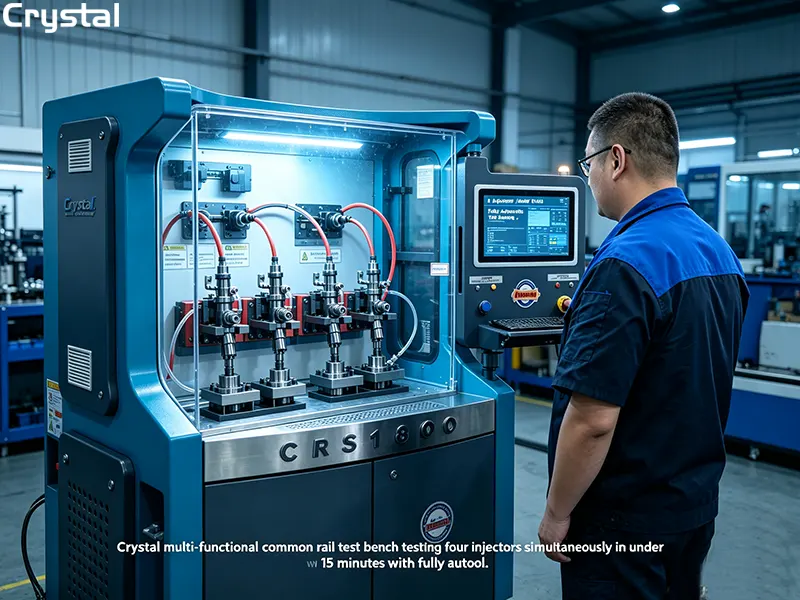
Crystal's CR918-PRO can test four injectors in under 15 minutes with fully automatic control. Compare that to manual or semi-manual testing at 30–45 minutes per injector. The throughput difference is not marginal—it is transformational.
The Labor Math
Assume a fully loaded technician cost of $50 per hour:
| Testing Method | Time Per Injector | Labor Cost Per Injector |
|---|---|---|
| Manual / single-function bench | 45 minutes | $37.50 |
| Multi-functional automatic bench (4 at once) | ~3.75 minutes effective | ~$3.13 |
Across 1,000 injectors per year, that is a labor cost difference of roughly $34,000—and that figure does not include the additional revenue generated by freeing technician hours for other billable work.
Why Multi-Functional Matters Here
Throughput is not only about speed. A multi-functional platform eliminates the machine-switching, re-setup, and re-calibration that occurs when a workshop moves a component between separate single-purpose benches. The workflow stays on one platform, under one software environment, with one set of test fluid conditions.
Way 3: Automate Calibration Code Generation and Eliminate Rework
The third profit path is quality. Rework destroys profit margins—and calibration code failures are one of the most common causes of diesel injector comebacks.
The Problem
Modern common rail injectors require correction codes (IQA, IMA, ISA, QR, c2i, c3i, ICC) for the ECU to compensate for each injector's individual characteristics. If a workshop cannot generate these codes—or generates them from inaccurate measurements—the injector may "pass" on the bench but perform incorrectly in the engine. The customer returns. The job is redone at the workshop's cost.
The Multi-Functional Solution
A properly equipped multi-functional common rail test bench generates calibration codes automatically as part of the test workflow. Crystal's CR918-PRO automatically generates QR, IQA, IMA, ISA, c2i, c3i, and ICC (VD0) codes, eliminating the need for a separate coding device and removing the transcription errors that occur when codes are manually transferred.
The Profit Impact
Rework consumes technician time, parts, and—most expensively—customer trust. Eliminating code-related comebacks converts what would have been a loss-making redo into a clean, profitable job. Over a year, even a modest reduction in comeback rate has a measurable effect on net repair profit.
Way 4: Lower Total Equipment Investment Versus Multiple Single-Purpose Benches
Multi-functionality is not only an operational advantage—it is a capital efficiency advantage.
The Cost Comparison
Matching the capability of one multi-functional platform with single-purpose machines typically requires three to four separate benches:
- One injector test bench
- One pump test bench
- One EUI/EUP test bench
- One HEUI test bench
The combined purchase cost, floor space, training burden, and maintenance load of these separate machines typically exceeds the cost of a single multi-functional platform—often substantially.
The TCO Data
Over a ten-year service life, the total cost of ownership gap is significant. A multi-functional platform can deliver 30–50% lower total cost of ownership compared to purchasing and maintaining three to four single-function units, driven by reduced floor space requirements, a single maintenance and calibration schedule, and consolidated spare parts inventory.
The Profit Impact
Capital not spent on redundant equipment is capital available for other profit-generating investments—additional technician training, expanded service bays, or marketing. And the lower ongoing maintenance cost directly improves net margin on every job the bench supports.
Way 5: Reduce Downtime Through Consolidated Maintenance and Higher Reliability
Downtime is the silent profit killer. A test bench that is out of service generates zero revenue while continuing to consume fixed costs.
The Reliability Difference
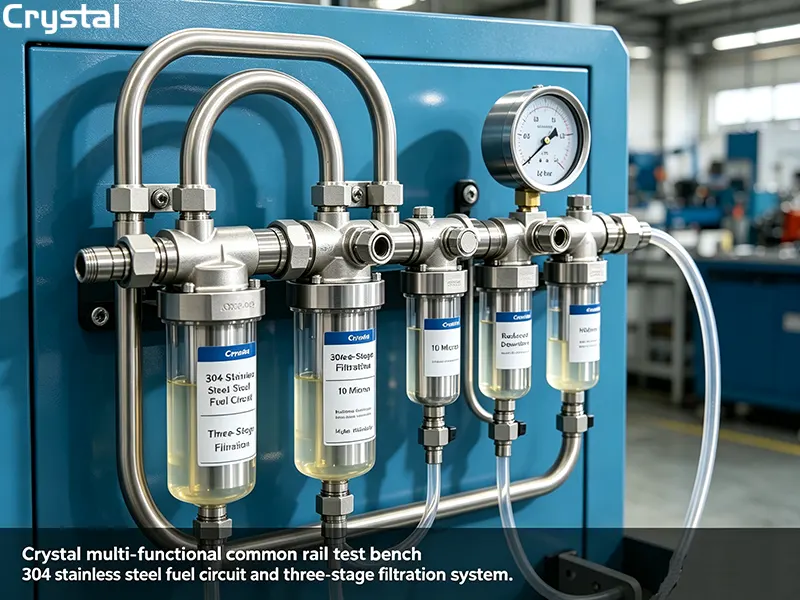
Multi-functional industrial platforms are typically built to a higher durability standard than entry-level single-purpose benches. Crystal's platforms, for example, specify 304 stainless steel fuel circuits for corrosion resistance and a three-stage filtration system with 10-micron high-pressure filtration—both directly targeting the contamination pathways that erode accuracy and cause premature component failure.
The Maintenance Consolidation
Maintaining three or four separate benches means three or four calibration schedules, three or four filter replacement cycles, three or four sets of consumables, and three or four potential failure points. A single multi-functional platform consolidates all of this into one maintenance program—reducing both the frequency of service interruptions and the administrative burden of managing them.
The Profit Impact
Every hour of avoided downtime is an hour of preserved billable capacity. For a workshop operating near capacity, downtime does not merely delay revenue—it displaces it, because customers who cannot be served promptly take their work elsewhere.
Way 6: Accelerate Technician Training and Improve Operator Flexibility
Skilled diesel technicians are scarce and expensive. A multi-functional common rail test bench reduces the training burden and increases the flexibility of the technicians you already have.
The Training Burden
Every separate machine requires its own training program: controls, software, maintenance procedures, safety protocols. Three or four machines multiply that burden. A single multi-functional platform concentrates training into one system, one interface, and one workflow.
Crystal's platforms include comprehensive manuals and training resources, and the CR918-PRO's automated test sequences reduce the depth of manual intervention required—lowering the skill threshold for routine testing while preserving the precision that expert diagnosis demands.
The Flexibility Gain
With a single platform, any trained technician can test injectors in the morning and pumps in the afternoon without switching workstations or re-learning a different machine. This flexibility improves labor utilization—the same payroll supports a broader service mix.
The Profit Impact
Faster training means new hires become productive sooner. Greater flexibility means less idle time waiting for "the person who knows that machine." Both translate directly into improved labor efficiency and higher gross margin per job.
Way 7: Future-Proof the Workshop Against Technology Shifts
The final profit path is strategic. Diesel technology is not static—and a test bench that cannot evolve becomes a stranded asset.
The Technology Trajectory
Injection pressures have progressed from 1,350 bar in first-generation common rail systems to 2,500 bar in today's fourth-generation systems, with 3,000 bar designs under development. Piezoelectric injectors are increasingly common. Alternative fuels—biodiesel, HVO, hydrogen blends—are entering the market and demanding fuel-compatible materials.
The Modular Advantage
A modular multi-functional platform can be expanded as the market shifts. Crystal's CRS1000 series allows users to select a single testing function or combine two or even three functions in one system—and to add capability as their service offering grows. This modularity protects the original investment: the platform does not become obsolete when a new component family enters the workshop's workload.
The Profit Impact
Future-proofing protects both capital and market position. A workshop that can test the next generation of injectors and pumps captures the work as it emerges—while competitors with obsolete equipment either decline the job or invest in replacement machines. Over a decade, the ability to evolve with the technology is itself a profit driver.
Summary: The 7 Profit Paths at a Glance
| Way | Profit Mechanism | Key Data |
|---|---|---|
| 1. Expanded service capability | Accept jobs previously declined or outsourced | Covers CR injectors, CR pumps, EUI/EUP, HEUI |
| 2. Higher throughput | Bill more jobs per day without adding staff | 4 injectors in under 15 minutes |
| 3. Automated calibration codes | Eliminate rework and comebacks | QR, IQA, IMA, ISA, c2i, c3i, ICC generated automatically |
| 4. Lower equipment investment | Avoid 3–4 single-purpose machines | 30–50% lower 10-year TCO |
| 5. Reduced downtime | Preserve billable capacity | 304 stainless steel; three-stage filtration |
| 6. Faster training, flexible labor | Improve gross margin per job | One platform, one training program |
| 7. Future-proofing | Capture emerging work, protect capital | Modular expansion capability |
The Crystal Automation Multi-Functional Advantage
Crystal Automation's multi-functional platforms—the CR918-PRO and CRS1000 series—are engineered around the profit paths described above:
- Broad component coverage across common rail injectors, high-pressure pumps, EUI/EUP, HEUI, and medium-pressure actuating pumps
- 2,600 bar pressure capability with ±0.1 MPa accuracy for modern common rail diagnostics
- 0.1 ml flow measurement accuracy to support valid calibration code generation
- Automatic generation of all major correction codes (QR, IQA, IMA, ISA, c2i, c3i, ICC)
- Four-injector testing in under 15 minutes with fully automatic control
- 304 stainless steel fuel circuits and three-stage 10-micron filtration for durability
- Modular design that supports capability expansion as the market evolves
- 12-month warranty and after-sales support across more than 100 export markets
Conclusion
A multi-functional common rail test bench boosts repair profits not through a single mechanism, but through seven reinforcing ones: it expands what you can accept, increases how much you can process, improves the quality of what you deliver, lowers what you spend on equipment, reduces the time you lose to downtime, makes your technicians more productive, and protects your investment as the technology moves forward.
For diesel workshop owners evaluating equipment, the question is not whether a multi-functional platform costs more than a single-function unit—it usually does, on the day of purchase. The question is whether the seven profit paths above outweigh that difference over the equipment's service life. For most professional workshops serving modern diesel vehicles, the answer is decisively yes.
Written by
Taian Crystal Automation Co., Ltd.
Editor Chen
WhatsApp:+86 185 5385 2072
Email:martin@crystalautotest.com
- Top Multi-Brand Common Rail Injector Test Bench: Can It Test Bosch, Denso, Delphi & Siemens?
- Top 10 Parameters to Verify When Buying a Fuel Injection Pump Test Bench
- Top 7 Common Rail Injector Test Bench Maintenance Tasks to Minimize Machine Downtime
- Top Common Rail Injector Test Bench Guide: Working Principle & 7 Key Testing Parameters

Crystal Automation is a leading Chinese manufacturer of common rail test benches and fuel injector test benches.