Top 10 Parameters to Verify When Buying a Fuel Injection Pump Test Bench
Purchasing a fuel injection pump test bench is one of the most consequential equipment decisions a diesel workshop will ever make. The wrong choice doesn't just cost money upfront—it costs accuracy, throughput, and customer trust for years afterward. The global fuel injector tester market alone is expanding from USD 0.8 billion in 2025 to USD 1.6 billion by 2036, a reflection of how central precision testing has become to modern diesel service.
Yet a test bench is not a commodity. Two machines with similar exteriors can differ dramatically in pressure capability, measurement accuracy, calibration code support, and long-term reliability. What separates a sound investment from an expensive mistake is the discipline of verifying the right parameters before signing a purchase order.
Here are the top 10 parameters to verify when buying a fuel injection pump test bench—each one a question that separates capability from marketing.
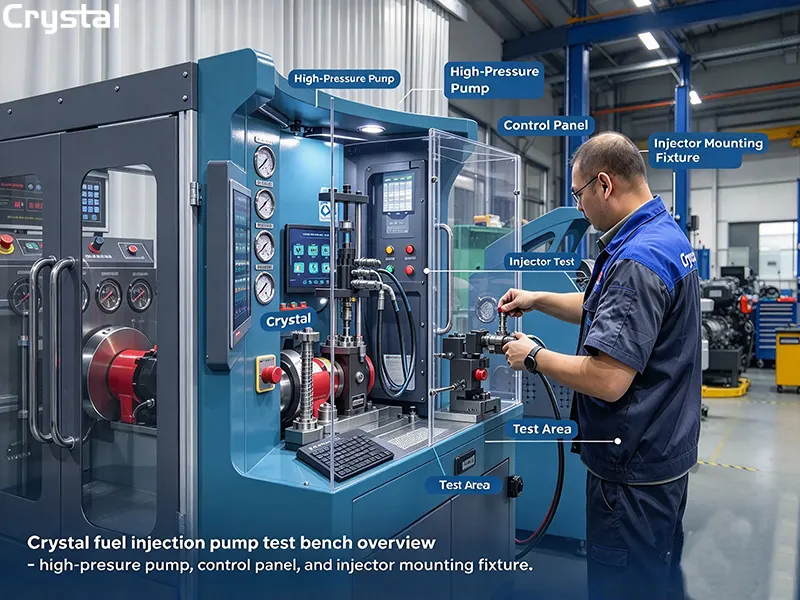
Parameter 1: Pressure Capability and Pressure Control Accuracy
Pressure is the reference against which every other measurement is judged. If a fuel injection pump test bench cannot generate and hold the pressures that modern pumps and injectors actually operate at, its diagnostic value is fundamentally limited.
What to Verify
Modern common rail systems operate at 2,000 bar and above, with 2,500 bar and higher required for the latest piezoelectric systems. Bosch's new DCP 800 pump test bench, for example, tests common-rail pumps at pressures up to 2,700 bar. Crystal's HCR708 and CR918-PRO platforms cover pressure control ranges extending to 2,500 bar and 2,800 bar respectively.
Pressure control accuracy matters as much as maximum pressure. A bench that reaches 2,600 bar but drifts by several bar during testing cannot deliver repeatable results. Verify that the manufacturer specifies ±0.1 MPa-level control accuracy, not merely a maximum pressure figure.
The Verification Question
Ask for the pressure control accuracy specification in writing, and request a demonstration at a pressure relevant to your most common pump families—not just at maximum pressure.
Parameter 2: Flow Measurement Accuracy
Flow rate is the highest-weighted diagnostic parameter for any injector or pump. A fuel injection pump test bench that cannot measure flow accurately cannot generate valid calibration codes, cannot distinguish a marginal component from a failed one, and cannot justify the repair decisions made in its name.
What to Verify
Look for flow measurement accuracy of 0.1 ml or better, with a flow range that covers the delivery volumes of the pumps you service. Crystal's HCR708 and CR918-PRO platforms specify flow measurement accuracy in this range, with flow testing ranges spanning up to 600 ml per 1,000 injections.
The Verification Question
Ask the supplier to run a repeatability test on a known-reference pump: three consecutive tests under identical conditions. If flow readings vary by more than 0.2–0.3 ml across the three runs, the bench's flow system is not stable enough for precision calibration.
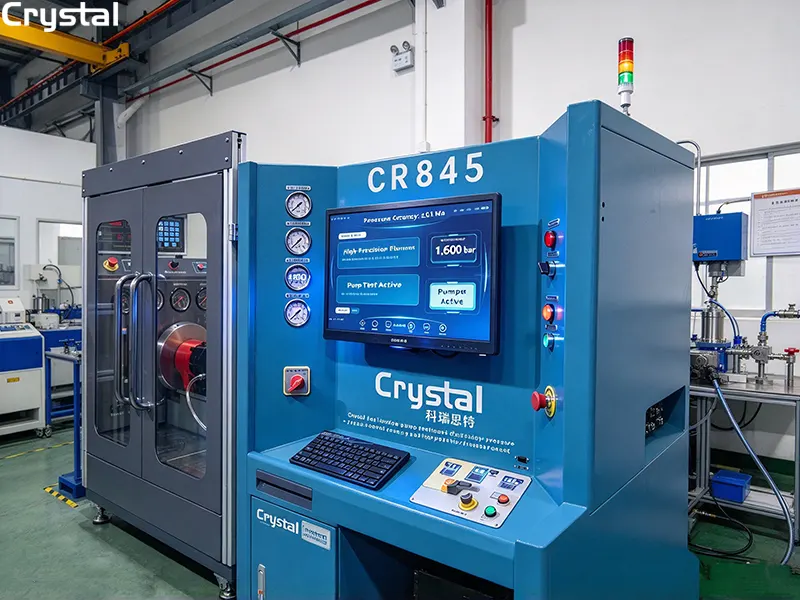
Parameter 3: Standard Injector Verification Capability
Standard test injectors are the measuring stick against which every pump and injector is evaluated. If the bench cannot verify its own standard injectors, the entire measurement chain is unanchored.
What to Verify
The standard injector opening pressure should be maintained at 17.5 ± 0.2 MPa. A fuel injection pump test bench should include, or support, the capability to verify and adjust standard injector opening pressure and flow uniformity.
The Verification Question
Ask whether the bench includes a standard injector verification procedure and whether replacement standard injectors are readily available. A bench without a verifiable reference standard is a bench without a foundation.
Parameter 4: Test Fluid Temperature Control
Temperature is the quiet variable that corrupts every other measurement. Diesel viscosity changes with temperature, and viscosity directly determines flow through nozzles and internal clearances. ISO 4113 calibration fluid is specified at 40oC for this reason, and SAE J967 requires test fluid to be held within a defined temperature band.
What to Verify
The bench should maintain test fluid temperature at 40 ± 2oC throughout testing, not merely at the start of a session. Crystal's HCR708 specifies a temperature control range of 40 ± 2oC. Verify that temperature is measured at the pump inlet, not only at the tank, and that the control system can hold the setpoint under load.
The Verification Question
Ask for the temperature control accuracy specification and confirm that the bench includes active heating and cooling, not passive thermal stabilization.
Parameter 5: Calibration Code Generation
Modern fuel injection pump test benches are not merely measurement devices—they are code generators. The ECU depends on correction codes (IQA, IMA, ISA, QR, c2i, c3i, ICC) to compensate for each injector's individual characteristics. A bench that measures accurately but cannot generate valid codes leaves the repair incomplete.
What to Verify
Confirm that the bench supports code generation for the injector brands you service. The PrimodeTech buying guide specifically identifies the ability to generate IMA/C2I/C3I correction codes as a key feature to compare. Crystal's platforms are engineered to generate the major correction codes required for ECU integration across Bosch, Denso, Delphi, and Siemens injector families.
The Verification Question
Ask for a demonstration of code generation for one injector from each of your top three brands. Verify that the generated code matches the format the ECU expects—not merely that the bench "supports coding" in principle.
Parameter 6: Test Channels and Multi-Injector Throughput
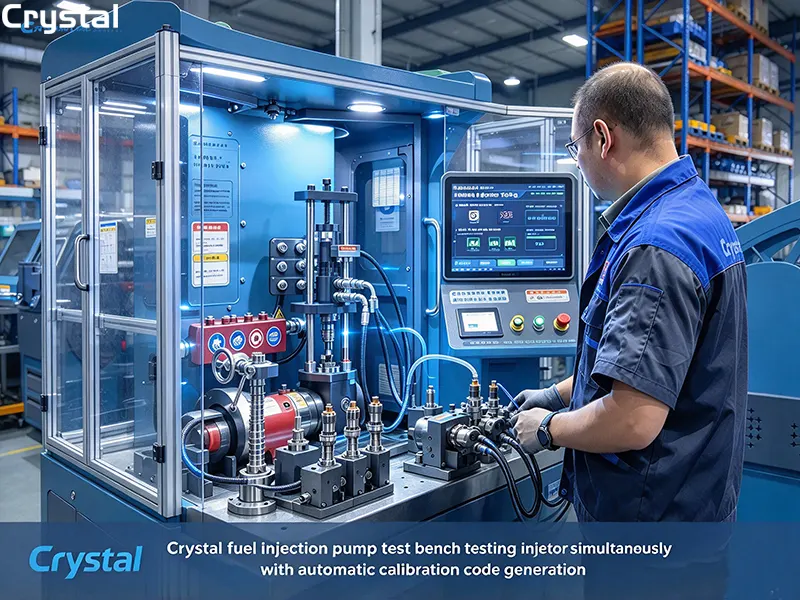
Throughput determines how many jobs a fuel injection pump test bench can process per day—and therefore how quickly it pays for itself. A single-channel bench forces sequential testing; a multi-channel bench enables parallel processing.
What to Verify
The PrimodeTech guide recommends 6-channel capability for efficiency—testing multiple injectors simultaneously. Some platforms, such as the Magneti Marelli ETBRX, support testing 1, 4, or more injectors in parallel, with complete test cycles in as little as 4 minutes. Bosch's DCP 800 targets test times of around 20 minutes per pump.
The Verification Question
Ask for the tested cycle time for your most common injector or pump type, and confirm how many components can be tested simultaneously without sharing measurement channels in a way that compromises accuracy.
Parameter 7: Multi-Component and Multi-Brand Compatibility
A fuel injection pump test bench that tests only one component type or one brand family limits your workshop's service scope. The broader the compatibility, the greater the return on the equipment investment.
What to Verify
Confirm support for the pump and injector families you actually service. Crystal's CRS1000 series, for example, supports high-pressure common rail injectors, high-pressure common rail pumps, EUI and EUP systems, HEUI systems, and medium-pressure actuating pumps through a modular design. The CR918-PRO extends compatibility to CR pumps, CR injectors, EUI/EUP, and CAT HEUI injectors.
The Verification Question
List your top five component types by service volume, and ask the supplier to demonstrate a complete test sequence for each—or provide documented evidence that the bench supports them.
Parameter 8: Build Quality and Contamination Resistance
A fuel injection pump test bench operates in a high-pressure, fluid-filled environment. Build quality determines how long it maintains accuracy—and how much it costs to keep it there.
What to Verify
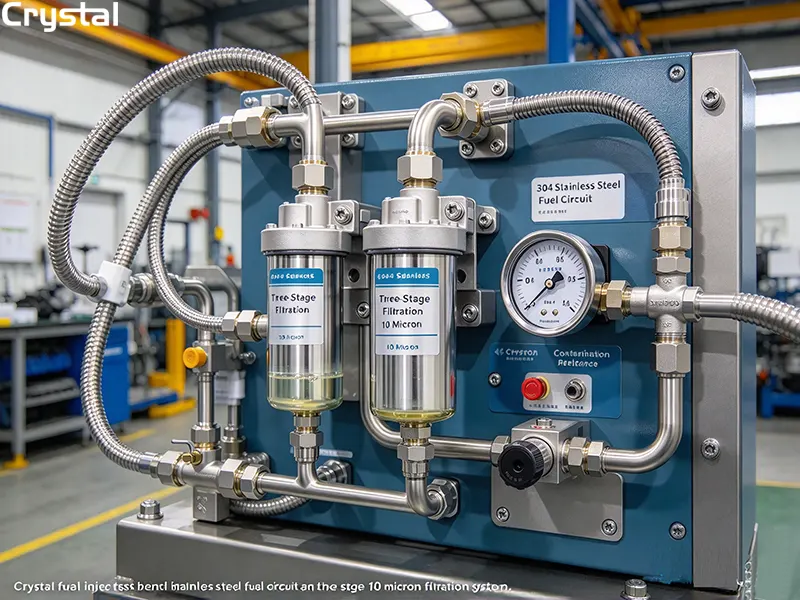
Look for 304 stainless steel fuel circuits, which resist corrosion and are compatible with biodiesel and alternative fuels. Crystal's CRS1000 series uses 304 stainless steel for both test and waste oil tanks, and incorporates a three-stage filtration system to prevent contamination from degrading performance. Verify the filtration precision—10-micron high-pressure filtration is a reasonable benchmark.
The Verification Question
Ask for the fuel circuit material specification and the filtration stage count and precision. A bench built with carbon steel circuits and single-stage filtration will cost more in maintenance and downtime over its service life than a bench with stainless steel and multi-stage filtration.
Parameter 9: Software, Database, and Documentation
The software layer is where measurements become verdicts and codes. A fuel injection pump test bench with a limited database or opaque software imposes a ceiling on what your technicians can accomplish.
What to Verify
Confirm that the bench includes:
- A test specification database covering the pump and injector models you service
- Automatic pass/fail assessment against OEM tolerances
- Report generation and data export for traceability
- Code generation integrated into the test workflow
The PrimodeTech guide identifies test plan databases, automatic pass/fail, and report generation as core software features to compare. Crystal's platforms integrate these functions into a single workflow, with the CR918-PRO performing idle, pre-injection, full-load, return flow, and leakage tests automatically.
The Verification Question
Ask for a live demonstration of the software using one pump or injector model from your own inventory. Verify that the database contains the model, that the test sequence runs automatically, and that the report and code outputs are usable without manual calculation.
Parameter 10: Support, Warranty, and Spare Parts Availability
Even a technically excellent fuel injection pump test bench becomes a liability if support is slow and spare parts are unavailable. Downtime is the hidden cost that erodes the return on any equipment investment.
What to Verify
Confirm:
- Warranty period (typically 12 months for Crystal platforms)
- Technical support responsiveness and language coverage
- Software update policy—can the bench be upgraded for new models and standards?
- Spare parts availability—are common wear items stocked and shippable?
- Training resources—manual, video, and remote assistance
Crystal Automation's machines are exported to more than 100 countries, and the company emphasizes after-sales support and detailed documentation as part of its value proposition.
The Verification Question
Ask for the name and contact details of a current customer in your region who services similar components. A supplier confident in its support will provide a reference; a supplier that hesitates is telling you something.
Summary: The 10 Parameters at a Glance
| # | Parameter | What to Verify | Verification Method |
|---|---|---|---|
| 1 | Pressure capability and accuracy | 2,000+ bar; ±0.1 MPa control | Written spec + demonstration |
| 2 | Flow measurement accuracy | 0.1 ml or better; repeatable | Three-run repeatability test |
| 3 | Standard injector verification | 17.5 ± 0.2 MPa opening pressure | Procedure + replacement availability |
| 4 | Test fluid temperature control | 40 ± 2oC at pump inlet | Spec + active heating/cooling |
| 5 | Calibration code generation | IQA, IMA, ISA, QR, c2i, c3i, ICC | Demonstration for your brands |
| 6 | Test channels and throughput | Multi-channel; documented cycle time | Cycle time for your components |
| 7 | Multi-component compatibility | Injectors, pumps, EUI/EUP, HEUI | Complete test sequence per type |
| 8 | Build quality | 304 stainless steel; 3-stage filtration | Material + filtration specification |
| 9 | Software and database | Test plans; pass/fail; reports; codes | Live demonstration with your model |
| 10 | Support and warranty | 12-month warranty; parts; updates | Customer reference in your region |
The Crystal Automation Perspective
Crystal Automation's fuel injection pump test benches—including the HCR708, CR918-PRO, and CRS1000 series—are engineered around these ten parameters. The HCR708 covers pressure control up to 2,500 bar with 40 ± 2oC temperature control. The CR918-PRO extends pressure capability to 2,800 bar and integrates automatic test sequences covering idle, pre-injection, full-load, return flow, and leakage. The CRS1000 series adds modular multi-component flexibility with 304 stainless steel construction and three-stage filtration.
But the purpose of this guide is not to declare one brand the winner by assertion. It is to give you the questions that make any supplier—Crystal included—prove its claims against verifiable parameters. A test bench purchase is a decade-long commitment. The ten parameters above are the questions that protect that commitment.
Conclusion
Buying a fuel injection pump test bench is not a decision to be made on price alone, or on the maximum pressure number printed in a brochure. The parameters that determine long-term value—flow accuracy, standard injector integrity, temperature control, code generation, throughput, compatibility, build quality, software depth, and support—are the parameters that separate a productive asset from an expensive source of frustration.
Verify them systematically. Ask for demonstrations, not descriptions. Request references, not reassurances. And choose a fuel injection pump test bench that can prove—parameter by parameter—that it is built for the work your workshop actually does.
Written by
Taian Crystal Automation Co., Ltd.
Editor Chen
WhatsApp:+86 185 5385 2072
Email:martin@crystalautotest.com
- Top Common Rail Injector Test Bench Guide: Working Principle & 7 Key Testing Parameters
- Best Injection Pump Test Bench Buying Guide – 7 Questions Every Diesel Workshop Must Ask
- Best Injection Pump Test Bench Oil Change Guide – 4 Steps at 200 Hours for Peak Performance
- The 5 Signs Your Common Rail Test Bench Needs Calibration

Crystal Automation is a leading Chinese manufacturer of common rail test benches and fuel injector test benches.