Common Rail Test Bench Buying Guide: 7 Questions Every Diesel Workshop Must Ask
Investing in a common rail test bench is one of the most significant decisions a diesel workshop can make. The global test benches market was valued at USD 1.85 billion in 2025 and is projected to grow at a CAGR of 6% to reach USD 3.22 billion by 2034—a clear reflection of the growing demand for precision diesel diagnostic equipment. With the high-pressure common rail injector market alone expected to grow from US$ 231 million in 2025 to US$ 350 million by 2031 at a CAGR of 7.2%, the stakes for choosing the right test bench have never been higher.
A common rail test bench is a specialized piece of equipment used to diagnose and test the functionality of diesel fuel injectors and pumps in a common rail system. But with so many options on the market—ranging from entry-level units to full-featured industrial systems—how do you choose the right one?
Here are 7 critical questions every diesel workshop must ask before making a purchase.
Question 1: What Pressure Capacity Do I Really Need?
Pressure capacity is the foundation of any common rail test bench. Modern common rail systems operate at extraordinarily high pressures, and your test bench must match—or exceed—those requirements.
What to look for: Today's premium test benches deliver pressures up to 2,600 bar (260 MPa). Some advanced systems even reach 3,000 bar. The Bosch DCI 700, for example, operates with a test pressure range of 30 MPa to 260 MPa. Pressure control accuracy is equally critical—look for ±0.1 MPa (1 bar) precision.
Why it matters: If your test bench cannot generate the pressures required by modern injectors, your diagnostics will be incomplete. A bench with pressure capacity below 2,000 bar simply cannot properly test the latest generation of piezoelectric injectors.
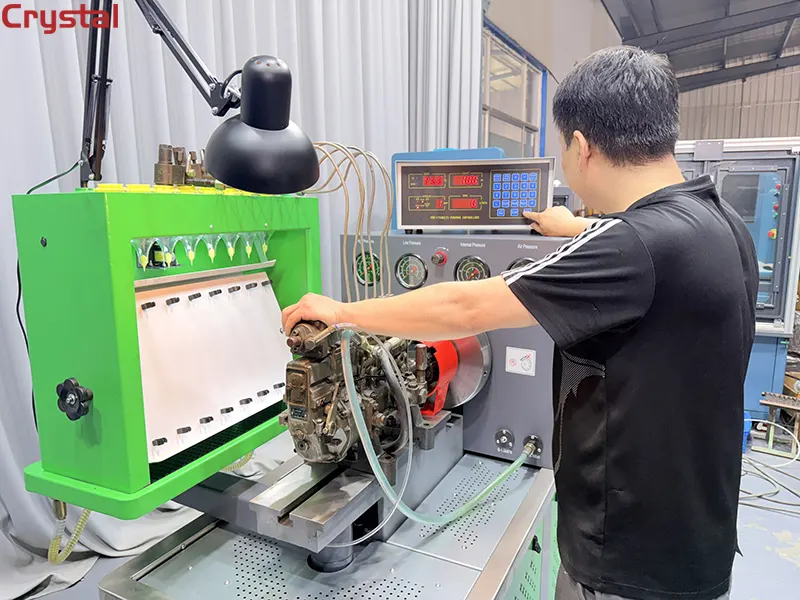
Crystal Advantage: Crystal's high-pressure common rail test benches operate at pressures up to 2,600 bar with pressure control accuracy of ±0.1 MPa. Powered by Bosch CP3.3 original common rail pumps, they deliver the pressure range needed for testing injectors from Bosch, Delphi, Denso, Siemens, and more.
Question 2: Which Injector Types and Brands Must the Bench Support?
Not all test benches are created equal. Some are designed for specific injector types; others offer broad compatibility.
What to look for: A versatile test bench should support:
- Solenoid (electromagnetic) injectors
- Piezoelectric injectors—which require specialized testing due to their ceramic actuators and capacitance measurements (typically 0–12 μF)
- HEUI injectors (Hydraulically actuated Electronically controlled Unit Injectors)
- EUI/EUP injectors (Electronic Unit Injectors / Electronic Unit Pumps)
- Common rail pumps
Why it matters: No single machine is designed to test all injectors and all engines. But the more types your bench supports, the broader your service capabilities and the greater your return on investment.
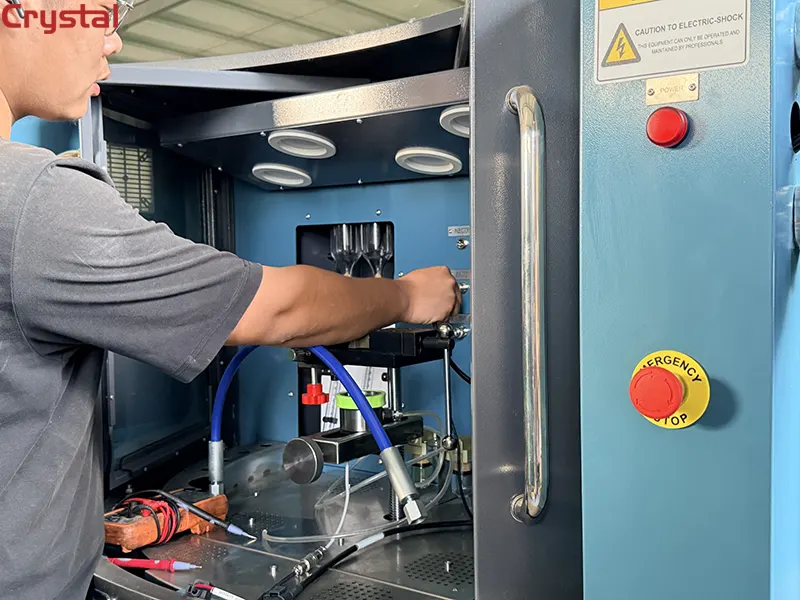
Crystal Advantage: Crystal's test benches accommodate a broad spectrum of components: high-pressure common rail injectors (including piezoelectric types), HEUI injectors, EUI/EUP injectors and pumps. The CR918-PRO can test injectors from Bosch, Delphi, Denso, Siemens/VDO, and more, with an extensive built-in database of thousands of standardized injector data profiles. Optional modules include piezoelectric injector testing and common rail pressure regulating valve testing.
Question 3: What Calibration Codes Does the Bench Generate?
Modern common rail injectors require calibration codes for ECU integration after servicing or replacement. Without these codes, even a perfectly repaired injector will not perform correctly.
What to look for: A test bench should automatically generate all major correction codes, including:
- QR (Quantity Regulation)
- IQA (Injector Quantity Adjustment
- IMA (Injector Manufacturing Adjustment)
- ISA (Injector Specific Adjustment)
- c2i, c3i (Correction codes)
- ICC (VD0)
Why it matters: Calibration codes ensure seamless ECU communication and perfect injector integration. Without them, you're sending injectors out the door that won't perform to specification.
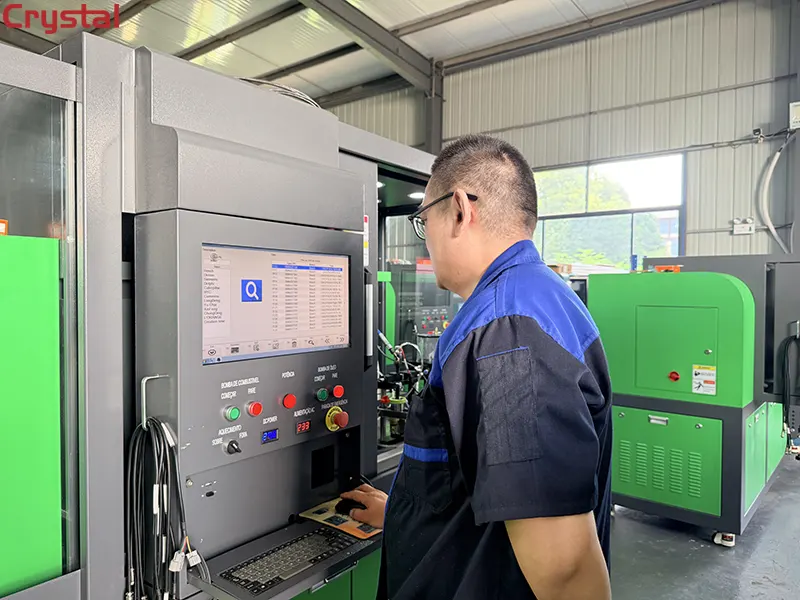
Crystal Advantage: The CR918-PRO features an advanced coding algorithm capable of generating every commonly required calibration code, including QR, IQA, IMA, ISA, c2i, c3i, and ICC (VD0). This eliminates the need for separate coding devices and streamlines the entire repair workflow.
Question 4: How Accurate Are the Flow Measurements?
Flow rate is the single most critical diagnostic parameter for any injector. If your test bench cannot measure flow accurately, every other test result is suspect.
What to look for: High-precision flow meters capable of measuring with 0.1 ml accuracy or better. Look for high repeatability, stable readings, and traceable accuracy.
Why it matters: A flow measurement error of just 0.2–0.3 ml can mean the difference between a "pass" and a "fail"—and can lead to misdiagnosed injectors, wasted workshop time, and costly comebacks.
Crystal Advantage: Crystal test benches are equipped with high-precision flow meters that deliver accurate fuel quantity measurement, which is critical for generating valid correction codes and performance assessments. The CR918-PRO's precision flow meter delivers high repeatability, stable readings, and traceable accuracy.
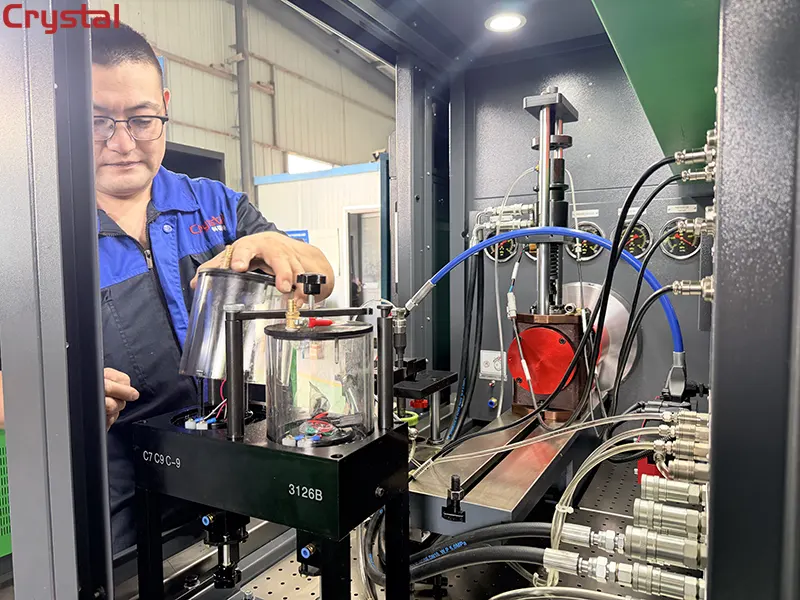
Question 5: Does the Bench Offer Automation and Efficiency Features?
In a busy workshop, time is money. A test bench that requires extensive manual intervention will slow you down and introduce human error.
What to look for: Features that streamline workflow:
- Fully automatic control systems that initiate comprehensive test sequences with minimal manual intervention
- One-click automatic cleaning cycles
- Multi-injector testing capability—testing multiple injectors simultaneously
- Intuitive software with detailed analysis, data logging, and report printing
- Built-in databases with thousands of injector data profiles
Why it matters: Automation reduces testing time, eliminates operator error, and allows technicians to focus on diagnosis rather than machine operation.
Crystal Advantage: Crystal's test benches feature fully automatic control systems that streamline the entire testing process. The CR918-PRO offers one-click automatic cleaning that cleans and flushes injectors, saving valuable workshop time. It can test multiple injectors simultaneously on its standard platform, and its intuitive software allows for detailed analysis, data logging, and report printing. The bench's ergonomic design and user-intuitive interface reduce operator fatigue and simplify workflows.
Question 6: What Is the Total Cost of Ownership?
The purchase price is just the beginning. Consider the full cost of ownership over the equipment's lifespan.
What to evaluate:
- Initial purchase price—entry-level benches can start around $4,000, while full-featured industrial systems command significantly higher prices
- Maintenance costs—filter replacements, oil changes, and calibration
- Training costs—how quickly can your team learn to use it?
- Space requirements—does it fit your workshop layout?
- Versatility—can one bench replace multiple single-purpose machines?
Why it matters: A cheap bench that can't handle your workload or requires constant repairs is false economy. A premium bench with broader capabilities may cost more upfront but delivers better long-term value.
Crystal Advantage: Crystal offers solutions ranging from compact, entry-level units to full-featured, multi-function setups. Their EPS205 and EPS205-PRO models, for example, are compact while still delivering high-pressure common rail performance. The CR918-PRO multi-functional unit replaces multiple single-purpose test benches, saving space, cost, and training time. Crystal's machines are exported globally to more than 100 countries, underscoring reliability and trust.
Question 7: What After-Sales Support and Warranty Are Provided?
A common rail test bench is a long-term investment. The quality of after-sales support can make or break your experience.
What to look for:
- Warranty period—typically 12 months
- Technical support—is it readily available?
- Software updates—can the bench be upgraded to support new models and test standards?
- Spare parts availability—are components readily accessible?
- Training and documentation—are resources provided to help your team get up to speed?
Why it matters: Even the best equipment will need maintenance, calibration, and occasional repairs. A supplier with strong after-sales support ensures minimal downtime and maximum productivity.
Crystal Advantage: Taian Crystal Automation Co., Ltd specializes in research, development, production, sales, and service of internal combustion engine test equipment. The company emphasizes strict quality assurance, close cooperation with research institutes, fuel pump and injector service teams, and extensive after-sales support. Software can be upgraded to support new models and new test standards. Crystal offers a 12-month warranty on its equipment.
Summary: Decision Matrix
| Question | Key Consideration | Crystal Advantage |
| 1. Pressure capacity | 2,600 bar minimum, ±0.1 MPa accuracy | 2,600 bar with Bosch CP3.3 pump |
| 2. Injector support | Solenoid, piezoelectric, HEUI, EUI/EUP | All types supported |
| 3. Calibration codes | QR, IQA, IMA, ISA, c2i, c3i, ICC | All major codes generated automatically |
| 4. Flow accuracy | 0.1 ml or better | High-precision flow meter |
| 5. Automation | Automatic sequences, one-click cleaning | Fully automatic control system |
| 6. Total cost | Purchase + maintenance + training | Multi-functional design replaces multiple benches |
| 7. Support & warranty | 12-month warranty, software updates | 12-month warranty, global export to 100+ countries |
Final Thoughts
Choosing the right common rail test bench is not just about buying a machine—it's about investing in your workshop's future. The right bench will expand your service capabilities, boost productivity, improve repair accuracy, and reduce equipment and training costs.
As diesel technology continues to advance—with increasingly complex electronic control systems and tighter emissions standards—tools like these will be indispensable in ensuring engines run cleaner, more efficiently, and with fewer faults.
Take the time to ask these 7 critical questions. Evaluate your options carefully. And choose a test bench that will grow with your business—not one that will hold it back.
Written by
Taian Crystal Automation Co., Ltd.
Editor Chen
www.crystalautotest.com
WhatsApp:+86 185 9528 8526
Email:martin@crystalautotest.com
- Top 6 Factors That Determine Injection Pump Test Bench Total Cost of Ownership
- Best 7 Tools for Injection Pump Test Bench Maintenance – Essential for Every Diesel Technician
- Injection Pump Test Bench Setup: 6 Essential Steps Before Your First Test Run
- Common Rail Test Bench Calibration: Why Precision Matters for Pump and Injector Diagnostics

Crystal Automation is a leading Chinese manufacturer of common rail test benches and fuel injector test benches.