7 Methods of Power Speed Regulation for High-Pressure Common Rail Test Bench
As a core technology of modern diesel engines, the high-pressure common rail system relies entirely on the precise coordination between the common rail pump and injectors to ensure the stability of injection pressure and the accuracy of injection timing. In maintenance and testing, one of the core tasks of a high-pressure common rail test bench is to simulate engine speed changes under different operating conditions to accurately test the dynamic response of the pump, nozzles, and rail pressure. However, traditional single-speed adjustment modes are insufficient to meet the accuracy requirements of common rail components with different power ratings and control logics. Therefore, mastering various methods of power speed control on the test bench is not only a prerequisite for ensuring the authenticity and reliability of test data but also crucial for technicians to accurately diagnose pump wear, actuator jamming, and rail pressure leakage faults. This article will systematically describe seven common power speed control methods used in the practical operation of high-pressure common rail test benches, providing a clear technical path for maintenance and testing work.
1. What is a High-Pressure Common Rail Test Bench?
1.1 Basic Definition
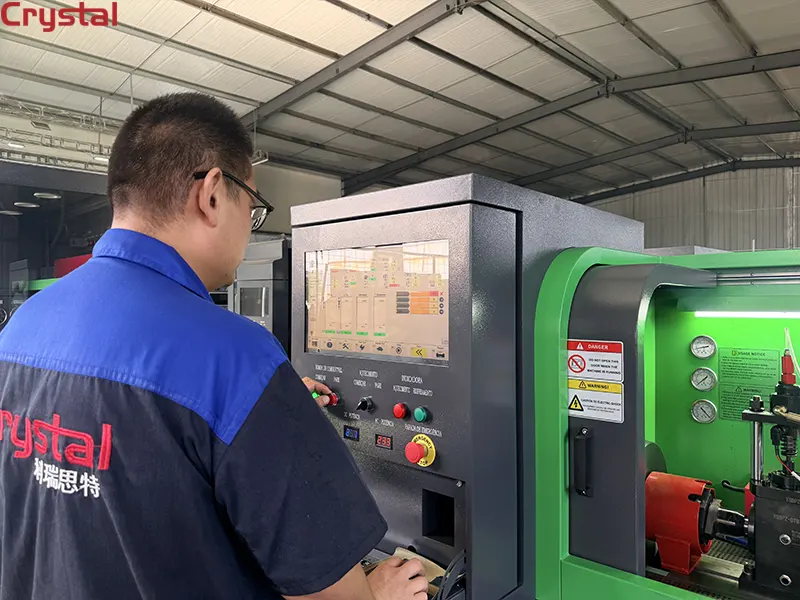
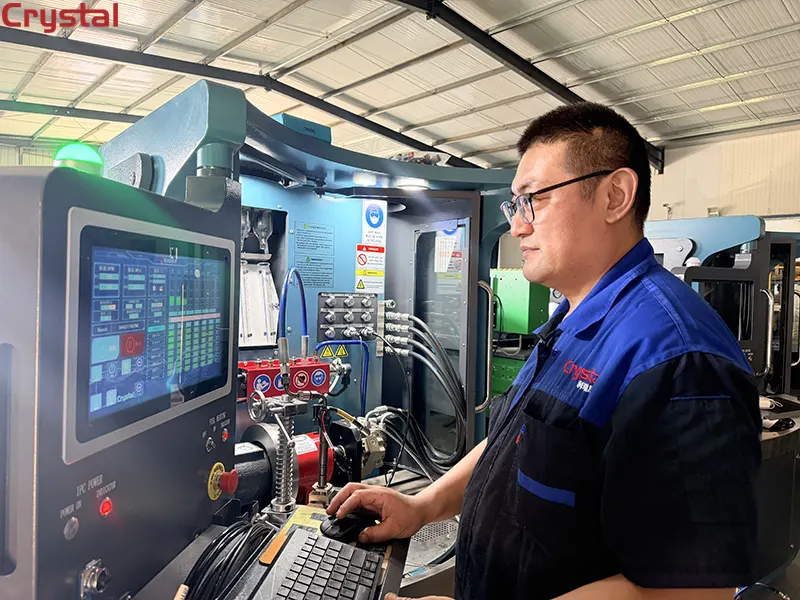
- A high-pressure common rail test bench is a specialized testing device for testing, debugging, and repairing high-pressure common rail fuel systems in diesel vehicles. It is widely used in auto repair shops, fuel pump and nozzle factories, and auto parts quality inspection.
1.2. Basic Components
- Main Drive System: Variable frequency motor + transmission mechanism, driving the common rail pump.
- Fuel Supply System: Fuel tank, fuel lines, filter, temperature control, providing clean fuel.
- High-Pressure Common Rail Simulation Unit: Simulates the original vehicle's common rail, monitoring rail pressure in real time.
- Electrical Control System: Mainboard, display screen, sensors, CAN communication, controlling speed, pressure, and data acquisition.
- Measuring Cup/Flow Detection Unit: Precisely measures the injection and return fuel amounts per cylinder.
2. Introduction to the Power System of the High-Pressure Common Rail Test Bench
2.1. Core Functions of the Power System
- Drives the high-pressure common rail pump, simulating engine speed conditions.
- Provides stable, adjustable, and high-precision speed, ensuring accurate testing of injection quantity and rail pressure.
- Outputs sufficient torque to drive the common rail pump to establish a high pressure of 1600–3000 bar.
- Works with the measurement and control system to achieve closed-loop speed control, load simulation, and automatic switching of operating conditions.
2.2. Main Components of the Power System
2.2.1. Drive Motor
- Mainstream: Variable frequency three-phase asynchronous motor (7.5–15 kW) or servo motor.
- Features: Variable frequency motors offer high cost-effectiveness, stepless speed regulation from 0–4000 r/min, and ±1 r/min accuracy. Servo motors provide fast response, constant torque, and are suitable for high-precision transient testing.
- Brands: ABB, Siemens, etc.
2.2.2. Inverter/Servo Driver
- Function: Receives controller commands, adjusts the motor frequency/voltage, and achieves stepless speed regulation.
- Control Modes: Speed mode: Fixed speed (e.g., 800, 1500, 3000 r/min). Torque mode: Simulates engine load changes.
- Accuracy: Speed control error ≤ ±1 r/min.
2.2.3. Transmission Mechanism
- Components: Coupling + Drive Shaft + Bearing Housing + Pump Connection Flange.
- Couplings: Mostly flexible/cloverleaf couplings are used to reduce vibration, compensate for coaxiality errors, and protect the motor and pump shafts.
- Function: To smoothly and with low vibration transmit motor power to the common rail pump camshaft.
2.2.4. Speed/Torque Feedback Unit
- Encoder: Mounted on the motor or drive shaft, it measures the speed in real time and feeds it back to the frequency converter to form a closed loop.
- Torque Sensor (High-end models): Measures output torque for load simulation and pump performance analysis.
- Accuracy: Encoder resolution up to 1024–4096 lines, torque accuracy ±0.5%FS.
2.2.5. Mechanical Test Bench and Protective Devices
- Bed: Heavy-duty cast iron/steel structure, vibration-damping, deformation-resistant, ensuring high-speed stability.
- Safety Protection: Emergency stop button, overload protection, overspeed protection, leakage protection.
- Limits: Mechanical limit screws to prevent runaway and protect the pump and test bench.
3. Seven Methods for Controlling Common Rail Pump Speed
3.1. Variable Frequency Motor Drive Speed Control
- Principle: The power supply frequency and voltage of the main drive motor are adjusted by a frequency converter, changing the motor speed and thus controlling the common rail pump speed.
- Features: Wide range of stepless speed regulation (0–4000 r/min), multiple speed presets, accuracy up to ±1 r/min.
- Application: The default speed control method on the test bench, compatible with all series of common rail pumps such as CP1/CP2/CP3.
3.2. Common Rail Pump Fuel Metering Valve Current Control
- Principle: The ECU/test bench controller outputs a PWM signal to control the opening of the common rail pump's fuel inlet metering valve, adjusting the pump flow rate and indirectly stabilizing the pump speed.
- Features: Continuously adjustable current (0–1200 mA), rail pressure control accuracy ±1 MPa, and rapid suppression of speed fluctuations.
- Application: Rail pressure closed-loop + speed closed-loop dual control, a dedicated speed control method for common rail systems.
3.3. Rail Pressure Closed-Loop Speed Control
- Principle: Real-time acquisition of rail pressure sensor signals, comparison with target rail pressure, and synchronous correction of metering valve current and motor speed through PID/adaptive algorithms to avoid speed drift caused by pressure fluctuations.
- Features: Speed recovery time < 200 ms during pressure surges, suitable for transient condition testing.
- Applications: High-precision scenarios such as injector flow testing and dynamic response testing.
3.4. PID/Adaptive Closed-Loop Algorithm Speed Control
- Principle: Using actual speed as feedback, the deviation from the target speed is calculated, and the control quantity is output through proportional (P), integral (I), and derivative (D) calculations to adjust the motor/metering valve; advanced algorithms include parameter self-learning and extended state observer (ESO) disturbance rejection.
- Features: Traditional PID is stable and reliable; the adaptive algorithm can adapt to time-varying disturbances such as pump wear and voltage fluctuations.
- Applications: All steady-state/transient conditions, providing core assurance for speed stability.
3.5. Mechanical Limit and Idle Speed Fine-Tuning
- Principle: Using mechanical structures such as high-speed limit screws, rocker arm adjusting screws, and connecting shafts, the maximum speed is limited, idle speed is fine-tuned, and rack travel under transitional operating conditions is adjusted to prevent runaway or idle speed vibration.
- Features: Purely mechanical structure, resistant to electromagnetic interference, suitable for extreme operating condition protection and basic speed calibration.
- Applications: New engine commissioning, calibration after worn pump repair, emergency speed adjustment in case of power failure.
3.6. Load Simulation Device Speed Control
- Principle: Combined with a magnetic powder brake/eddy current dynamometer, it simulates engine load changes. By adjusting the load resistance, speed fluctuations are offset, achieving "constant speed with variable load" or "constant load with variable speed" control.
- Features: Load adjustable from 0–500 N•m, fast transient loading/unloading response, and can reproduce actual engine operating conditions.
- Applications: Common rail pump durability testing, variable operating condition stability testing.
3.7. Host Computer Communication-Based Speed Control
- Principle: The host computer sends speed commands via RS485/Ethernet/CAN bus, and the test bench controller automatically executes programmed tasks such as multi-segment speed curves, step tests, and cyclic tests.
- Features: Allows for preset speed segments (10+), automatic switching of operating conditions, real-time data acquisition and storage, reducing manual intervention.
- Applications: Batch testing, calibration data acquisition, factory consistency testing.
4. Comparison Table of Seven Methods
| Control Method | Control Level | Core Components | Speed Accuracy | Applicable Scenarios |
| Variable Frequency Motor Speed Control | Power Source | Inverter + Main Motor | ±1 r/min | Basic Speed Control Under All Operating Conditions |
| Metering Valve Current Control | Fuel Control | PCV Metering Valve | ±2 r/min | Rail Pressure-Speed Closed-Loop |
| Rail Pressure Linked Speed Control | Coupled Control | Rail Pressure Sensor + Controller | ±1.5 r/min | Transient Injection Test |
| PID/Adaptive Algorithm | Software Core | Controller Algorithm | ±0.5 r/min | High-Precision Speed Stabilization |
| Mechanical Limit Fine-Tuning | Hardware Assistance | Limit Screw + Swing Arm | ±5 r/min | Calibration/Emergency |
| Load Simulation Speed Control | Resistance Matching | Magnetic Powder Brake/Dynamometer | ±2 r/min | Variable Operating Condition Durability Testing |
| Host Computer-Controlled Speed Regulation | Automation | Industrial PC + Communication Module | ±1 r/min | Batch/Automated Testing |
5. Key Technical Parameters of the Power System for the High-Pressure Common Rail Test Bench
- Motor Power: 7.5 kW / 11 kW / 15 kW.
- Speed Range: 0~4000 r/min, Commonly Used: Idle 800, Medium 1500, High 3000.
- Speed Accuracy: ±1 r/min.
- Maximum Torque: 50–200 N•m.
- Control Method: Variable Frequency Closed-Loop / Servo Closed-Loop.
6. Common Faults in the Power System of High-Voltage Common Rail Test Bench
6.1. Motor Fails to Start/Completely Does Not Rotate
- Symptom: The motor does not respond after power-on and speed commands are given; the fan and drive shaft do not move.
- Causes: Main power trip/phase loss, emergency stop button not reset, inverter malfunction, motor overload protection triggered, control circuit open circuit, contactor damage.
- Solution: Reset emergency stop; check circuit breaker/three-phase power supply; check inverter fault codes; disconnect power and check wiring; replace damaged contactor; reset motor thermal protection.
6.2. Abnormal Noise from the High-Voltage Common Rail Test Bench
- Symptom: Humming sound but the motor does not rotate.
- Causes: Single-phase motor operation, transmission mechanism jamming, common rail pump seizure, coupling jamming, bearing seizure.
- Solution: Disconnect the coupling and test the motor separately to determine whether the jamming is due to the motor itself or the load; clean transmission components; repair the jammed oil pump/bearing; check the wiring and restore three-phase power.
6.3. Large speed fluctuations and noticeable shaking
- Causes: Loose/damaged encoder, excessive wear and clearance in the coupling, PID parameter misalignment, loose motor mounting bolts, transmission coaxiality deviation, frequent changes in oil circuit load.
- Solutions: Tighten/replace the encoder; recalibrate coaxiality; adjust PID parameters; reinforce the test bench and motor mounting components; check for abnormal oil pump load.
6.4. Actual speed deviates significantly from the set value
- Causes: Abnormal encoder signal, incorrect inverter parameter settings, speed feedback circuit interference, aging motor with insufficient output.
- Solutions: Verify the inverter's rated parameters; check the encoder signal and shielding wire; clear interference sources from the circuit; repair or replace windings in old motors.
6.5. Speed loss of control
- Causes: Inverter main control malfunction, lost speed feedback signal, mechanical limit switch failure, control system program error.
- Solutions: Immediately press the emergency stop button; check the encoder circuit; restore the mechanical limit switch; reset the inverter parameters; repair the drive board if necessary.
7. Maximum Power Loss in High-Pressure Common Rail Test Bench
7.1. Excessive Coaxiality Deviation
- Misalignment of the motor, coupling, drive shaft, and oil pump flange generates additional radial and axial resistance during operation, resulting in a significant increase in losses at high speeds, along with increased vibration.
7.2. Aging of Flexible Couplings, Deformation/Seizure of Rubber Blocks
- The coupling loses its buffering effect, increasing transmission resistance, causing jerking and additional frictional losses.
7.3. Wear and Insufficient Clearance of Drive Shaft and Support Bearing Housings
- Excessive bearing preload and wear of balls/raceways continuously increase rotational resistance.
7.4. Loose Connecting Bolts and Component Movement
- During operation, components rub against and interfere with each other, generating ineffective resistance.
8. Conclusion
The seven methods form a closed loop across seven dimensions: power source, fuel control, pressure coupling, software algorithm, hardware protection, load simulation, and automated control. This ensures stable, high-precision, and highly interference-resistant speed across the entire 0–4000 r/min range of the high-pressure common rail test bench, meeting the needs of common rail pump/injector R&D, calibration, testing, and maintenance.
In summary, the power speed control of the high-pressure common rail test bench is not simply about starting and stopping the motor, but a comprehensive technology involving signal simulation, load matching, and dynamic compensation. The seven methods mentioned above, from basic voltage regulation and PID closed-loop control to manual signal simulation and automatic waveform modulation for different systems such as Bosch, Delphi, and Denso, cover all levels from general maintenance to professional fault diagnosis. In practice, technicians should flexibly select the optimal speed control strategy based on the specific model of the component under test and the hardware and software configuration of the test bench. Only by accurately understanding and skillfully applying these seven control methods can the performance potential of the test bench be fully realized, ensuring the accuracy of the common rail pump's flow test data, thereby laying a solid foundation for the efficient maintenance and performance improvement of the high-pressure common rail system.
Written by
Taian Crystal Automation Co., Ltd.
Editor Chen
www.crystalautotest.com
WhatsApp:+86 185 9528 8526
Email:martin@crystalautotest.com
- Top 5 Injection Pump Test Bench Market Trends Driving 5.7% CAGR Through 2031
- Top 6 High-Pressure Pump Diagnostic Methods on an Injection Pump Test Bench
- Best Injection Pump Test Bench Filter Cleaning Guide – 7 Tips to Prevent Circuit Contamination
- Top 5 Must-Know Signs Your Injection Pump Test Bench Calibration Is Off

Crystal Automation is a leading Chinese manufacturer of common rail test benches and fuel injector test benches.