5 Features That Separate Entry-Level from Industrial Injection Pump Test Benches
Choosing an injection pump test bench is one of the most consequential equipment decisions a diesel workshop will ever make. Buy too small, and you'll outgrow the machine within a year. Buy too large, and you'll tie up capital in capabilities you never use. The key is understanding exactly what separates an entry-level injection pump test bench from an industrial-grade injection pump test bench—and which category matches your actual workload.
The global diesel engine market was valued at USD 67.44 billion in 2026 and continues to grow at a CAGR of 5.49%, projected to reach USD 93.14 billion by 2032. Meanwhile, the global fuel injector tester market is expanding from USD 0.8 billion in 2025 to USD 1.6 billion by 2036 at a CAGR of 6.1%. As diesel technology grows more complex, the gap between entry-level and industrial testing equipment is widening.
Here are the 5 defining features that separate these two categories—and what each means for your workshop.
Feature 1: Pressure Capacity and Test Range
The single most visible differentiator between entry-level and industrial injection pump test benches is pressure capacity. This isn't about marketing—it's about the physical limits of what the machine can test.
Entry-Level Injection Pump Test Bench
Entry-level models typically operate at pressures up to 1,000–1,800 bar. These machines are perfectly adequate for older mechanical systems: inline pumps, distributor pumps, and first-generation common rail systems (Bosch CP1, early Denso HP0). For a workshop servicing agricultural equipment, older trucks, or marine engines with conventional fuel systems, an entry-level injection pump test bench covers the majority of jobs.
Industrial-Grade Injection Pump Test Bench
Industrial injection pump test benches operate at pressures up to 2,600 bar and beyond. Some advanced systems reach 3,000 bar to match the latest generation of heavy-duty common rail systems. The Bosch DCI 700, for example, operates with a test pressure range of 30 MPa to 260 MPa.
The critical difference: Injection pressures have progressed from 1,350 bar in first-generation common rail systems (introduced in 1997) to 2,500 bar in today's fourth-generation systems—with 3,000 bar designs already under development. An injection pump test bench capped at 1,800 bar simply cannot properly test these units. It may generate pressure, but it cannot validate performance at the pressures where modern pumps actually operate.
| Specification | Entry-Level | Industrial-Grade |
|---|---|---|
| Maximum pressure | 1,000–1,800 bar | 2,600–3,000 bar |
| Pressure accuracy | ±2–5 bar | ±0.1–0.5 bar |
| Suitable systems | Mechanical, early common rail | All generations including Gen 4+ |
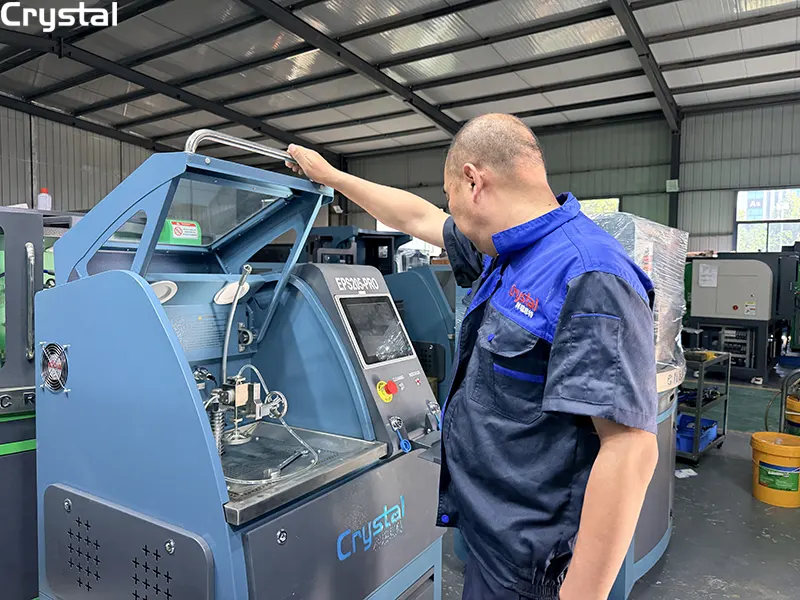
Crystal Advantage: Crystal's high-pressure common rail test benches operate at pressures up to 2,600 bar with pressure control accuracy of ±0.1 MPa, powered by Bosch CP3.3 original common rail pumps.
Feature 2: Injector and Pump Type Compatibility
The second major differentiator is the range of components the injection pump test bench can service. This determines your workshop's service capability—and its revenue potential.
Entry-Level Injection Pump Test Bench
Entry-level injection pump test benches are typically designed for a narrow set of applications. They may handle only mechanical inline pumps, or only VE distributor pumps, or only one brand of common rail injectors. Adapters are limited, and adding new pump families often requires purchasing an entirely separate machine.
Industrial-Grade Injection Pump Test Bench
Industrial injection pump test benches are engineered as multi-functional platforms. A single machine can test:
- Mechanical inline pumps – Bosch K, M, MW, A, B, BV, P series
- VE distributor pumps – EP/VA, EP/VM, VE, VP36, VP37, VP44
- High-pressure common rail pumps – Bosch CP1/CP3/CP4, Denso HP0–HP4, Delphi, Siemens
- HEUI injectors and pumps – CAT C7, C9, 3126, 3406, 3408, Ford 6.0L, 7.3L
- EUI/EUP systems – with comprehensive adapter sets
- Piezoelectric injectors – capacitance 0–12 μF, response time 0–999 μS
The practical impact: Research has found that 70% of aftermarket diesel injectors fail comprehensive testing and would present significant engine performance issues if installed. An industrial injection pump test bench that supports a broad range of component types ensures you can verify every injector and pump before it leaves your shop—regardless of brand or generation.
| Component Support | Entry-Level | Industrial-Grade |
|---|---|---|
| Pump types | 1–2 families | 4+ families |
| Injector brands | Limited (1–2) | Bosch, Denso, Delphi, Siemens, CAT, Cummins |
| Piezoelectric support | Rarely | Standard or optional module |
| HEUI/EUI/EUP support | No | Optional modules available |
| Multi-cylinder testing | 1–2 cylinders | Up to 12 cylinders |
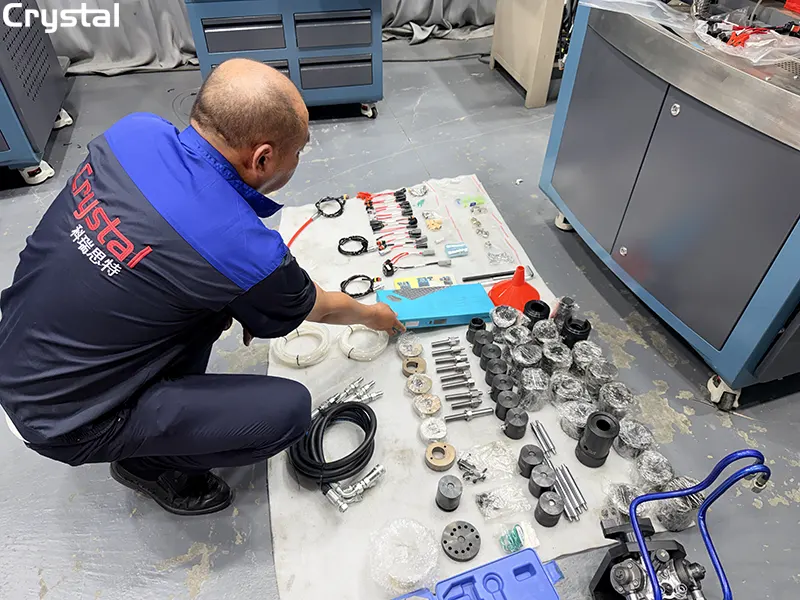
Crystal Advantage: Crystal's test benches accommodate a broad spectrum of components including high-pressure common rail injectors (including piezoelectric types), HEUI injectors, EUI/EUP injectors and pumps, and common rail pumps. The CR918-PRO supports injectors from Bosch, Delphi, Denso, Siemens/VDO, and more.
Feature 3: Automation Level and Throughput
Time is money in a professional workshop. The degree of automation built into an injection pump test bench directly affects how many jobs you can complete per day—and how much you pay in labor per job.
Entry-Level Injection Pump Test Bench
Entry-level injection pump test benches are largely manual or semi-manual. Operators adjust pressure and speed by hand, read analog gauges, and record results on paper. Test sequences must be initiated individually. Multi-injector testing is often impossible or requires cumbersome manual switching.
Industrial-Grade Injection Pump Test Bench
Industrial injection pump test benches are built for throughput. Key automation features include:
- Fully automatic control systems – initiate comprehensive test sequences with minimal manual intervention
- One-click automatic cleaning – cleans and flushes injectors without disassembly
- Simultaneous multi-injector testing – test 4, 6, or even 12 injectors at once
- Automatic data logging and reporting – results are captured, analyzed, and stored without operator input
- Built-in databases – thousands of injector and pump profiles for instant model recognition
The numbers: A modern industrial injection pump test bench like the Crystal CR918-PRO can test four injectors in under 15 minutes—a fraction of the time required for manual testing. The Bosch DCP 800 pump test bench offers rapid setup and average test times of around 30 minutes, testing common-rail pumps at pressures up to 2,700 bar.
Automatic control systems also reduce operator error—a critical factor when incorrect calibration codes can lead to engine damage. One industry source reports that automation can reduce operator error by 50% compared to manual test benches.
| Automation Feature | Entry-Level | Industrial-Grade |
|---|---|---|
| Test sequence initiation | Manual | Fully automatic |
| Multi-injector testing | 1 at a time | Up to 12 simultaneously |
| Cleaning | Manual disassembly | One-click automatic |
| Data logging | Paper records | Automatic digital reports |
| Calibration code generation | Manual calculation | Automatic (QR, IQA, IMA, ISA, c2i, c3i, ICC) |
| Database | None or minimal | 4,000–7,600+ profiles |
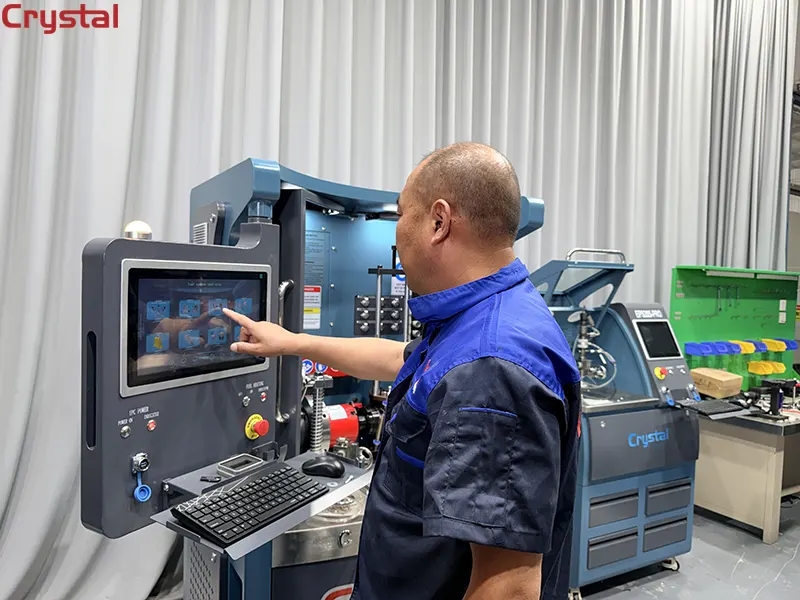
Crystal Advantage: Crystal's CR918-PRO features fully automatic control systems, one-click automatic cleaning, and simultaneous multi-injector testing. The built-in database includes thousands of standardized injector data profiles, and the system automatically generates all major correction codes.
Feature 4: Measurement Precision and Accuracy
The difference between a "pass" and a "fail" often comes down to measurement precision. Industrial injection pump test benches are built to detect deviations that entry-level machines simply cannot see.
Entry-Level Injection Pump Test Bench
Entry-level injection pump test benches typically use analog gauges and mechanical flow measurement. Accuracy may be within ±5% of reading—adequate for gross pass/fail decisions on older equipment, but insufficient for modern common rail injectors that operate at microscopic tolerances.
Industrial-Grade Injection Pump Test Bench
Industrial injection pump test benches are built around precision measurement:
- Flow measurement accuracy: 0.1 ml
- Flow testing range: 0–4,000 ml/min
- Pressure control accuracy: ±0.1 MPa
- Injection duration control: 0–65,535 μs with microsecond precision
- Response time measurement: 0–999 μS resolution
Why precision matters: A flow measurement error of just 0.2–0.3 ml can mean the difference between a "pass" and a "fail." The quality of repair, reduced fuel consumption, and proper emissions compliance all depend on accurate fuel delivery and timing.
Furthermore, variation between pumping elements at full load speed should not exceed 3 percent. At low idle, the tolerance is 12 percent. An injection pump test bench that cannot measure with 0.1 ml accuracy cannot reliably verify compliance with these tolerances.
| Precision Specification | Entry-Level | Industrial-Grade |
|---|---|---|
| Flow accuracy | ±5% of reading | 0.1 ml |
| Pressure accuracy | ±2–5 bar | ±0.1–0.5 bar |
| Injection duration precision | Millisecond | Microsecond |
| Response time resolution | Not measured | 0–999 μS |
| Temperature control | ±5°C | ±2°C |
Crystal Advantage: Crystal test benches are equipped with high-precision flow meters delivering 0.1 ml accuracy, with a flow testing range spanning 0–600 ml per 1,000 injections. Temperature control maintains test oil at 40±2°C as standard.
Feature 5: Durability, Build Quality, and Service Life
The final differentiator—and the one that most affects total cost of ownership—is build quality and expected service life. An industrial injection pump test bench is designed to run continuously for years. An entry-level machine may struggle under daily production loads.
Entry-Level Injection Pump Test Bench
Entry-level injection pump test benches are built with cost as a primary constraint. Components may include:
- Standard carbon steel fuel circuits (corrosion-prone)
- Single-stage filtration
- Lighter-duty motors (7.5 kW or less)
- Basic electrical protection
- Limited or no spare parts availability
- Shorter warranty periods (often 6–12 months)
Industrial-Grade Injection Pump Test Bench
Industrial injection pump test benches are engineered for longevity and continuous operation:
- 304 stainless steel fuel circuits – corrosion-resistant, compatible with biodiesel and alternative fuels
- Three-stage filtration systems – 10-micron high-pressure filtration to prevent contamination
- Heavy-duty motors – 7.5 kW to 22 kW, with frequency conversion speed regulation for energy efficiency
- Comprehensive electrical protection – overload protection, emergency stop, and auto-protecting functions
- Sealed, industrial-grade components – designed for 10+ years of service
- Comprehensive manuals and training resources – ensuring proper maintenance
The service life comparison: Entry-level injection pump test benches may require significant repairs or replacement within 3–5 years under daily use. Industrial injection pump test benches, properly maintained, deliver consistent performance for 10 years or more. When amortized over that lifespan, the industrial machine often costs less per year than the entry-level alternative.
| Durability Feature | Entry-Level | Industrial-Grade |
|---|---|---|
| Fuel circuit material | Carbon steel | 304 stainless steel |
| Filtration | Single-stage | Three-stage, 10-micron |
| Motor power | 5.5–7.5 kW | 7.5–22 kW |
| Speed regulation | Mechanical | Frequency conversion |
| Expected service life | 3–5 years | 10+ years |
| Warranty | 6–12 months | 12 months+ |
Crystal Advantage: Crystal test benches feature 304 stainless steel fuel circuits for maximum corrosion resistance, a three-stage filtration system, and advanced frequency conversion speed regulation technology with motor power options from 7.5kW to 22kW. Crystal's machines are exported to more than 100 countries, underscoring their reliability.
Summary: The 5 Features Compared
| Feature | Entry-Level | Industrial-Grade |
|---|---|---|
| 1. Pressure Capacity | 1,000–1,800 bar | 2,600–3,000 bar |
| 2. Component Compatibility | 1–2 pump families | 4+ families, multi-brand |
| 3. Automation & Throughput | Manual, 1 injector | Fully automatic, up to 12 injectors |
| 4. Measurement Precision | ±5% flow accuracy | 0.1 ml flow accuracy |
| 5. Durability & Service Life | 3–5 years | 10+ years |
How to Choose: Matching the Bench to Your Workshop
The right injection pump test bench depends on your actual workload and business strategy.
Choose an Entry-Level Injection Pump Test Bench If:
- You service primarily older mechanical systems (inline, VE distributor pumps)
- Your volume is low—a few pumps or injectors per week
- Your budget is tightly constrained
- You don't plan to expand into modern common rail systems
Choose an Industrial-Grade Injection Pump Test Bench If:
- You service modern common rail systems—especially Gen 4 and beyond
- You handle multiple pump families and injector brands
- You process high volumes and need throughput
- You want to expand into piezoelectric injectors, HEUI, or EUI/EUP systems
- You plan to position your workshop as a regional center of excellence
As one industry observer notes, a multi-functional industrial injection pump test bench is "more than just equipment; it is a business strategy" — one that eliminates rejected jobs and exponentially increases revenue potential.
Conclusion
The gap between entry-level and industrial injection pump test benches is not a matter of marketing—it's a matter of physical capability. Pressure capacity determines what you can test. Component compatibility determines who you can serve. Automation determines how much you can earn. Precision determines how accurate you can be. And durability determines how long your investment will last.
For workshops that intend to remain competitive as diesel technology advances, an industrial-grade injection pump test bench is not a luxury—it's a necessity. The question is not whether you can afford one, but whether you can afford to be without one.
With a Crystal Automation injection pump test bench, you're not just buying a machine. You're investing in a diagnostic platform built to serve every generation of diesel fuel system—today and for the next decade.
Written by
Taian Crystal Automation Co., Ltd.
Editor Chen
www.crystalautotest.com
WhatsApp:+86 185 9528 8526
Email:martin@crystalautotest.com
- Top 5 Injection Pump Test Bench Market Trends Driving 5.7% CAGR Through 2031
- Best Injection Pump Test Bench Filter Cleaning Guide – 7 Tips to Prevent Circuit Contamination
- Injection Pump Test Bench Flow Accuracy: 7 Calibration Steps to Avoid Costly Errors
- The 10 Important Considerations for Troubleshooting High-Pressure Common Rail Test Benches

Crystal Automation is a leading Chinese manufacturer of common rail test benches and fuel injector test benches.