An injection pump test bench is a substantial investment. But the test bench itself—the motor, the drive system, the control panel—is only part of the equation. What truly determines your bench's capability, accuracy, and versatility are the accessories you pair with it.
Test bench accessories are the specialized components that enable your bench to interface with different pump types, injector families, and testing requirements. Without the right accessories, even the most advanced test bench is limited in what it can do. With them, a single bench can transform into a comprehensive diagnostic platform capable of servicing virtually every diesel fuel system on the road today.
This guide covers the major categories of test bench accessories, what they do, and how to choose the right ones for your workshop.
1. Mounting and Coupling Accessories
The most fundamental category of test bench accessories is the hardware that physically connects the pump to the bench. These components ensure proper alignment, secure mounting, and reliable torque transfer—all prerequisites for accurate testing.
Drive Couplings
Drive couplings connect the test bench drive shaft to the injection pump camshaft. They come in various configurations to match different pump interface types.
Conical couplings are among the most versatile options. A 25 mm conical coupling, for example, can drive diesel pumps on virtually any test bench, with lengths available in 58 mm and 100 mm variants and 12 mm tooth profiles. Some couplings include an internal nut for locking and pulling out the shaft, simplifying installation and removal.
Splined couplings serve specific pump families. For example, a splined coupling designed to drive CP3.4 (MAN) pumps on any test bench provides the precise interface required for these high-pressure common rail units.
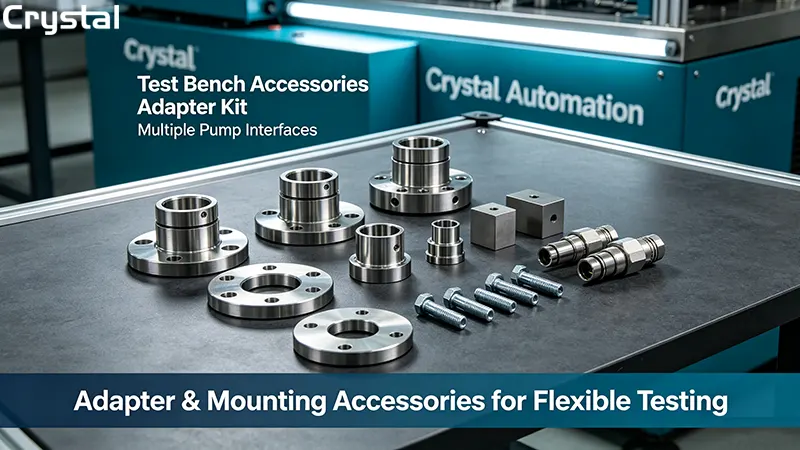
Mounting Plates and Flanges
Mounting plates replicate the original mounting geometry of specific pump models, ensuring perfect mechanical alignment and precise injection timing when paired with the correct camshaft, slide bar, rack connector, and spacer set.
Centering flanges are critical for pumps that require precise radial alignment. For instance, a centering flange for Denso ECD-V4 pumps ensures centered clamping on any test bench, requiring a universal cradle or equivalent for proper mounting. Similarly, a centering flange for common rail pumps—compatible with Bosch CP1, CP3, CP4, Delphi, Denso, and VDO models—uses four reducing rings (Ø 50, 60, 68, and 80 mm) to accommodate different pump hub diameters.
Cradle Brackets and Universal Supports
Universal supports and cradle brackets provide the foundation for secure pump mounting. A typical universal cradle features a 125 mm center distance and 20 mm guide (Bosch standard), which can be adapted to different requirements through specific spacers. These cradles are often made of durable cast iron with precision machining, delivering exceptional stability and accuracy for centered diesel pump mounting and testing.
Key consideration: Always verify that the cradle and flange combination is compatible with both your test bench interface and the specific pump model you intend to test.
2. Camboxes and Modular Testing Systems
Camboxes are specialized fixtures designed for testing camshaftless pumps—pumps that do not have an integrated camshaft and therefore require an external cam drive to operate.
Universal Cambox Systems
A universal cambox forms the foundation of a modular testing system. Combined with additional plates and spacers, it can be configured into a complete system for testing a wide range of camshaftless pumps.
Brand-Specific Cambox Configurations
Modular cambox systems are available for specific pump families. A Zexel PFR configuration, for example, typically includes:
- Universal cambox and spacers
- 4-cylinder camshafts
- Fixing plates for various PFR sizes (1K, 2K, 3K, 4K, 3KD/MD, 4KD/MD)
- Rods and fuel control connectors
- Cambox mounting flange
- Drive coupling
This complete system is supplied in a single wooden box, making it a turnkey solution for workshops servicing Zexel PFR pumps.
Why this matters: Cambox systems dramatically expand the range of pumps your test bench can handle. Instead of purchasing multiple dedicated benches, you invest in a single modular platform that adapts to different pump families through interchangeable components.
3. Injector Mounting and Testing Accessories
For workshops that test injectors alongside pumps, the right mounting and testing accessories are essential.
Injector Mounting Rigs
Mobile injector mounting and calibrating units are available for testing injectors separately from the pump. These units often feature bottom-fill/bottom-drain designs and can accommodate multiple injectors—some systems support up to 18-cylinder capacity.
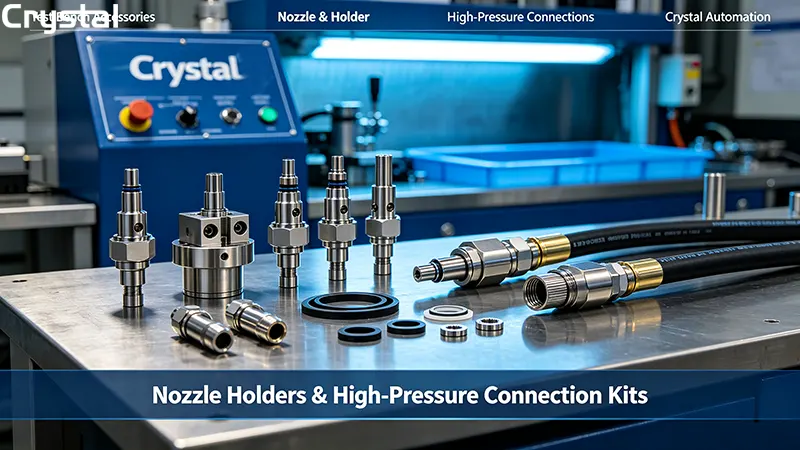
An ISO injector support allows installation of 6+6 test injectors with 6 reinforced tubes for high-pressure connections and quick-release fittings (20×1.5 mm male/female).
Test Nozzles and Orifice Plates
Test nozzles are precision components that determine the flow characteristics against which injectors are evaluated. Standard test stand injector nozzles include a 0.020 in. (0.5 mm) orifice plate, and calibrating nozzles should be set at ± 25 psi (11,721 ± 172 kPa).
Nozzle condition directly affects measurement accuracy. Worn or damaged nozzles introduce variability that makes consistent calibration impossible.
Adapter Kits for Common Rail Injectors
Common rail systems require specialized adapter kits for proper testing. A typical CR pump adapter kit for Bosch CP3.3/CP3.4 includes a clamping bracket, flange, coupling, and fittings to fully test and control the pump. Similar kits are available for CP4.1/CP4.2, CAT common rail pumps, and Asian applications such as Bosch CB18 and CB28.
For injector testing, Bosch offers adapter sets for specific injector types. An IPC-400 adapter set for Nrz injectors, for example, includes 6 pieces of Compact 1.1a Code 1 to M4 claw connectors, optimized for temperature sensor testing.
4. Test Fluid Management Accessories
The test fluid system—filters, tanks, and temperature control components—directly impacts test accuracy. Accessories in this category ensure that calibration fluid remains clean, at the correct temperature, and free of contamination.
Filtration Systems
High-quality filtration is non-negotiable. Test oil should be filtered to 5 microns or finer to prevent contaminants from damaging precision components. Some systems use dual screw-on cartridge filters with 5-micron retention, while others feature a final-stage filter kit with spin-on 2-micron elements.
Filter replacement intervals are equally important. Bosch specifies that test oil and the test oil filter should be replaced after testing 200 injection pumps, or at the latest every 2 months.
Calibration Fluid
Calibration fluid must conform to ISO 4113 standards. Authorized grades include Shell Calibration Fluid S 9365, Shell V-Öl 1404, and Castrol Fluido para Calibracao 4113. The fluid must maintain a temperature of 40 ± 2°C (or 110°F–115°F at the pump inlet) throughout testing.
Temperature Control Components
Temperature control accessories—heaters, heat exchangers, and temperature sensors—maintain fluid viscosity at the correct level. A typical system includes a 2.5 kW heater incorporated in the fuel tank and a solenoid-operated oil/water heat exchanger controlled by a temperature controller.
5. Electrical Adapters and Cables
Modern common rail injectors and pumps require precise electrical signals for actuation. Electrical adapters and cables connect the test bench control unit to the component under test.
Actuation Cable Harnesses
Cable harnesses are available for driving multiple injectors simultaneously. A typical harness set for a common rail test bench control unit supports actuation of 6 injectors, including testing and standard adapters. Separate adapter sets are available for specific injector types, such as Nrz injectors and piezo injectors.
Return Flow Adapters
Return flow adapters connect the injector's return port to the measurement system. A standard return adapter—with O-ring seal and knurled nut—is suitable for most injectors. Different adapter variants exist for specific injector families, including Bosch CRI 2.18, CRI 2.20, and CRI 3 series.
Specialized Testing Cables
Adapter cables are available for actuating specific injector brands during testing. For example, an adapter cable for actuating Denso CRI or Denso CRI piezo injectors ensures proper electrical interface between the test bench and these components.
6. Measurement and Calibration Accessories
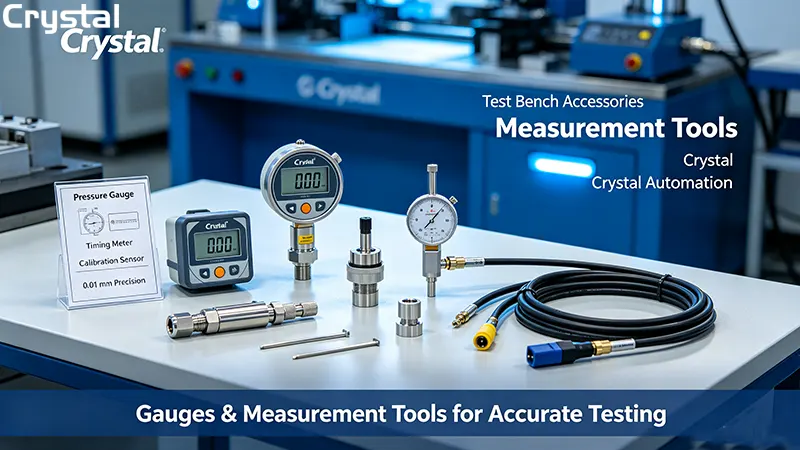
Accurate measurement is the foundation of reliable diagnostics. Measurement accessories include flow meters, pressure gauges, tachometers, and stroke counters.
Flow Measurement Components
High-precision flow meters measure delivery and return flow. Some systems use a return fuel flowmeter with a range of 140–1400 cc/min. Others use a pressure audit transducer kit for verifying pressure accuracy across the operating range.
Pressure Gauges and Sensors
Pressure gauges and sensors must be calibrated against traceable references. A compound pressure/vacuum gauge with a range of 0–30 in.Hg vacuum and 0–100 psi pressure is standard for monitoring fuel supply line conditions.
Graduates and Collection Vessels
Graduated collection vessels capture and measure delivered fuel. A typical system uses 12 acrylic pyramidal graduates with 160 cc capacity and 0.5 cc subdivisions, allowing precise reading of delivery volumes.
7. Maintenance and Cleaning Accessories
Keeping your test bench and its components clean is essential for long-term accuracy.
Ultrasonic Cleaning Systems
Ultrasonic cleaners are available in sizes ranging from 20L to 150L, with frequencies of 42 kHz and features such as sweep technology, degas function, and controlled heaters. For high-throughput workshops, automated models with lift and sway systems ensure thorough cleaning of complex parts.
Cleaning Fluids and Solvents
Diesel injector calibration oil (ISO 4113), ultrasonic solvent (concentrated, available in 4L, 20L, and 208L containers), and diesel/gasoline injector cleaning detergent (2L and 25L) are essential consumables for maintaining component cleanliness.
8. How to Choose the Right Test Bench Accessories
Selecting the right accessories requires careful consideration of several factors:
Compatibility with Your Pump Portfolio
The accessories you need depend on the pumps you service. A workshop specializing in Bosch VE distributor pumps needs different adapters than one servicing heavy-duty common rail systems. Start by identifying the most common pump families in your market, then select accessories that cover those applications.
Compatibility with Your Test Bench
Not all accessories fit all test benches. Before purchasing, verify the interface dimensions, mounting bolt patterns, and drive coupling specifications of both your bench and the accessory. Universal supports and adapters offer flexibility, but specific applications may require dedicated components.
Quality and Durability
Accessories are subject to the same extreme pressures, temperatures, and mechanical stresses as the test bench itself. Choose components made from durable materials—cast iron for cradles and flanges, hardened steel for couplings and nozzles—and from manufacturers with proven track records.
After-Sales Support and Availability
Accessories wear out. Nozzles erode. Couplings loosen. Filters clog. When replacement is needed, availability matters. Choose a supplier that maintains stock and provides prompt technical support.
The Crystal Automation Advantage
Crystal Automation's test benches are designed as complete systems, with accessories engineered to work together seamlessly. The CRS1000 series, for example, features a modular design that supports testing of common rail injectors, high-pressure pumps, EUI/EUP systems, HEUI systems, and medium-pressure actuating pumps.
Key accessories and capabilities include:
- Multi-brand adapter systems supporting Bosch, Denso, Delphi, Siemens, and Cummins components
- High-precision flow sensors with 0.1 ml accuracy for accurate delivery measurement
- 304 stainless steel fuel circuits for corrosion resistance and durability
- Three-stage filtration systems to keep test fluid clean
- Comprehensive manuals and training resources to help your team get the most from every accessory
Whether you are equipping a new test bench or expanding the capabilities of an existing one, the right accessories transform your equipment from a single-purpose tool into a comprehensive diagnostic platform.
Summary: Accessory Categories at a Glance
| Category | Key Components | Primary Function |
|---|---|---|
| Mounting & Coupling | Drive couplings, mounting plates, centering flanges, cradle brackets | Secure pump mounting and torque transfer |
| Camboxes | Universal cambox, brand-specific configurations, camshafts | Testing camshaftless pumps |
| Injector Testing | Mounting rigs, test nozzles, adapter kits | Injector calibration and diagnostics |
| Fluid Management | Filters, calibration fluid, temperature control | Maintaining fluid quality and viscosity |
| Electrical | Cable harnesses, return adapters, testing cables | Electrical interface for injectors and pumps |
| Measurement | Flow meters, pressure gauges, graduates | Accurate data collection |
| Maintenance | Ultrasonic cleaners, solvents, detergents | Component cleaning and upkeep |
Conclusion
Test bench accessories are not afterthoughts—they are the components that determine what your bench can do, how accurately it can do it, and how long it will continue to perform. From drive couplings that ensure proper torque transfer to adapter kits that unlock compatibility with new pump families, every accessory plays a role in your workshop's success.
Invest in quality accessories. Maintain them properly. Replace them when they wear. And choose a supplier who understands that your test bench is only as good as the components you pair with it.
Feel free to write us

Crystal Automation is a leading Chinese manufacturer of common rail test benches and fuel injector test benches.